40W Dynamic Power Adapter & iPhone 17 Charging
Exploring Apple's new 40W Dynamic Power Adapter and how it interacts with the lastest iPhone 17 lineup.
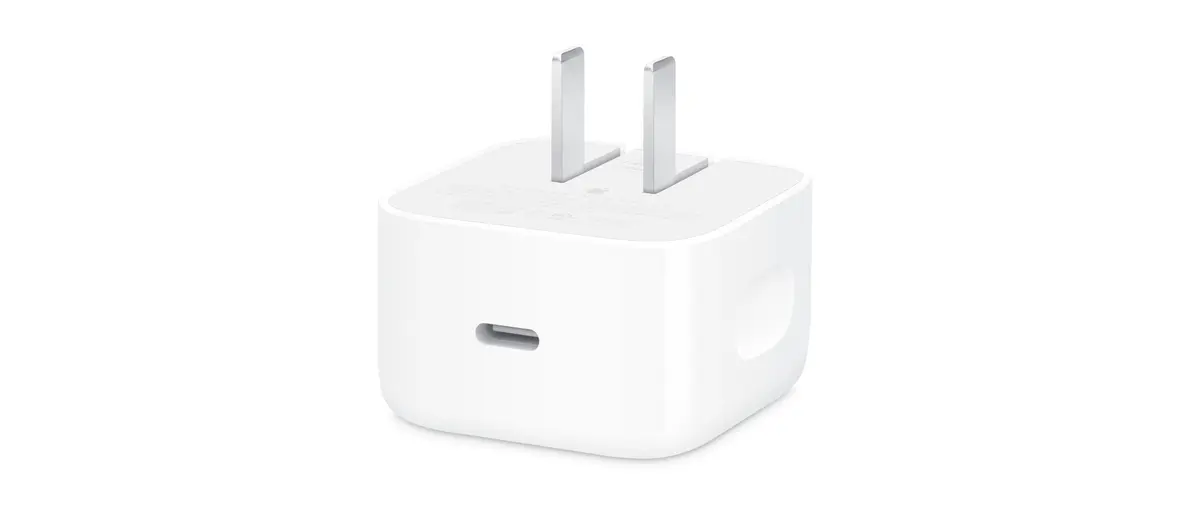
Apple just released four new phones, the iPhone 17, iPhone 17 Pro, iPhone 17 Pro Max, and the iPhone Air. I'm personally enamoured with the iPhone Air, but what I found most interesting while browsing Apple.com was the new 40W Dynamic Power Adapter with 60W Max.
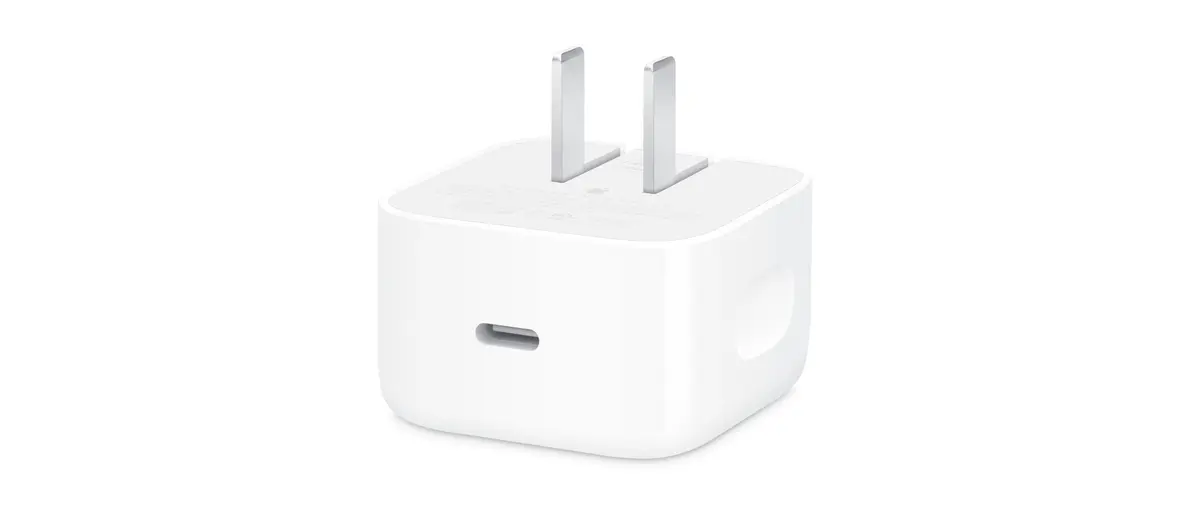
Since launch, this has predominantly received attention as the only power adapter that can achieve the claimed 50% battery in 20 minutes of the iPhone 17, iPhone 17 Pro, and iPhone 17 Pro Max. Firstly, the technology of the 40W Dynamic charger(including AVS) is completely within the USB-C Power Delivery(PD) specification, so no worries about Apple going rogue and proprietary. Also, from our testing it looks like other 40 W+ chargers are able to achieve the claimed 50% charge in 20 minutes. The iPhones don't even capitalize on the 40 W offered by the charger, reaching a maximum of around 38 W in our tests before they slow down significantly.
Dynamic
ChargerLab documented a teardown of the device which is very nice, and because x-ray vision is cool, we CT scanned the device. I recommend checking it out as we have created a number of bookmarks(lower left panel) of interesting sections and the scan is very interactive.
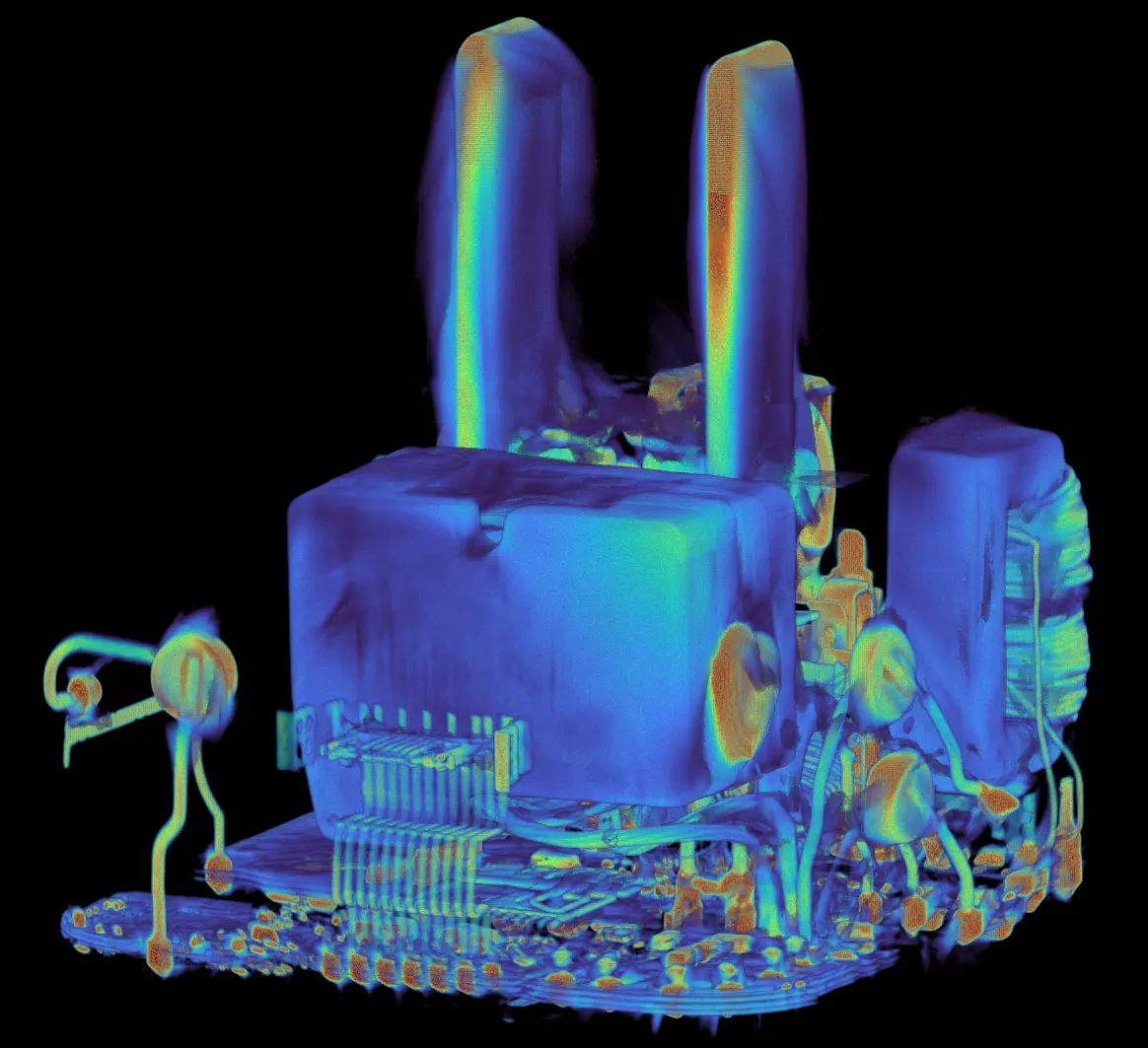
The ‘dynamic’ functionality of the 40W Dynamic Power Adapter has been possible under previous versions of the USB-C PD specification, but I don’t believe that it has been widely used or advertised.
Within the USB-C PD handshake, power sources advertise a list of their output capabilities to the sink(device consuming power), from which the sink then requests the one it prefers. However, if the power source is already supplying significant power to other devices, or has reached a critical temperature, then it can advertise a subset of the capabilities supplying only lower wattages.
Bushwhacking through the Apple marketing, "dynamic" appears to be doing just this. On a 'cold start', it will supply 60W until it reaches a point where it risks hazardous temperatures, after which it will step down to 40W. We don’t have a full USB-C load setup at this point but I used the 40W dynamic to charge a large battery bank and it was able to charge at 60W for almost 35 minutes before stepping down to 40W. It then stepped back up to 60W after a few minutes, see Appendix A for more on this, there is a lot more. A user on Reddit did some impressive investigation and achieved 20 minutes before the derating. Our testing was done in an ambient of roughly 21°C, though there are many factors to consider so it will vary for everyone.
This could have been Apple's product plan from the start, after all, most devices only request/receive a high charging wattage for a short period at the start of the charge cycle before stepping down the power to protect the battery. Or, maybe Apple designed a 60W charger that in testing they found to exceed safe temperatures when supplying a constant 60W. Maybe it is only able to maintain safe temperatures if they strategically limit it to 40W at a critical point. That might explain the somewhat clumsy power output ratings for a company that typically desires simplicity.
Good Enough?
While it isn't ideal that the 40W Dynamic can't sustain the full output wattage indefinitely, it likely won't affect your charge time, even with higher wattage mobile devices. Devices will advertise 45 W or 65 W charging, but they will typically only charge at that rate for a short period of time before gradually stepping down to lower power profiles.
Each type of battery cell will have a maximum charging rate and for lithium-ion cells that rate is typically around 1C, where C is the current equal to the battery's capacity in amp-hours. This will be specified by the manufacturer, often alongside other charging information and rates. Below is a datasheet excerpt for a TinyCircuits 18650 LiPo battery.
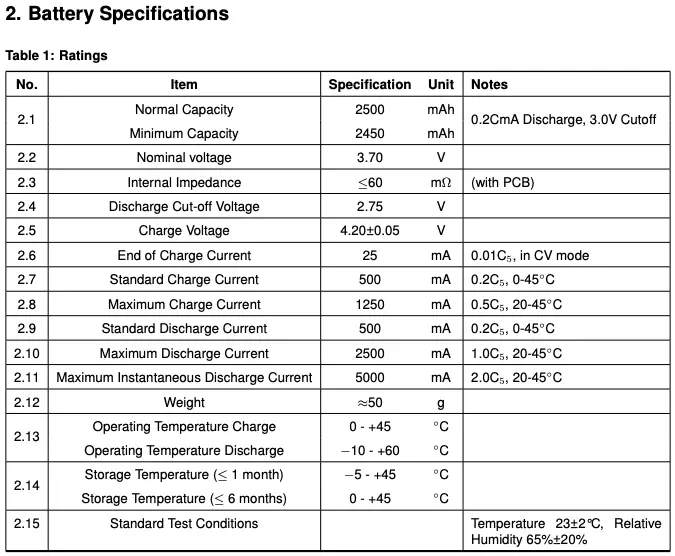
Testing may also reveal that charging at a much lower rate is almost necessary to maximize the cell’s useful number of charge cycles. The ideal rate will depend on many factors like cell age, temperature, and state of charge(SoC). The designers of these tightly integrated mobile devices must thoroughly characterize the cells to understand the precise limits of their performance and longevity.(Apple does have a few pages dedicated to their batteries)
While mobile devices manufacturers want to have the quickest charging device, they also don't want to deal with the fallout of millions of severely damaged batteries within a couple years. This results in the high wattages for low SoC charging, followed by tapering as the device reaches full charge.
40W Dynamic in Practice
We conducted some testing with the 40W Dynamic charger, the ANKER NANO II 45W (A2664), and the new 2025 iPhone lineup. Below are graphs showing the wattage delivered to the device through the USB-C port as measured by an Infineon CY4500-EPR.
iPhone 17 Pro and 17 Pro Max
We can see that the iPhone 17 Pro and iPhone 17 Pro Max are able to achieve their claimed 50% charge within 20 minutes when using the 40W Dynamic charger. Furthermore, we tested the iPhone 17 Pro using an ANKER 45W charger and achieved very similar results, showing that the new 40W Dynamic charger is not strictly required.
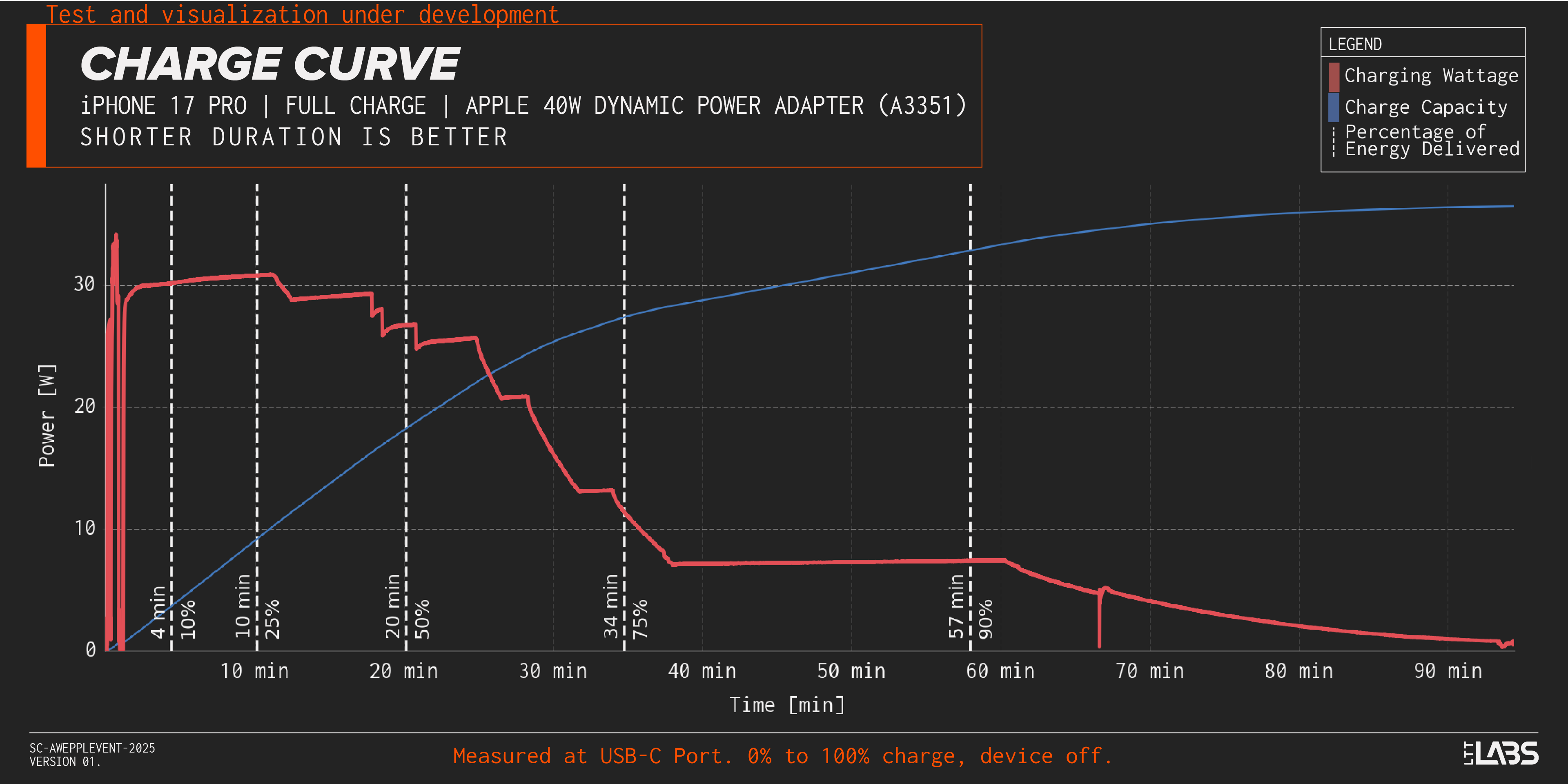
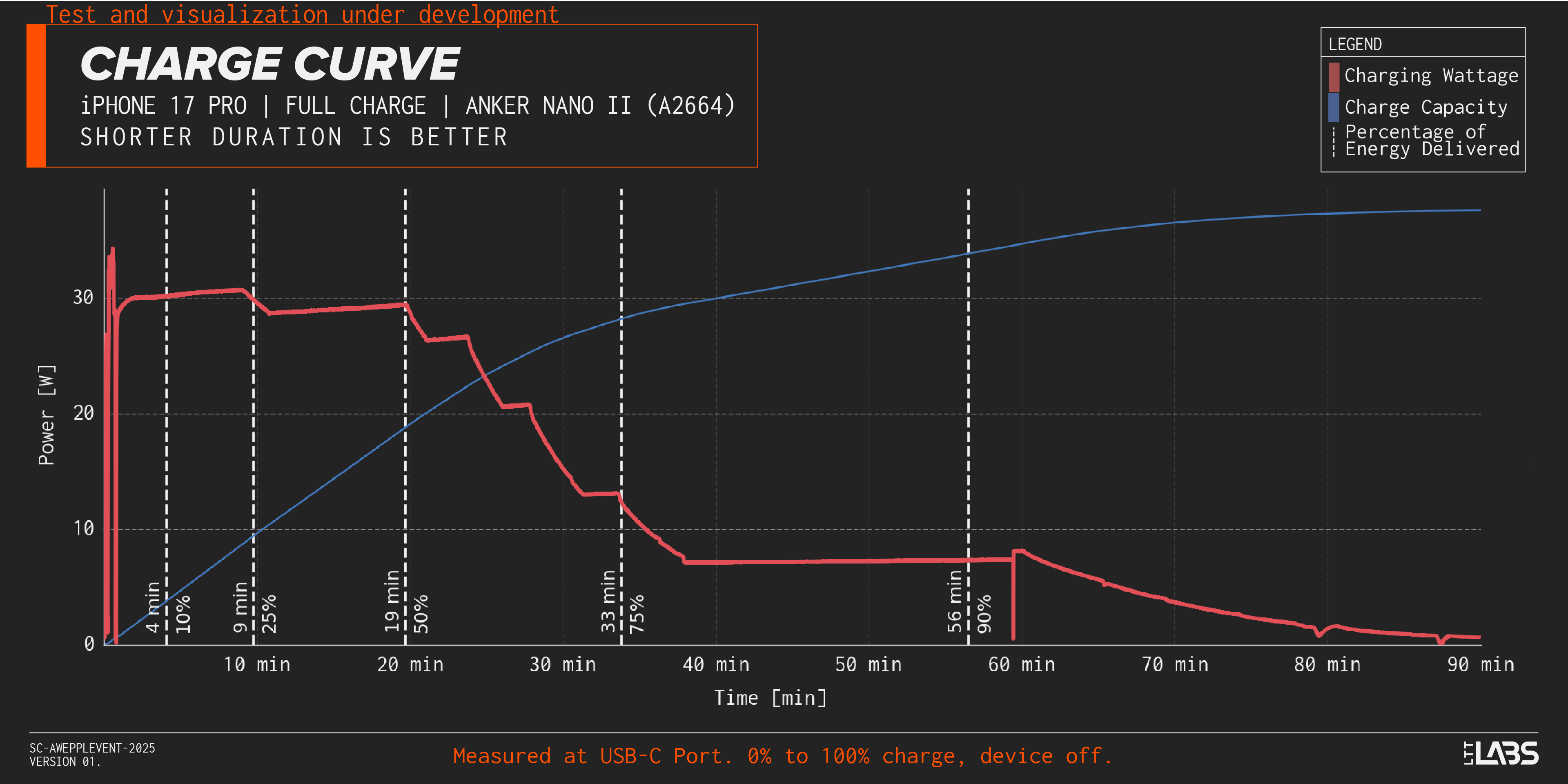
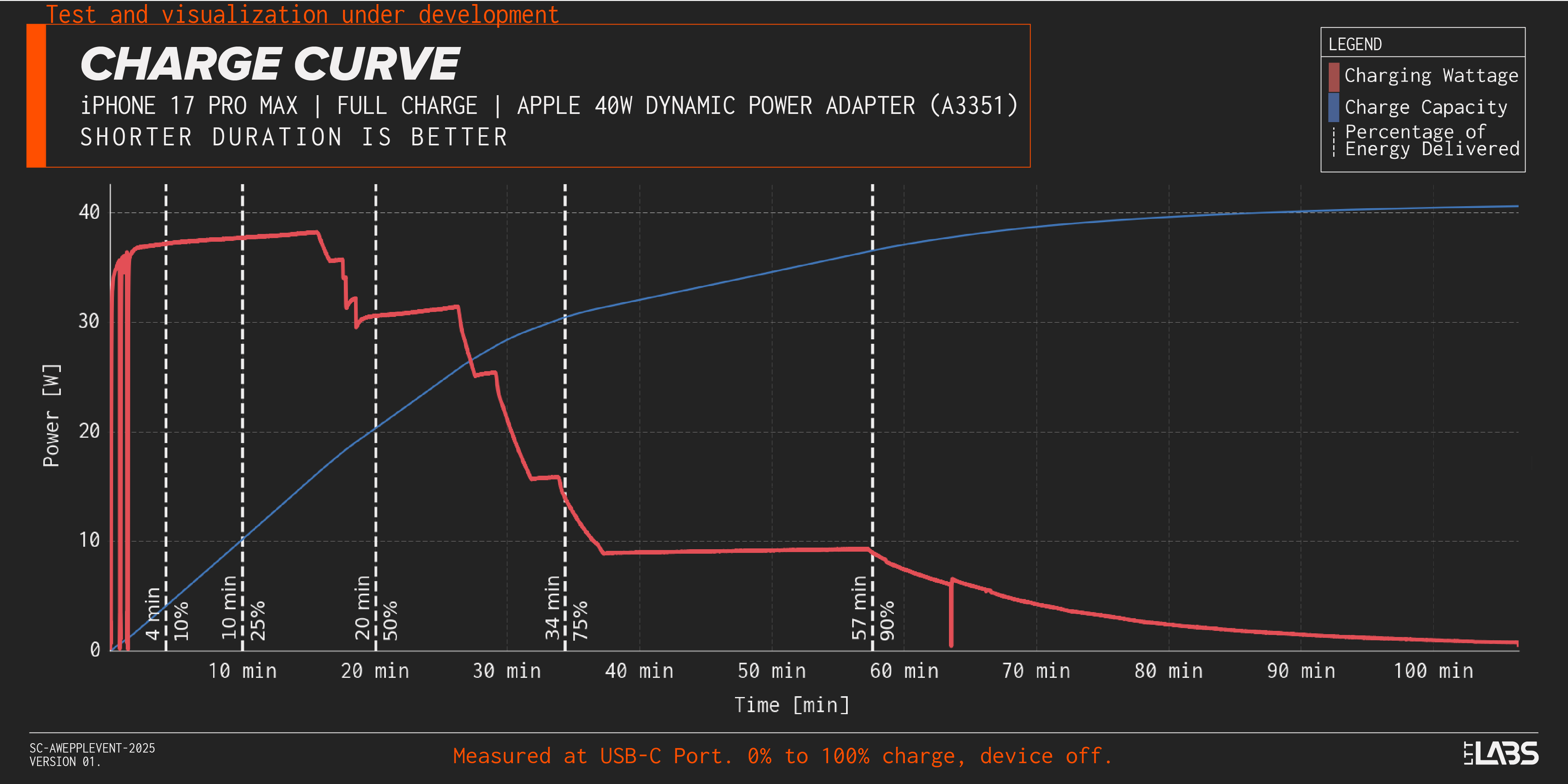
{{slide}}Charge Curve iPhone 17 Pro - Apple 40W Dynamic Power Adapter{{/slide}} {{slide}}Charge Curve iPhone 17 Pro - Anker Nano II{{/slide}} {{slide}}Charge Curve iPhone 17 Pro Max - Apple 40W Dynamic Power Adapter{{/slide}}
iPhone 17 and iPhone Air
The iPhone 17 was also able to achieve the claimed 50% charge in 20 minutes and the iPhone Air confirmed the claim of 50% charge in 30 minutes with the ANKER NANO II 45W. It is interesting to note how long the wattage taper is. Wattage tapers are common with mobile devices but we've found iPhones to be particularly protective of the battery.
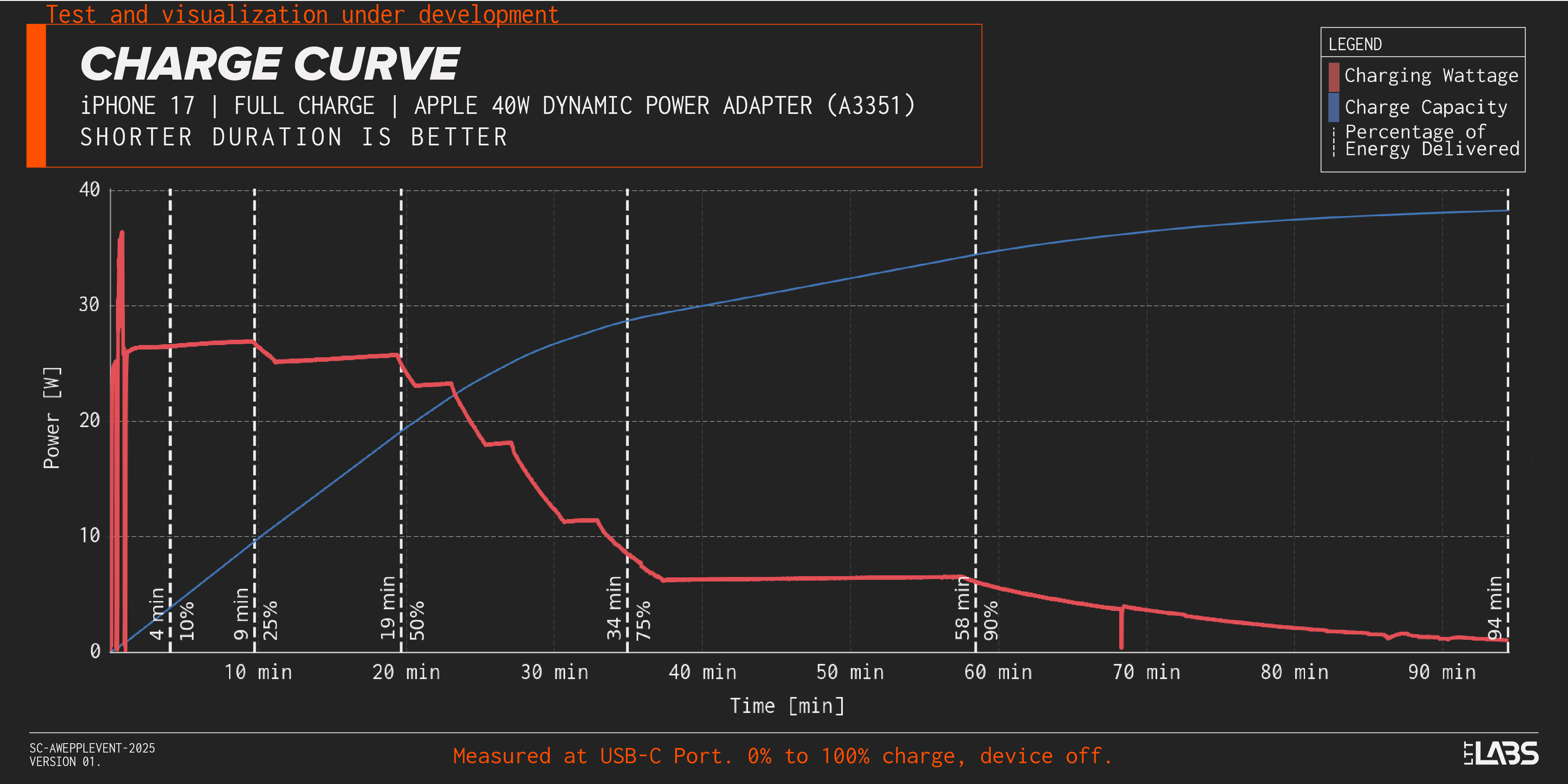
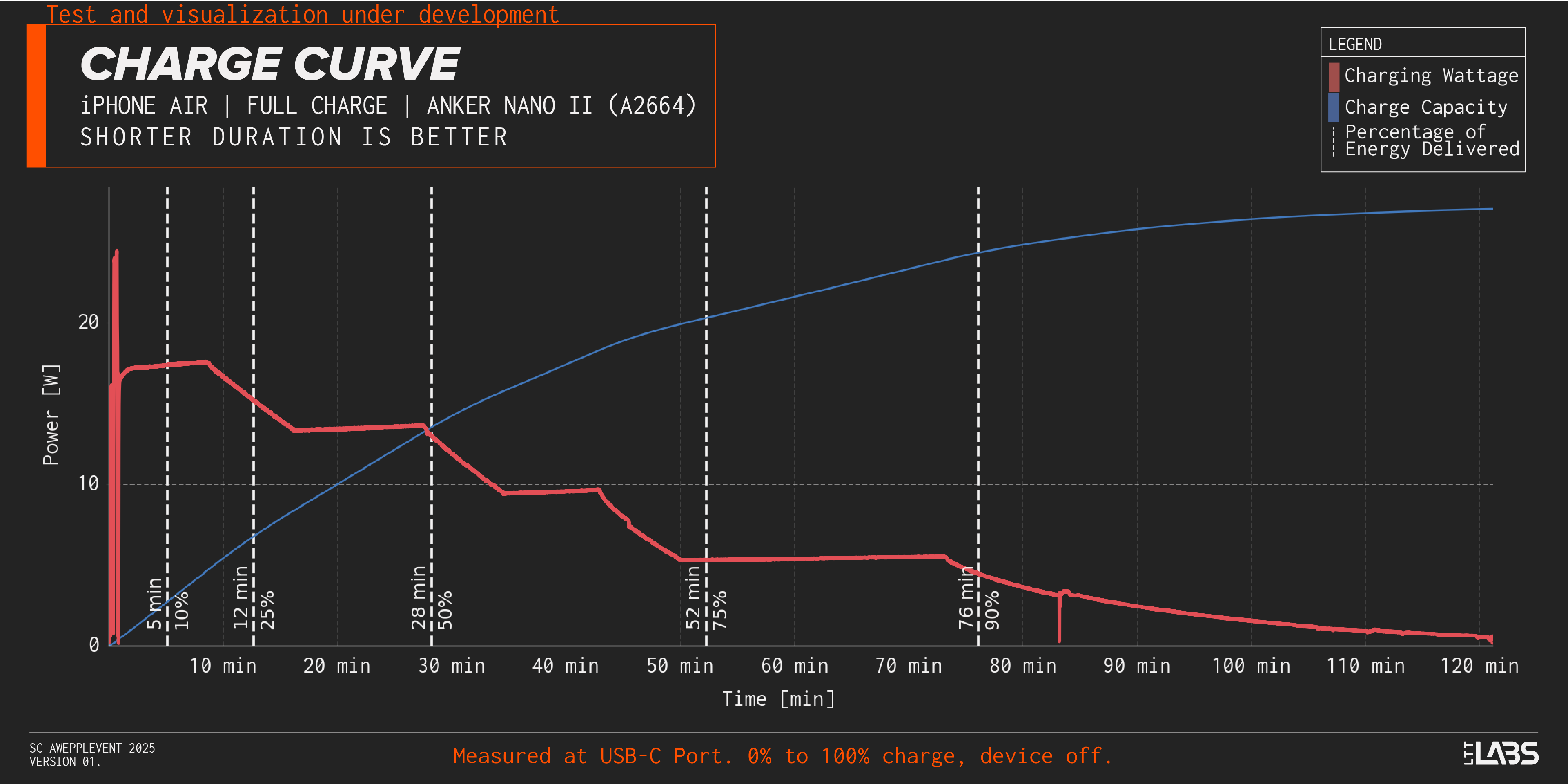
{{slide}}Charge Curve iPhone 17 - Apple 40W Dynamic Power Adapter{{/slide}} {{slide}}Charge Curve iPhone Air - Anker Nano II{{/slide}}
Shown above, none of the new iPhones draw greater than 40W when charging, let alone 60W. Other USB-C PD chargers are fully capable of charging iPhones at their maximum rate, as can be seen in the similarity between the charge test with the 40W Dynamic and ANKER NANO II 45W charger tests.
As for actionable advice, any 30W charger is likely sufficient for your iPhone and if you prioritize battery health over quick charge then you can still use as low as a 10 W charger for charging overnight.(apparently zinc ion batteries are an exception to this rule) The higher wattage models will help for mid-day top-ups, but Optimized Battery Charging and other technologies will likely slow things down anyway.
We would love to hear what kind of power adapter you're using, or other questions you have about them on the LinusTechTips forum post.
Appendix A: 40W Dynamic Endurance Testing
To confirm the 40W/60W claims of the 40W Dynamic charger I plugged it into an empty battery bank that is capable of drawing greater than 60W. It lasted for just over 36m43s at 60W when it derated to the 40W using an ALERT USB-C PD message from the source to the sink. Curiously, the ALERT message didn’t have any of the indicators asserted, but it was immediately followed by the source advertising its capabilities. I am not sure, but maybe it is standard in the USB-C PD specification for the sink to request a new power object.
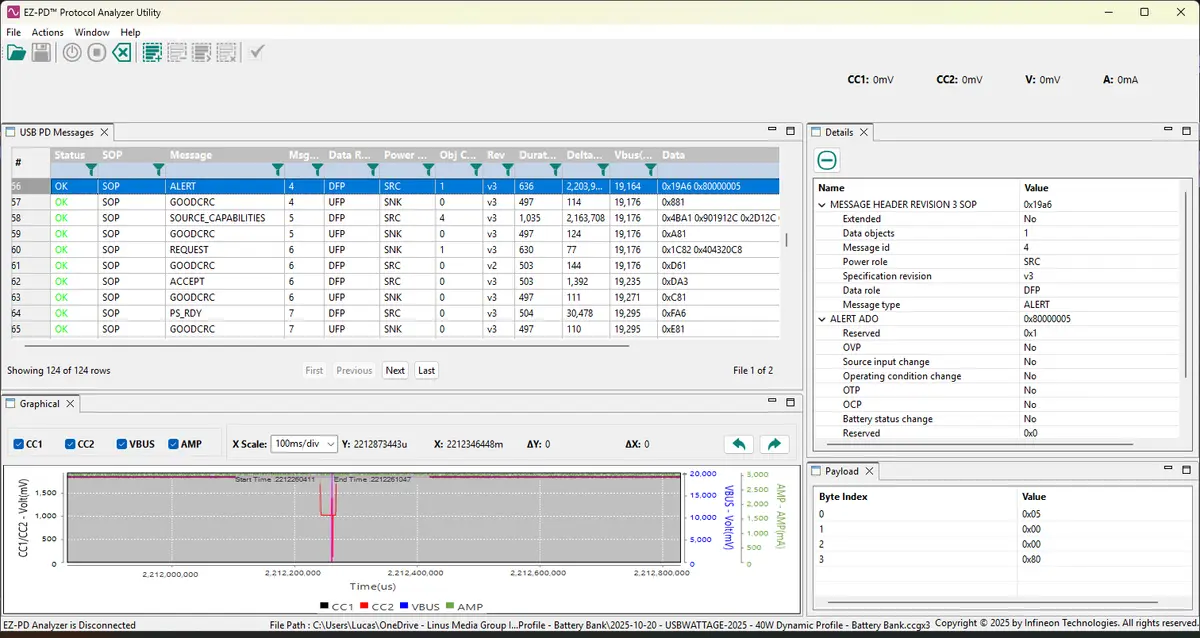
In an even more interesting turn of events, after charging at 40W for a couple minutes the 40W Dynamic charger went back to charging at 60W! It repeated this cycle a few times before I ended the test, below is a table showing the cycles that I measured.
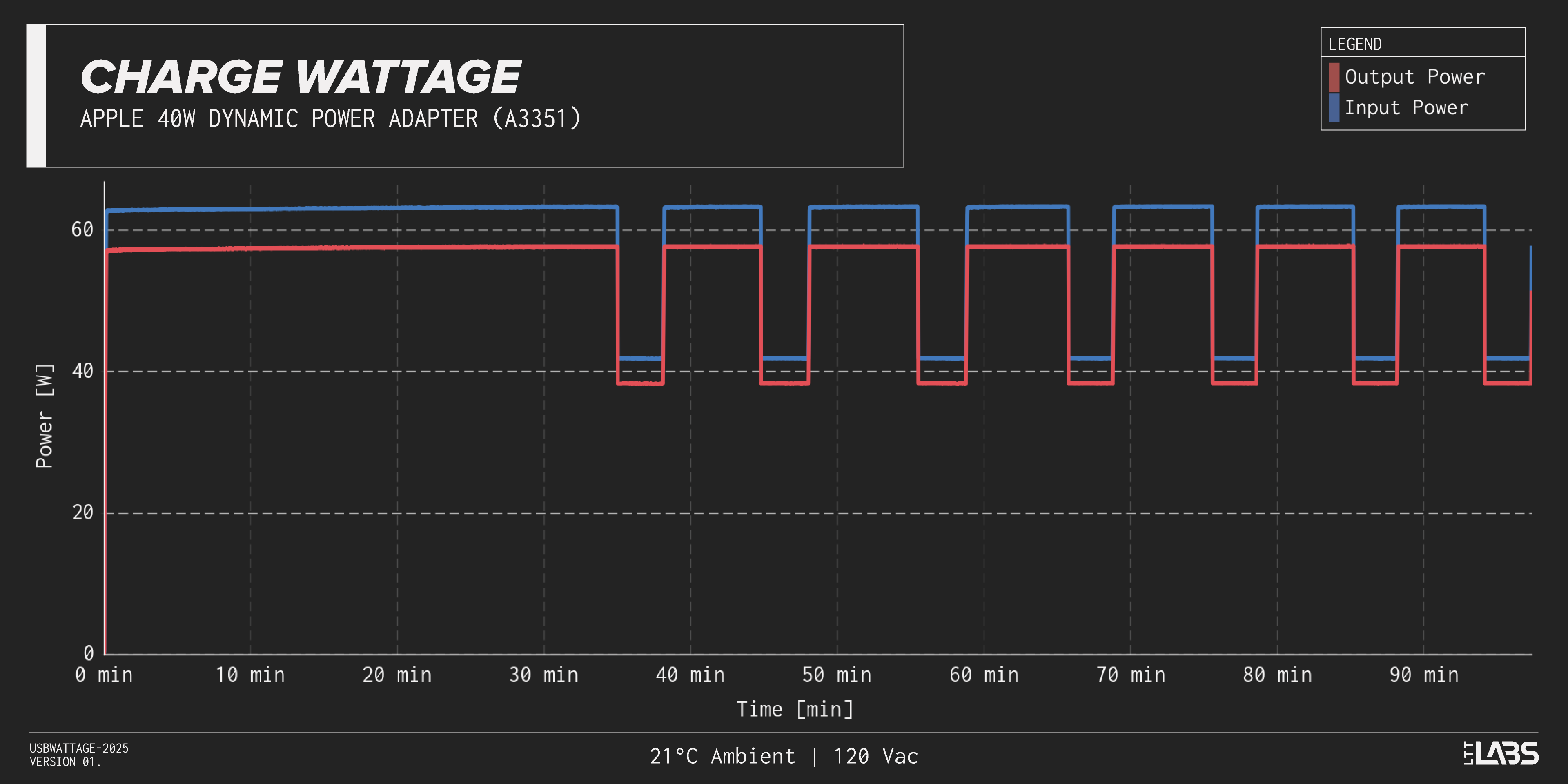
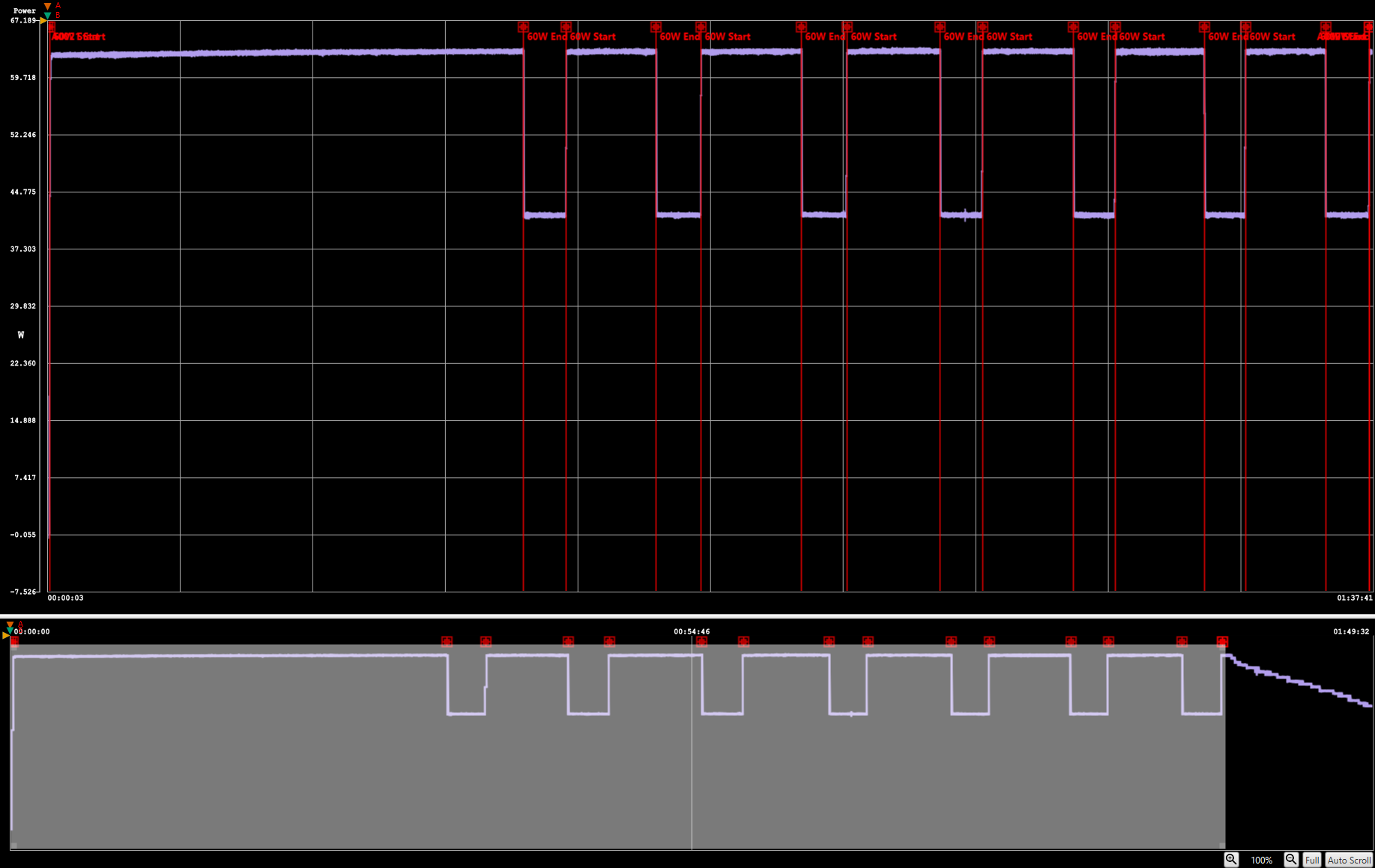
{{slide}}Charge Wattage Graphed{{/slide}} {{slide}}Oscilloscope view of wattage changes{{/slide}}
Session | Duration [s] | Duration [min] |
60W Cycle 1 | 2,093 | 34.88 |
40W Cycle 1 | 190 | 3.16 |
60W Cycle 2 | 398 | 6.63 |
40W Cycle 2 | 198 | 3.29 |
60W Cycle 3 | 444 | 7.40 |
40W Cycle 3 | 201 | 3.36 |
60W Cycle 4 | 414 | 6.90 |
40W Cycle 4 | 186 | 3.10 |
60W Cycle 5 | 403 | 6.71 |
40W Cycle 5 | 185 | 3.08 |
60W Cycle 6 | 394 | 6.56 |
40W Cycle 6 | 182 | 3.03 |
60W Cycle 7 | 354 | 5.90 |
40W Cycle 7 | 194 | 3.24 |
From this testing it appears to have a duty cycle of roughly 0.66 after the initial warming up.(at our ambient of 21°C) Averaging out with a duty cycle of roughly 0.66 after the initial warmup it looks like it can sustain roughly 51W of output.
{{blockLatex}}(0.66) \cdot (58W) + (0.33) \cdot (38W) = 51.33W{{/blockLatex}}
This does slightly go against my theory of Apple building a 60W charger that couldn’t quite achieve their temperature limits, 51W is quite far off from 60W. I didn’t have the FLIR around but I don’t think it would add too much insight as the adapter wasn’t particularly hot to the touch. No hotter than my Intel Macbook Pro used to get.
If this is interesting to you then I suggest you check out AllThingsOnePlace, who conducts power adapter testing regularly and made a video about the 40W Dynamic charger.