$40 ANKER Nano Charger (45W) Testing and Exploration
The new $39.99 USD Anker Nano 45W(A121D) charger claiming iPhone detection, charge percentage display, and "Care Mode" seems to offer up only gimmicks, but that is only true for most of the features.
The new 39.99 USD Anker Nano 45W(A121D) charger claiming iPhone detection, charge percentage display, and "Care Mode" seems to offer up only gimmicks, but that is only true for most of the features. Labs uses the previous Anker Nano II 45W(A2664) as the default for our charge tests so we're interested in checking out this new model. For these reasons - and because it has a display that nobody asked for - we explored the construction, modes, temperatures, and claims of the new Anker Nano 45 W(A121D) in the sections below.
This article covers a lot, sections can be found with the table of contents on the left!
Construction
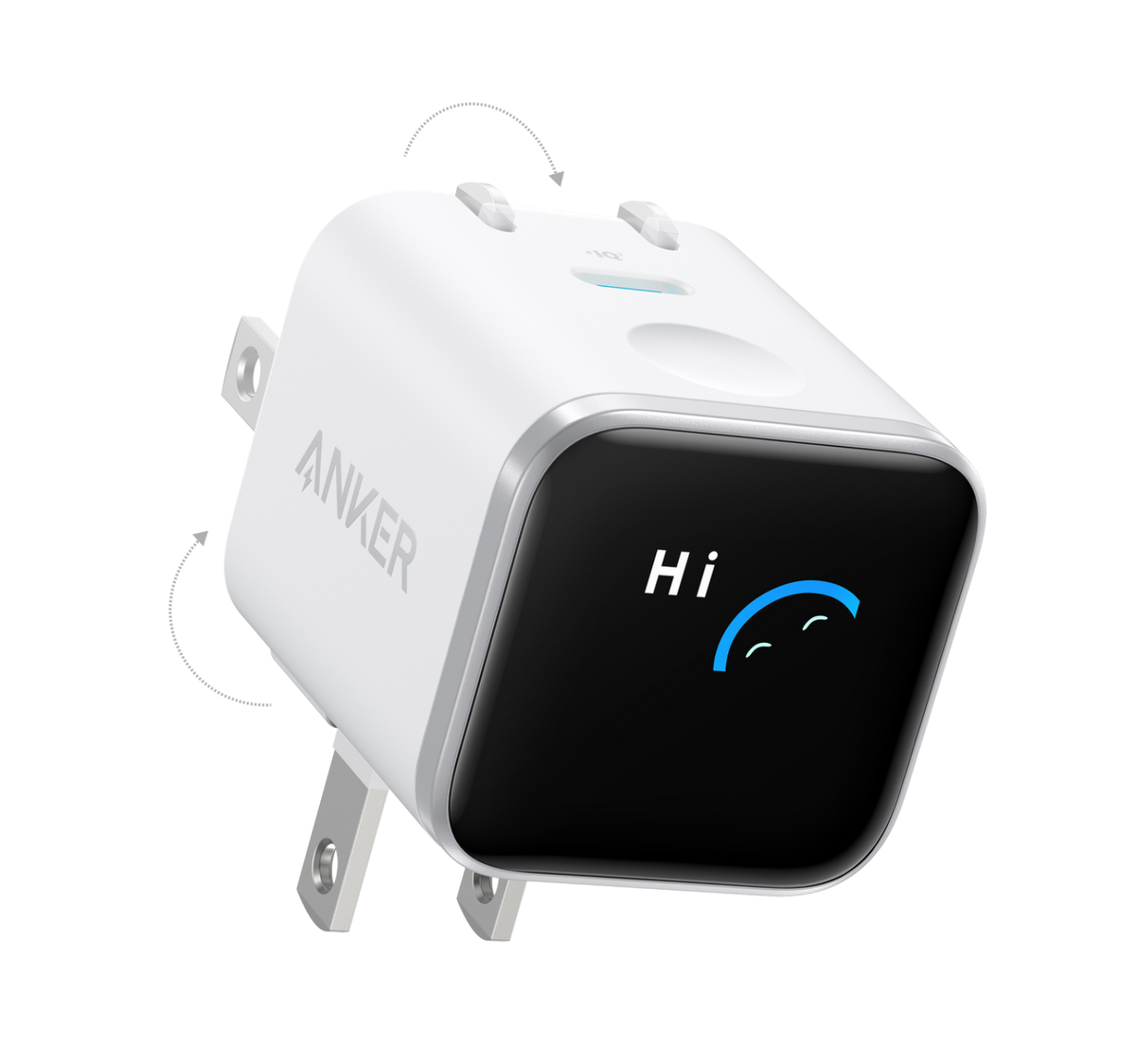
To get the simple things out of the way, the power adapter feels sturdy and the display will light up temporarily when a device is plugged in or when the capacitive button is pressed, though it is usually turned off. The display is functional, but it would be nice if there was a feature to 'permanently' disable the display if you are going to be using it in a dark room and don't want it lighting up with each interaction.
We CT scanned the charger using our Lumafield Neptune CT scanner and it can be explored with the interactive viewer below.
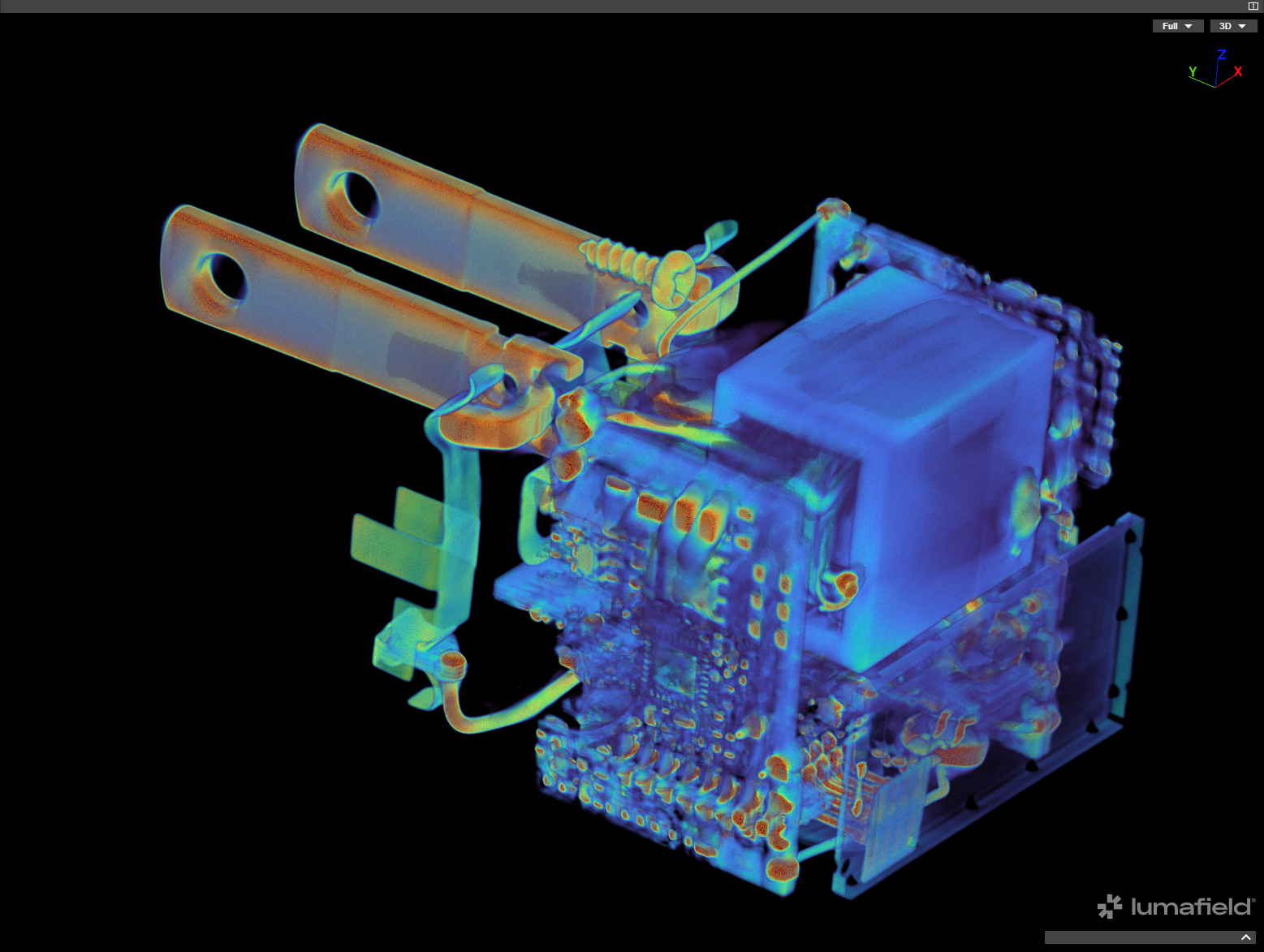
The ability for the prongs to face in two different directions offers a lot of flexibility. This allows the cable to run down the wall or stick straight out and I imagine that this will be adopted by quite a few charging bricks in the future. The prongs operate with a tri-stable leaf spring system that also provides the electrical contact for the prongs. These views are also bookmarked in the interactive CT scan available here.
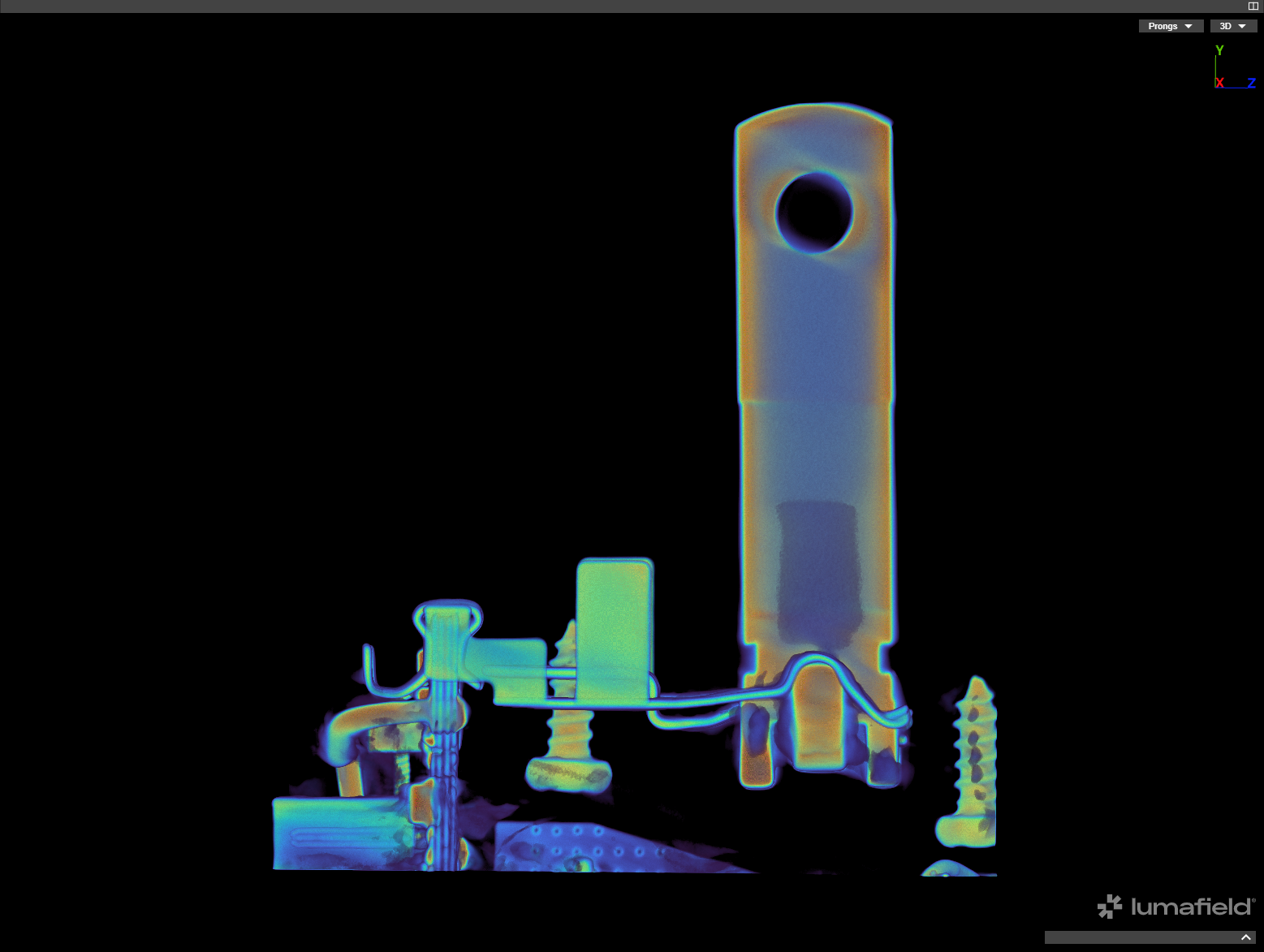
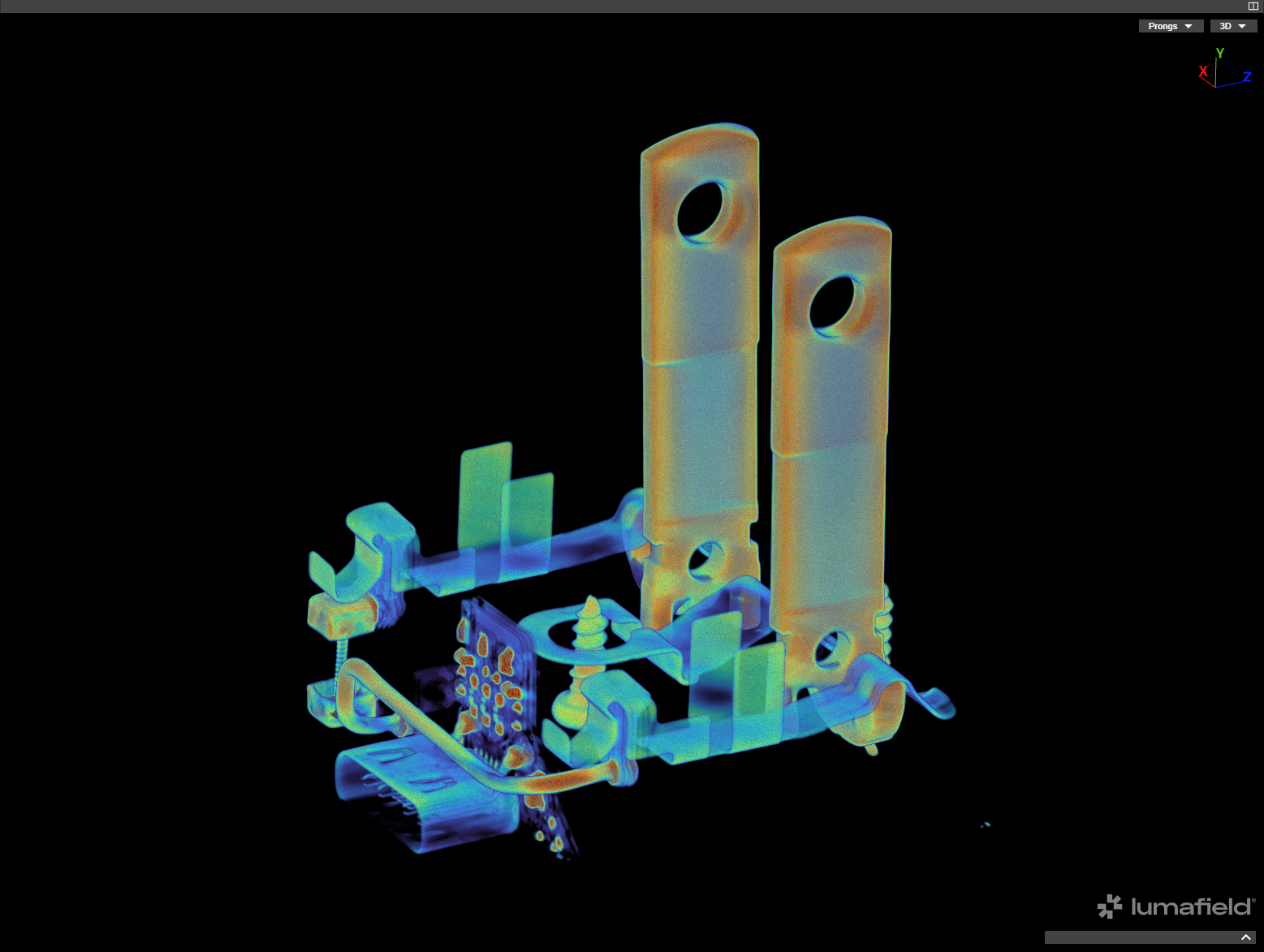
{{slide}}3D Prong Detail View{{/slide}}{{slide}}3D Prong Detail View{{/slide}}{{lumafield}}https://voyager.lumafield.com/project/8b2b7969-bced-4a5a-90bd-192eac79049e?embed=true{{/lumafield}}
Source Capabilities (Auto Mode)
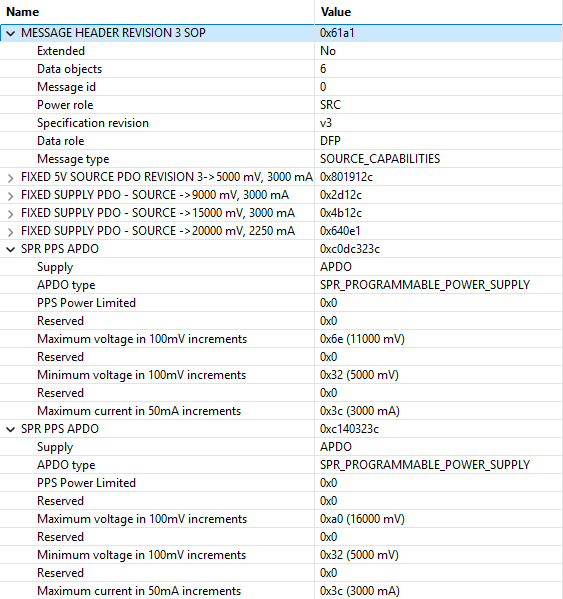
We can confirm that the source capabilities(the types and amount of power it can deliver) of this charger are as advertised on the packaging. We tested this with an Infineon CY4500-EPR to read the USB-C Power Delivery(PD) Power Data Objects(PDOs)(which specify the charge modes), as well as with a PD trigger board and programmable load. We then conducted testing to pull the maximum amperage claimed in all of the fixed voltage modes.
2026-02 Update: We have found Anker documentation stating that the A121D supports PPS up to 21 V. We retested with our CY4500-EPR, ChargerLab Power-Z, and a handful of devices, we still only saw a maximum of 16 V.
Anker Nano 45W(A121D) Auto Mode Source Capabilities
- Fixed 5 V, 3 A
- Fixed 9 V, 3 A
- Fixed 15 V, 3 A
- Fixed 20 V, 2.25 A
- SPR PPS APDO: 5 V to 11 V, 3 A
- SPR PPS APDO: 5 V to 16 V, 3 A
We also checked the source capabilities of the previous Anker Nano II 45W(A2664) charger as presented below.
Anker Nano II 45W(A2664) Source Capabilities
- Fixed 5 V, 3 A
- Fixed 9 V, 3 A
- Fixed 15 V, 3 A
- Fixed 20 V, 2.25 A
- SPR PPS APDO: 3.3 V to 11 V, 5 A
- SPR PPS APDO: 3.3 V to 16 V, 3 A
- SPR PPS APDO: 3.3 V to 21 V, 2.25 A
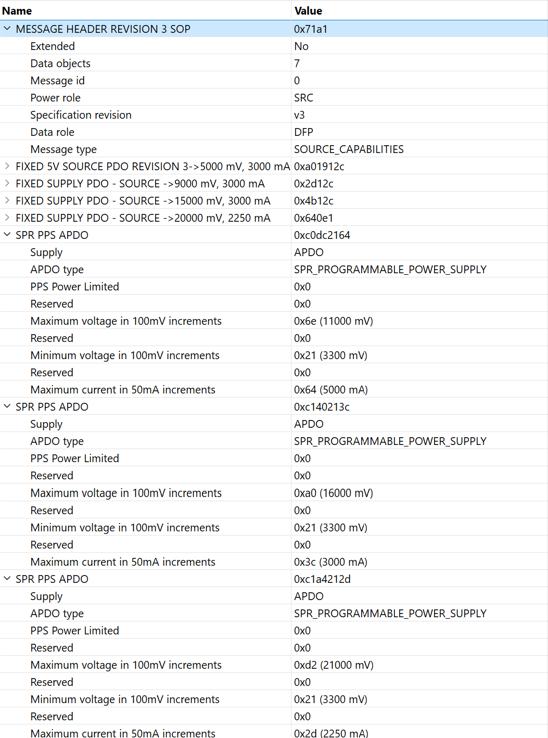
Note that the new Anker Nano 45W(A121D) charger has increased the minimum SPR PPS voltage from 3.3 V to 5 V and omitted the 3.3 V to 21 V SPR PPS mode. The increase of the minimum voltage will likely have no impact on use, but the loss of the SPR PPS mode could limit the charging speed/efficiency of some devices in specific scenarios.
Overall, these two versions are equivalent, and in real world scenarios these changes shouldn't be the source of any noticeable charging limitations.
Auto Mode Charge Curve
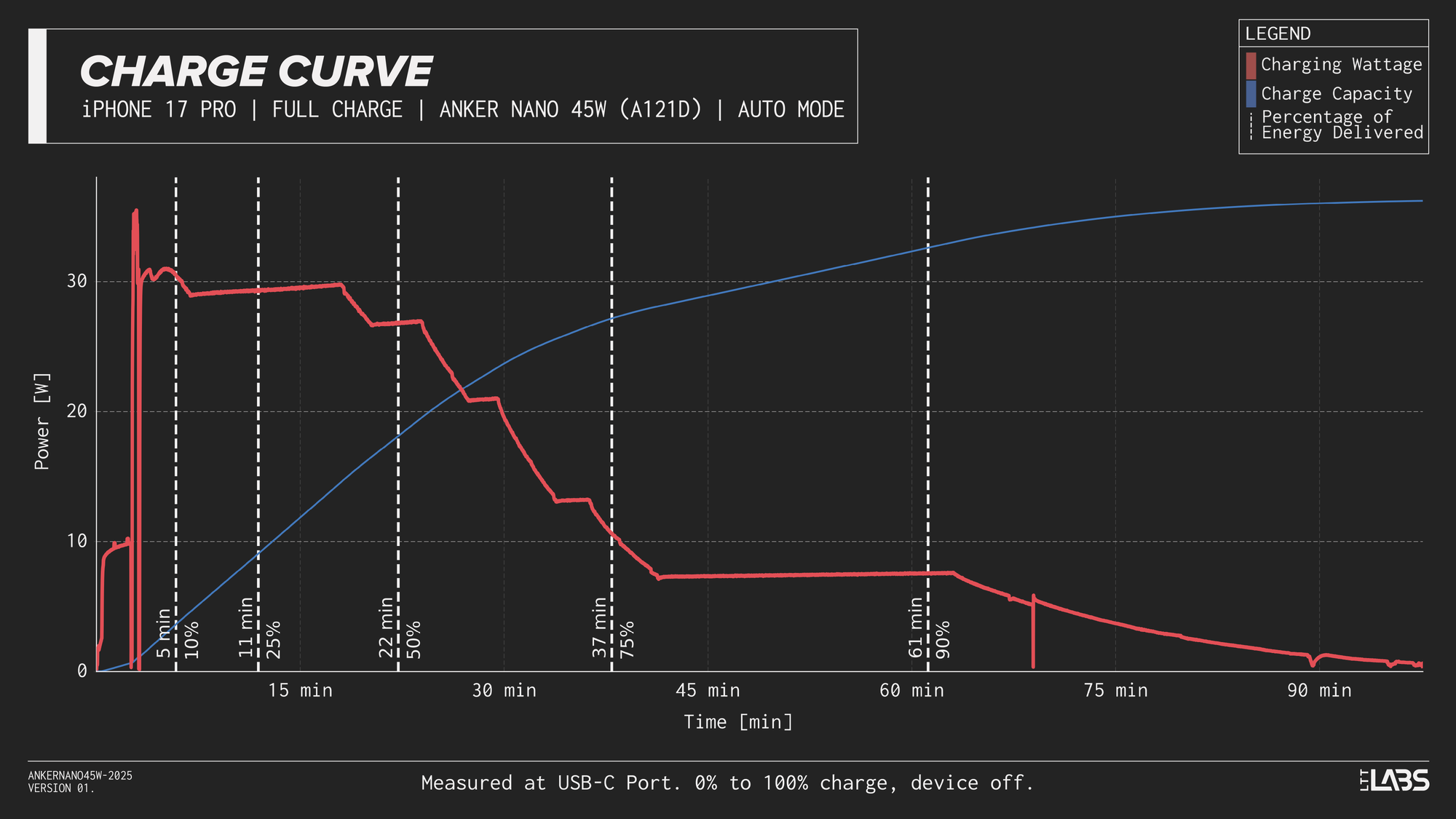
We conducted a charge test of an iPhone 17 Pro with the new Anker Nano 45W(A121D) in Auto Mode. The charge curve matches all other charge curves we've collected with the iPhone 17 Pro. Note that this test did begin slightly differently, but the iPhone 17 Pro was extremely depleted and had to charge briefly at a low wattage before it turned on.
Care Mode
Continuing with the source capabilities to look at Anker's new "Care Mode", they make claims that the charger will stay 36°F(20°C) cooler while the phone battery stays 9°F(5°C) cooler. I performed some exploratory phone surface temperature testing to check this, but there is also an odd PDO addition in the new mode.
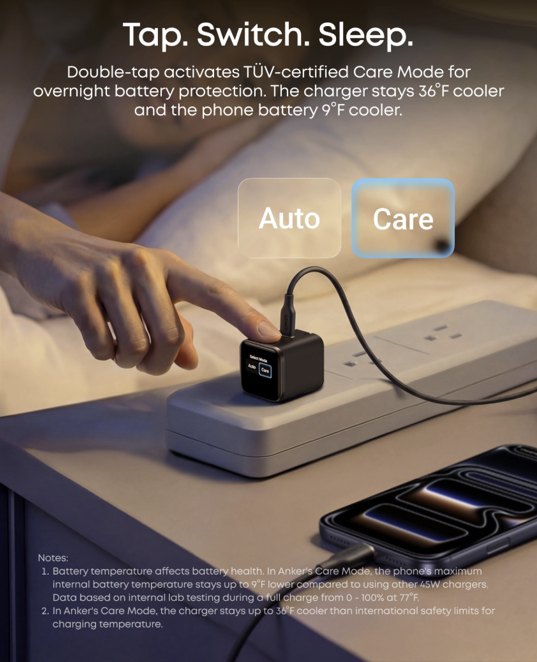
Care Mode can be accessed using the capacitive button on the 'bottom' of the charger and will effectively just convert it to a 20 W charger. The charger will also reset to "Auto Mode" when unplugged. We measured the source capabilities of the charger in Care Mode as shown below.
Anker Nano 45W(A121D) Care Mode Source Capabilities
- Fixed 5 V, 3 A
- Fixed 9 V, 2.22 A
- Fixed 12 V, 1.67 A
- SPR PPS APDO: 5 V to 11 V, 2.2 A
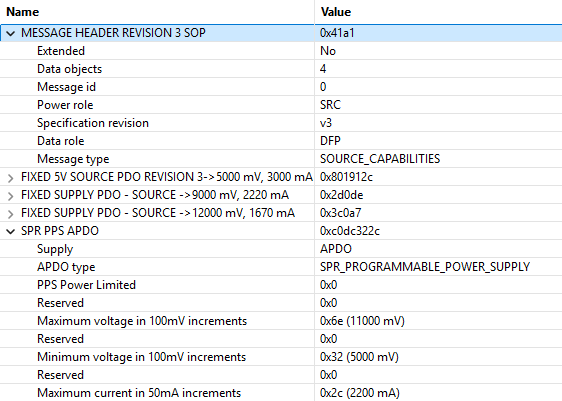
I think the most interesting/quirky part of Care Mode is that it introduces a fixed 12 V PDO that isn't present in Auto Mode. My assumption would be that they're using a controller chip in the charger that is capable of all Standard Power Range(SPR) modes and Anker may have found that the fixed 12 V mode is more efficient than the fixed 15 V mode at these lower wattages. Otherwise I have no explanation, but it should not materially impact the charging experience.
By only advertising these lower wattage PDOs, the Anker Nano 45W(A121D) isn't 'working with' the phone to optimize the charge rate for better care, it is limiting the charging options to what it deems safe. I think the ability for chargers to emulate lower wattage limits is a useful feature for some products. However, it may lead to a suboptimal experience if both your charger and iPhone are trying to be too smart about the correct rate of charge.
Care Mode Charge Curve
We conducted a charge test of an iPhone 17 Pro with the Anker Nano 45W(A121D) in Care Mode. This can be compared to the charge curve graph in Auto Mode to see that Care Mode limits the charging to 20 W and results in a roughly 10-15 minute slower charge.
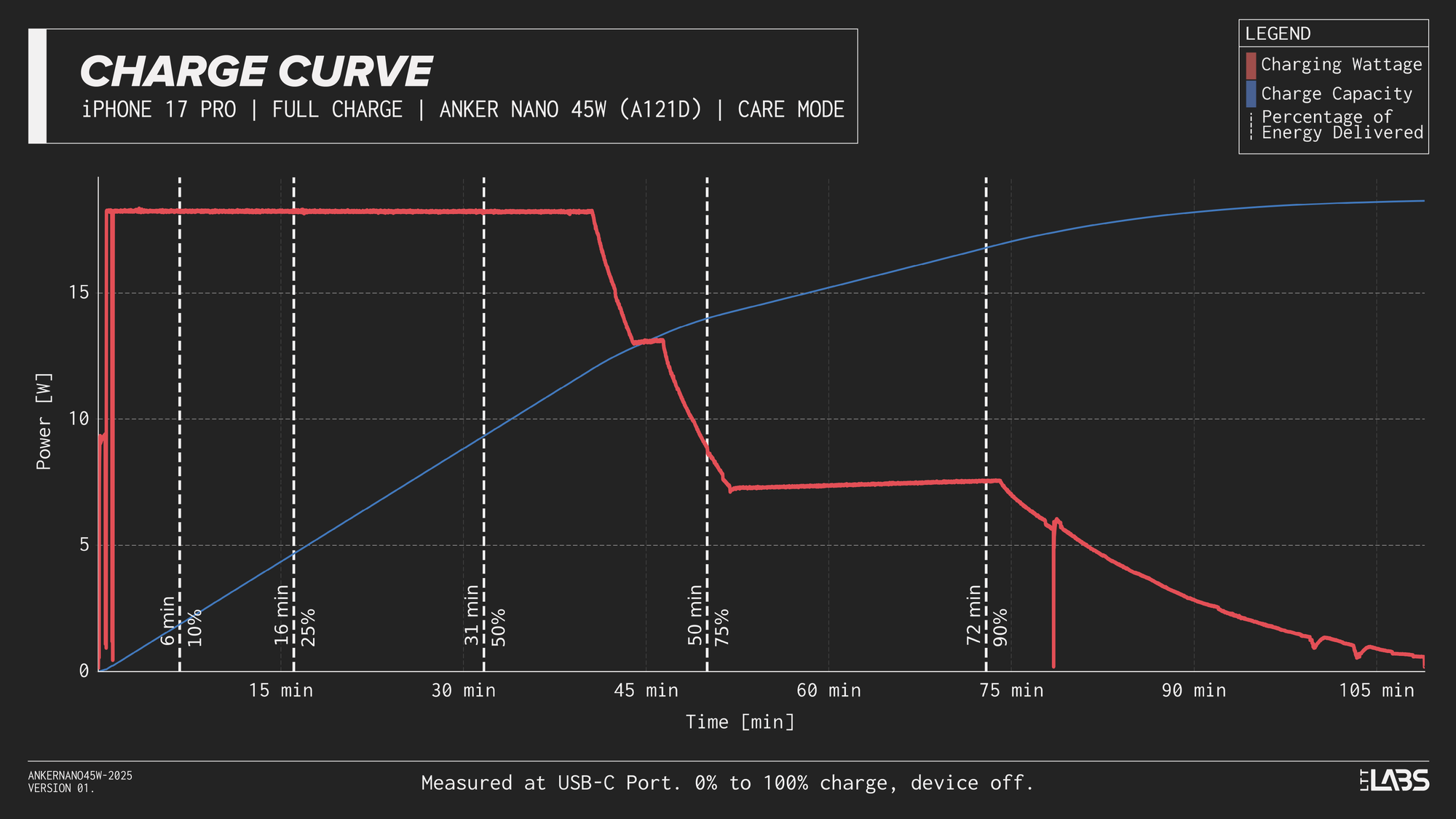
iPhone 17 Pro Charge Curve with Anker Nano 45W(A121D) in Care Mode
Auto Mode and Care Mode Surface Temperature
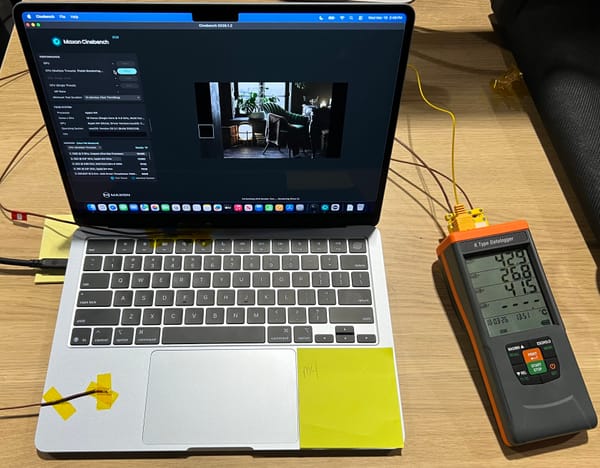
During the Auto Mode and Care Mode charge tests, I used a thermocouple logger with K-type thermocouples affixed to the rear of the iPhone 17 Pro using Kapton tape to collect temperature data. Ideally, superglue(cyanoacrylate) would be used to secure the thermocouples, but I didn't want to mar the surface. This fixation method led to some sensitivity to movement, which could alter the measurements. Note the use of Excel graphs to signify lower confidence in reproducibility.
Note that the two tests did have slightly different beginning temperatures, with the Care Mode starting temperature 1.4°C higher.
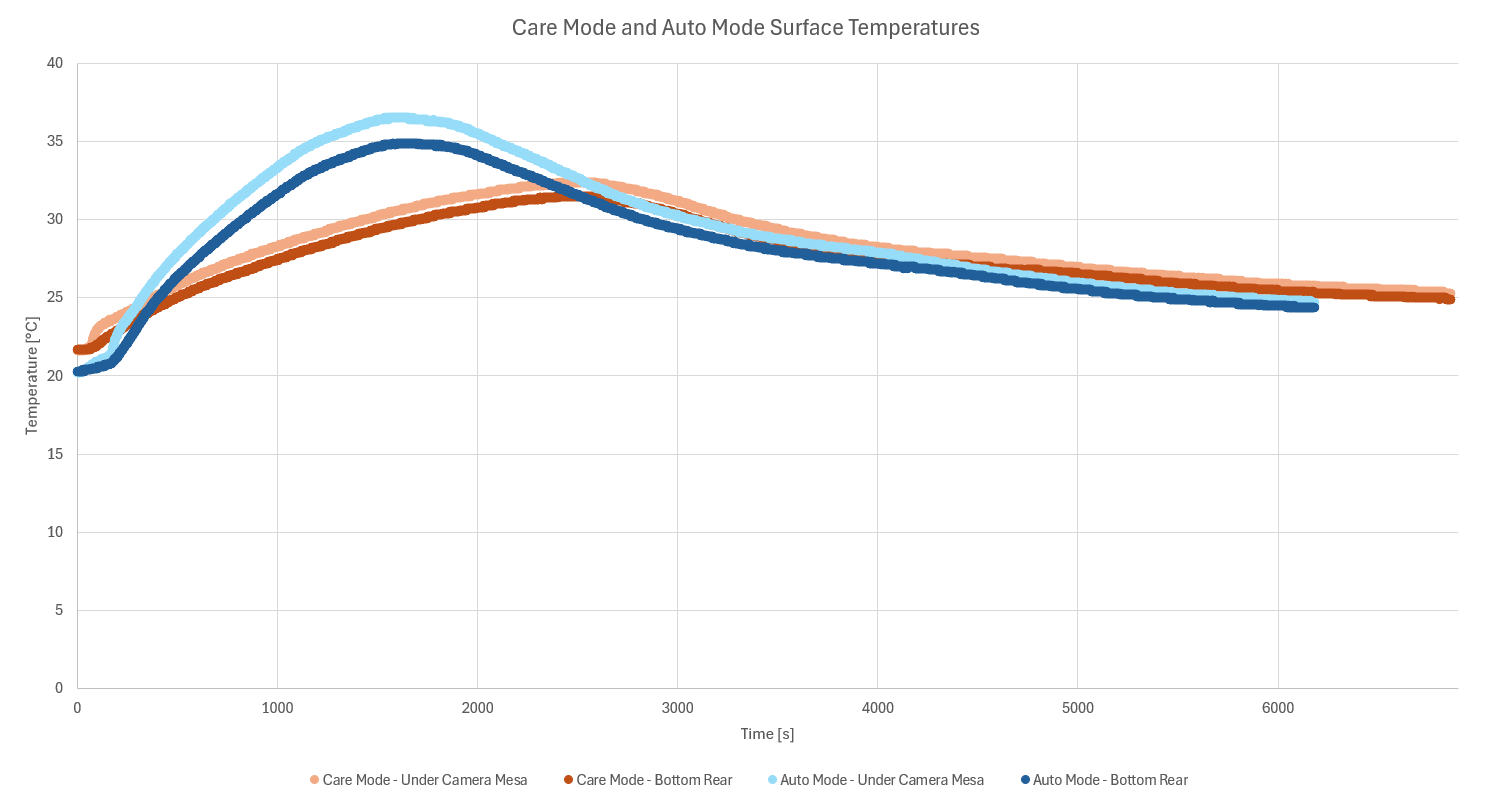
These results did show that Auto Mode had the iPhone 17 Pro reach a maximum temperature of 36.5°C while charging with Care Mode only reached a maximum of 32.4°C. Considering the difference in starting temperature between the two tests, this does support Anker's temperature claims.
'Smart' Features
Anker Smart 3-Stage Charging
While the Care Mode and built-in display may offer some functionality to users, I believe the "Smart 3-Stage Charging" is slightly misleading. From my knowledge of USB PD and some experimentation with this device, besides "Care Mode", the power adapter/charge only plays a very passive role in the charging cycle. It isn't dictating the wattage at which your device is charging, and you probably don't want it to.
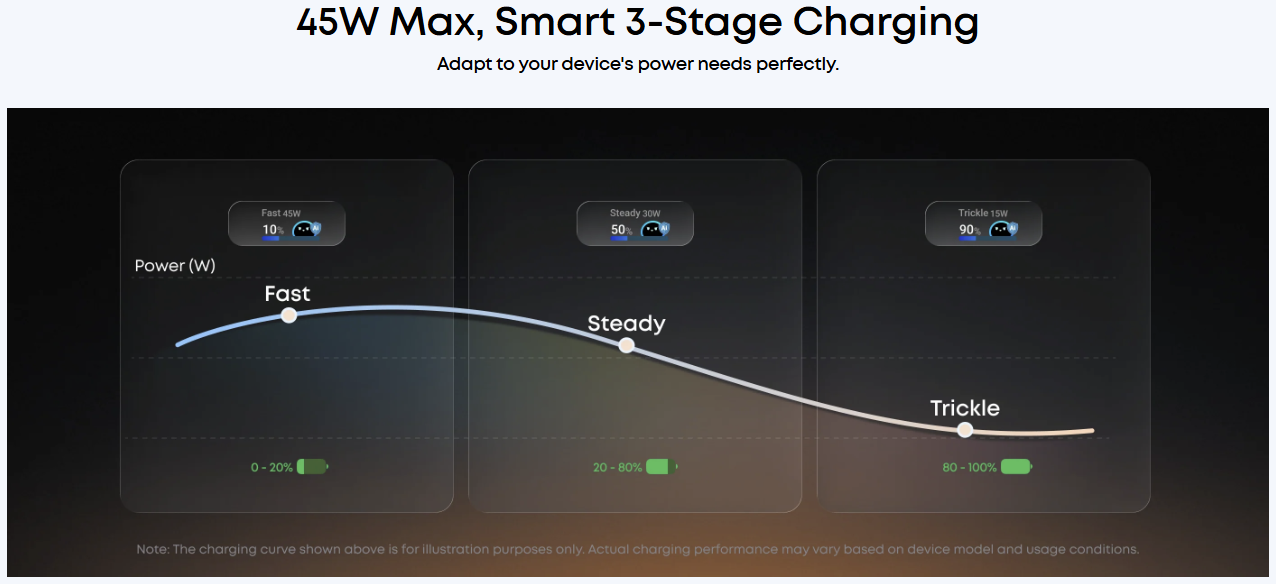
The charger provides a range of PDOs for the device to choose from, but the device being charged knows much more about its internal state than the charger does and therefore it can make smarter decisions about when to fast charge vs. trickle charge. The Anker Nano 45W(A121D) enables devices to do this with the aforementioned variety of PDOs, but other than that I don't believe it is doing anything smart. If Anker is doing something special here then I would be interested to learn about it.
Our charge tests of an iPhone 17 Pro with the Anker Nano 45W(A121D) in Auto Mode showed no apparent difference to charge tests we've conducted with other chargers.
Device Identification
One of the new features advertised for this charger is the ability to identify the model of the iPhone connected and present it on the front display.
We were able to experimentally confirm that it could identify USB-C equipped iPhones back to the iPhone 15. A 'fun fact' is that if a completely depleted iPhone 17 Pro is plugged in, it will show "iPhone 17 Series" instead of "iPhone 17 Pro". Though when the iPhone has enough energy to power up, it will display "iPhone 17 Pro".
I was curious how this is being done so we asked Anker but they didn't provide any additional information. I'm not 100% sure I've found the method, but it doesn’t seem like they’re doing anything revolutionary.
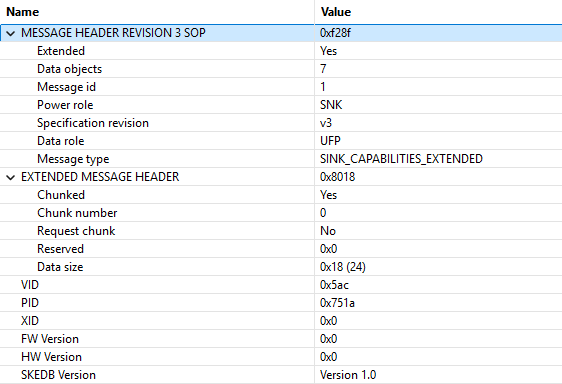
I suspect they're identifying the device using the Vendor Identifier(VID) and Product Identifier(PID) already communicated over PD. This could be done with some exploration and creating a lookup table. Online repositories of manufacturers and devices already exist online, like Device Hunt. This is a feature that could easily be implemented by other manufacturers, and likely support a much larger range of devices.
Apple's VID is 0x05AC(this is 1452 in decimal), and connecting iPhones to the Anker Nano 45W(A121D) I was able to find the PID of the iPhone 15 as 0x7510, the iPhone 16e as 0x751C, and the iPhone 17 Pro as 0x751A. This was consistent when connecting to the Anker Nano 45W(A121D), but I did read a PID of 0x7519 when I connected the iPhone 17 Pro to the Apple 40W Dynamic charger. I'm not an expert in this domain so there may be more factors involved here.
Displaying Battery Status
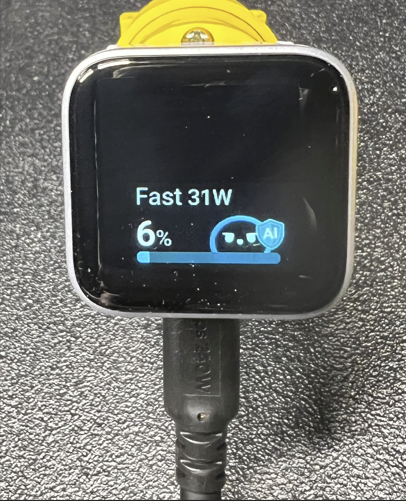
When Anker advertised that they would be displaying the battery percentage of the iPhone(only iPhones) on the charger itself, I assumed that they were doing something complicated to determine battery status. A really complicated and imprecise way of doing this is comparing the wattage being delivered against previous testing. We've previously tested some iPhone charge curves and found them to be fairly repeatable.
It turns out that there are USB-C PD messages specifically made for battery reporting purposes. There is GET_BATTERY_CAP with response BATTERY_CAPABILITIES, and GET_BATTERY_STATUS with response BATTERY_STATUS.(GOODCRC is just an acknowledge)

BATTERY_CAPABILITIES returns "Battery Design Capacity" and "Battery Last Full Charge Capacity" while BATTERY_STATUS returns the "Battery Present Capacity", all in Watt-hours. These can be compared to simply calculate the battery percentage of the connected phone. There will be some imprecision in these calculations, and I'm really not sure why you would want this feature when your phone will only ever be a cord-length away, but it's a feature!
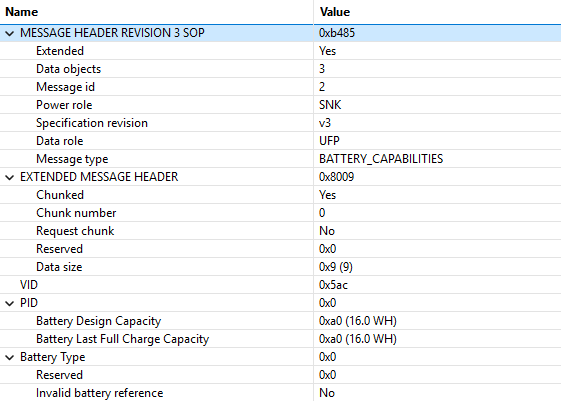
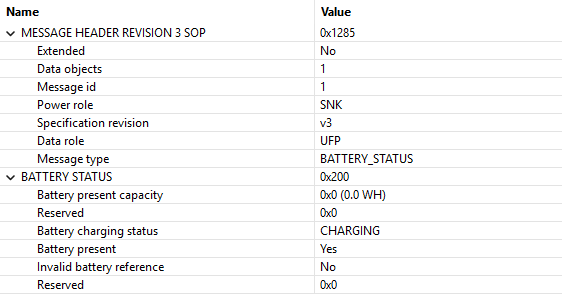
{{slide}}Battery Capabilities Message Contents{{/slide}}{{slide}}Battery Status Message Contents{{/slide}}
The iPhone 17 Pro reports a design battery capacity of 16 Wh, iPhone 16e also reports 16 Wh, and iPhone 15 reports 12 Wh.
Endurance 45 W Output
Power Output
With the recent release of Apple's 40W Dynamic charger - which boosts to 60 W for limited periods - I conducted some endurance testing to find that the Apple charger will initially output 60 W for up to 35 minutes. It will then drop to 40 W output for a short period and alternate between 40 W and 60 W with a duty cycle of approximately 0.66. I calculated an approximate average sustained output of 51 W for the Apple 40W Dynamic.
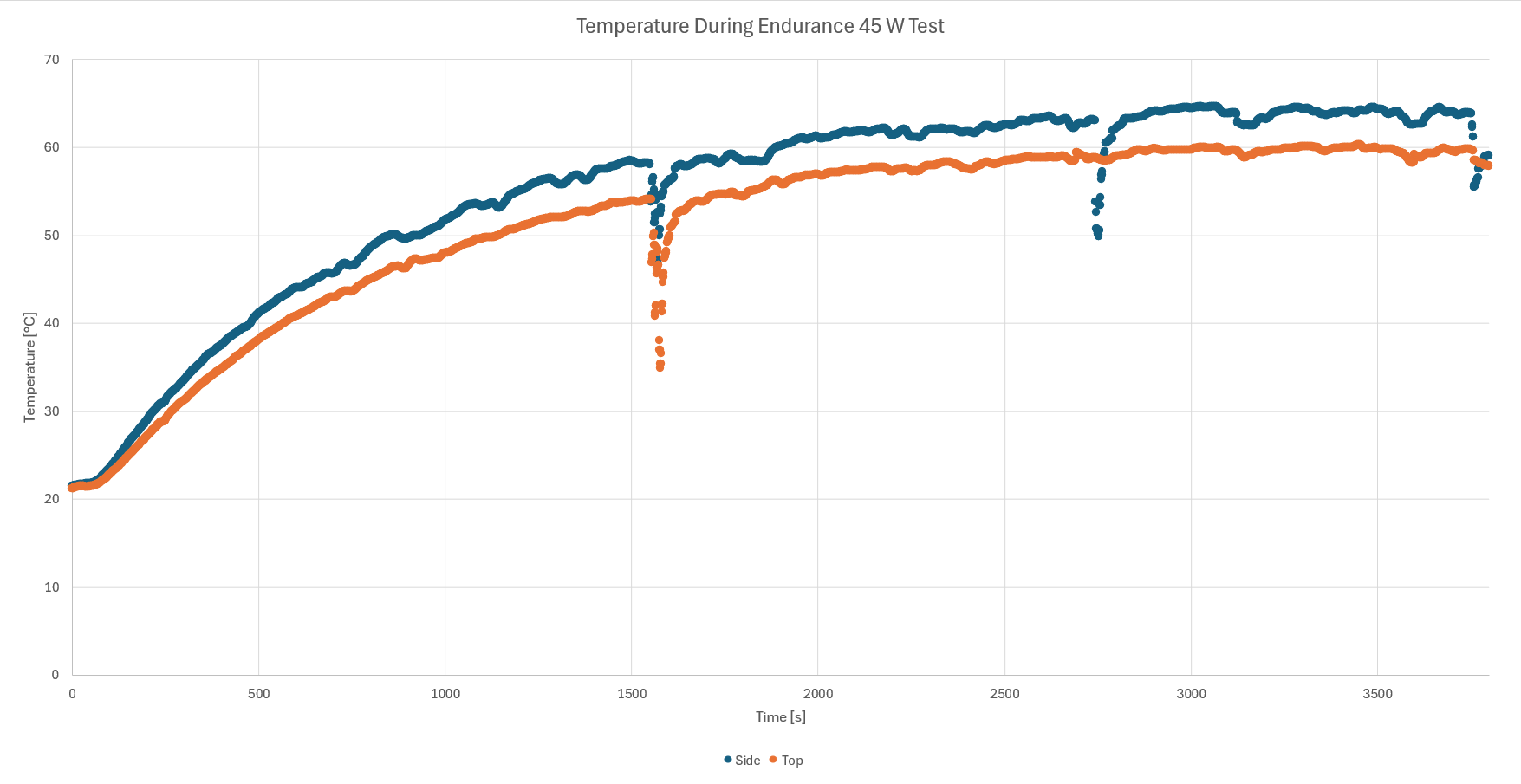
As the Anker Nano 45W is slightly smaller, I thought it might eventually step down in wattage to protect itself, but I was able to output a constant 45 W while pulling 3 A at 15 V for an hour with no drops.
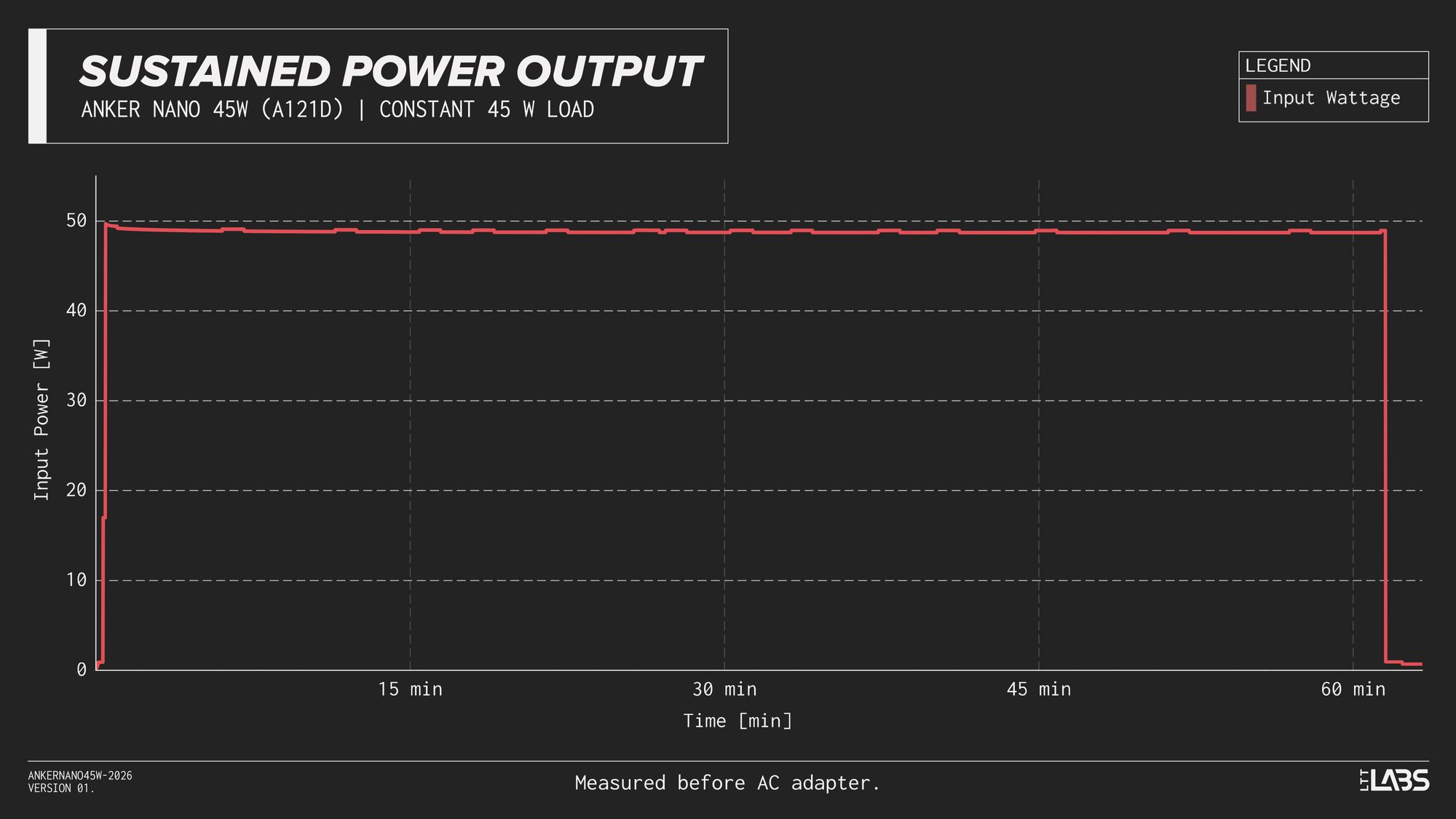
The output wattage wasn't measured, but the 3 A output was sustained for the entire period. I believe those small increases in wattage are when I interact with the display.
Thermal Testing
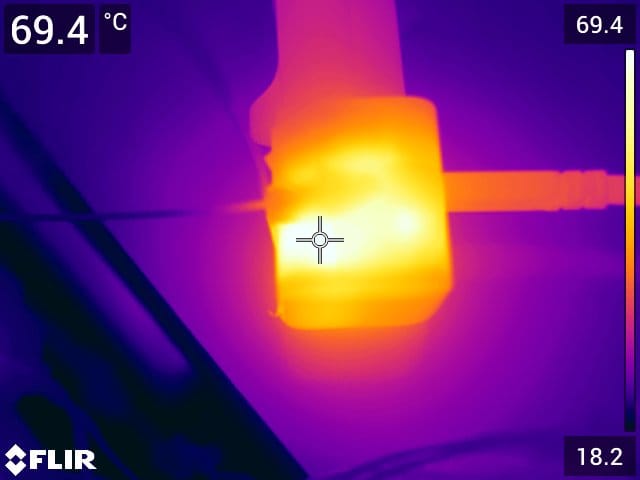
During the endurance 45 W output testing, I again used a thermocouple logger with K-type thermocouples, but now affixed to the surface of the charger using Kapton tape to collect temperature data. I also used our FLIR camera to capture a few measurements(on matte surfaces).
I am not entirely confident in the absolute values of these measurements but they do allow us to observe that the charger was near thermal equilibrium after 60 minutes. The charger could potentially derate itself with a longer charge test.
Below is a FLIR capture of a hot spot on the casing, near the end of the test.
Conclusion
Overall, I think the Anker Nano 45W(A121D) has a couple useful additions over the existing Anker Nano II 45W(A2664) charger. The 180° foldable prongs really increase the flexibility, and the Care Mode could prove useful in specific scenarios, though likely isn't necessary all of the time. As mentioned in this previous article, devices already do a lot to maintain battery longevity.
Besides those new features, this charger remains a very compact option to deliver 45 W, which is plenty to charge most phones and even larger devices if you're not in a rush. I don't think there is a reason to purchase this if you already own a previous version, but otherwise it offers a lot of value for the $39.99 USD price and size.