Handheld Power Has Never Been Higher…or Pricier.
We got our hands on the world's first handheld with AMD's Strix Halo chipset and with some new and interesting cutting-edge technology to support it.

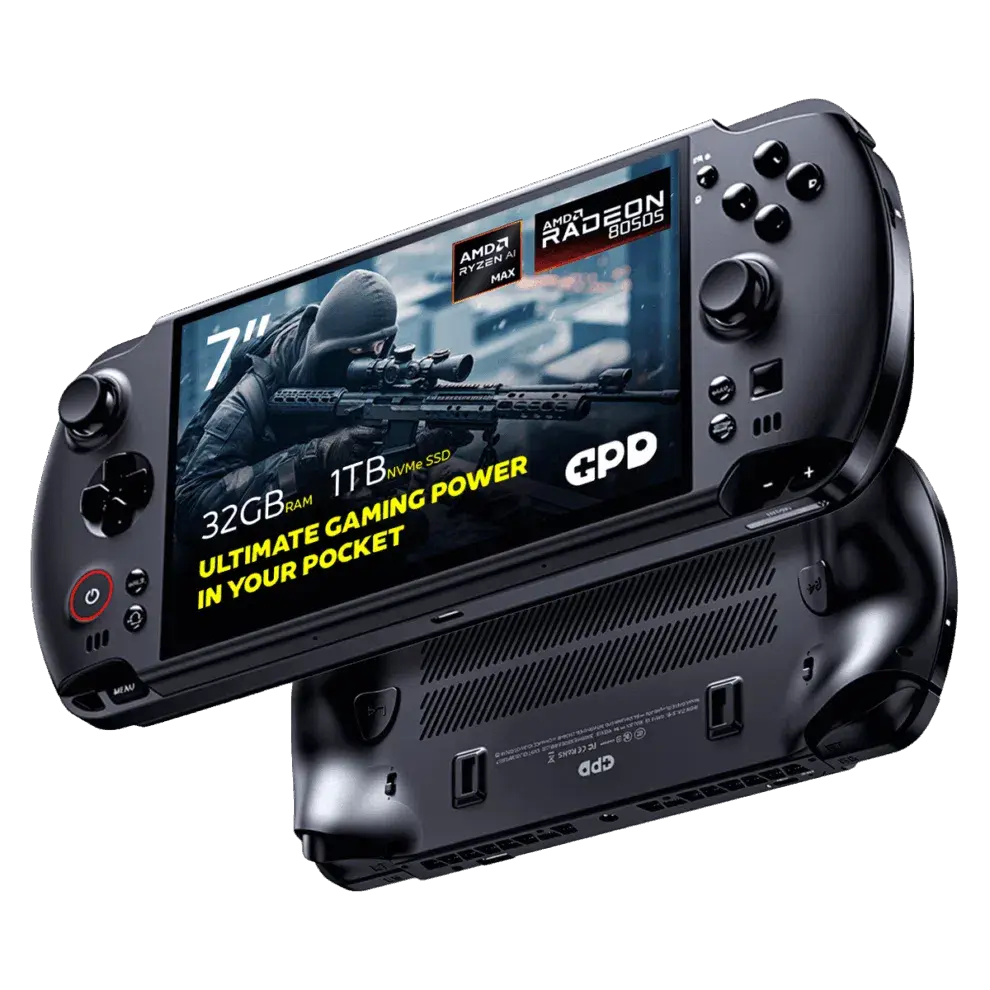
Anyone who thought handhelds had already gone too far clearly hasn’t met the GPD Win 5. It is the world’s first handheld console based on the AMD Ryzen AI Max+ 395 and Max 385 processors with a natively landscape 7” 120 Hz 1080p display, an 80 Wh external battery, capacitive joysticks, and a mini SSD slot.
It’s a marvel of engineering with a lot of new features to offer. So much so that Linus had to fawn over it in an ShortCircuit video AND he is daily driving it for 30 days for a more thorough examination of it. It also happens to be one of the heaviest and one of the most expensive handhelds you can get your hands on (currently) in this form factor. It makes us optimistic (and slightly concerned) about where the trend in the industry is headed, even if the road there costs a sore arm. Let us see what makes this product so remarkable.
Performance and Efficiency
Before getting to the graphs, let’s address the beast of a chip that the GPD Win 5 uses. The Ryzen AI Max+ 395 and Max 385 of the “Strix Halo” family are the first APUs of this calibre to show up in a handheld. They're the same class of silicon powering compact PCs like the Framework Desktop and they hit far harder than any handheld APU before them. You get up to 16 Zen 5 CPU cores, up to 40 graphic cores (32 for the Max 385), up to 5.1 GHz clock speeds and the ability to configure VRAM allocation. The default TDP listed by AMD is 55 W, although the configurable TDP allows for 45 to 120 W.
The Raven Black Win 5 comes in 32 GB, 64 GB, 128 GB RAM variants and a recently added the Pearl White color which is available only for the 128 GB variant. Here’s how we conducted our testing:
- We tested the performance of the Win 5 variant with the Max+ 395 and 64GB of RAM (We tested it with the out-of-box 32 GB allotment to the VRAM) across three power settings that we thought would make for fair comparisons with other products: 75 W, 35 W, and 17 W. The “Motion Assistant” application lets us specify the TDP in the range of 8 W to 75 W. We also tested it at 13 W for a battery longevity test.
- Each power level was run through our standard handheld gaming tests at both 1080p and 720p. All devices used identical game settings for each title.
- We also left the CPU Boost option enabled on the Win 5 as that is the default.
- All performance tests were performed with the devices plugged in to ensure the best performance.
- For comparison, the ASUS Xbox Ally X was tested at its matching TDPs: Turbo mode at 35W, and Performance mode at 17 W. We also tested the Silent mode at 13 W only for our battery tests.
- The Framework Desktop was evaluated at its out-of-box 120 W, which sits above the Win 5’s ceiling but provides a useful reference point for how much the Strix Halo APU can flex when it is not power limited.
75 W Mode
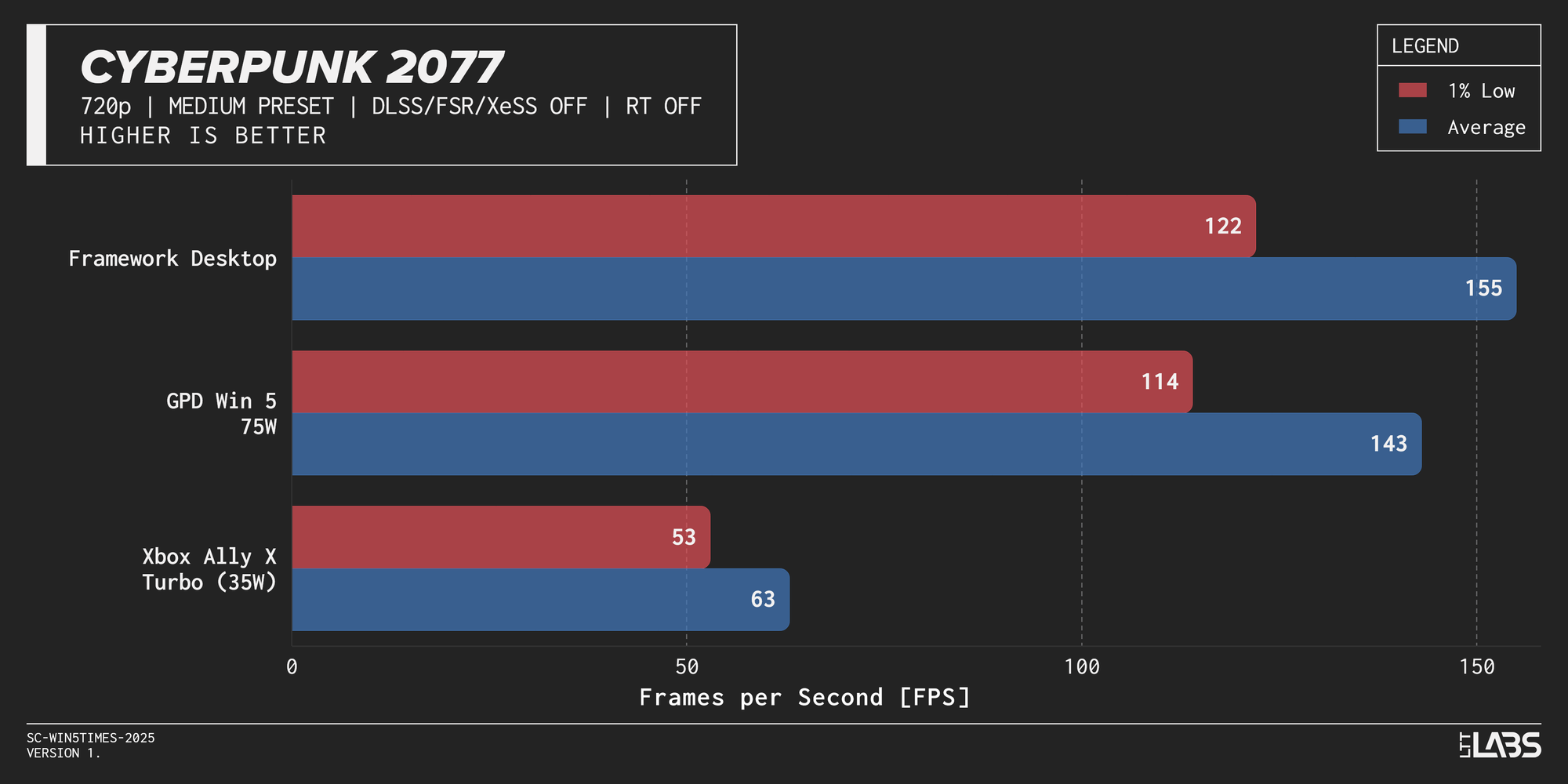
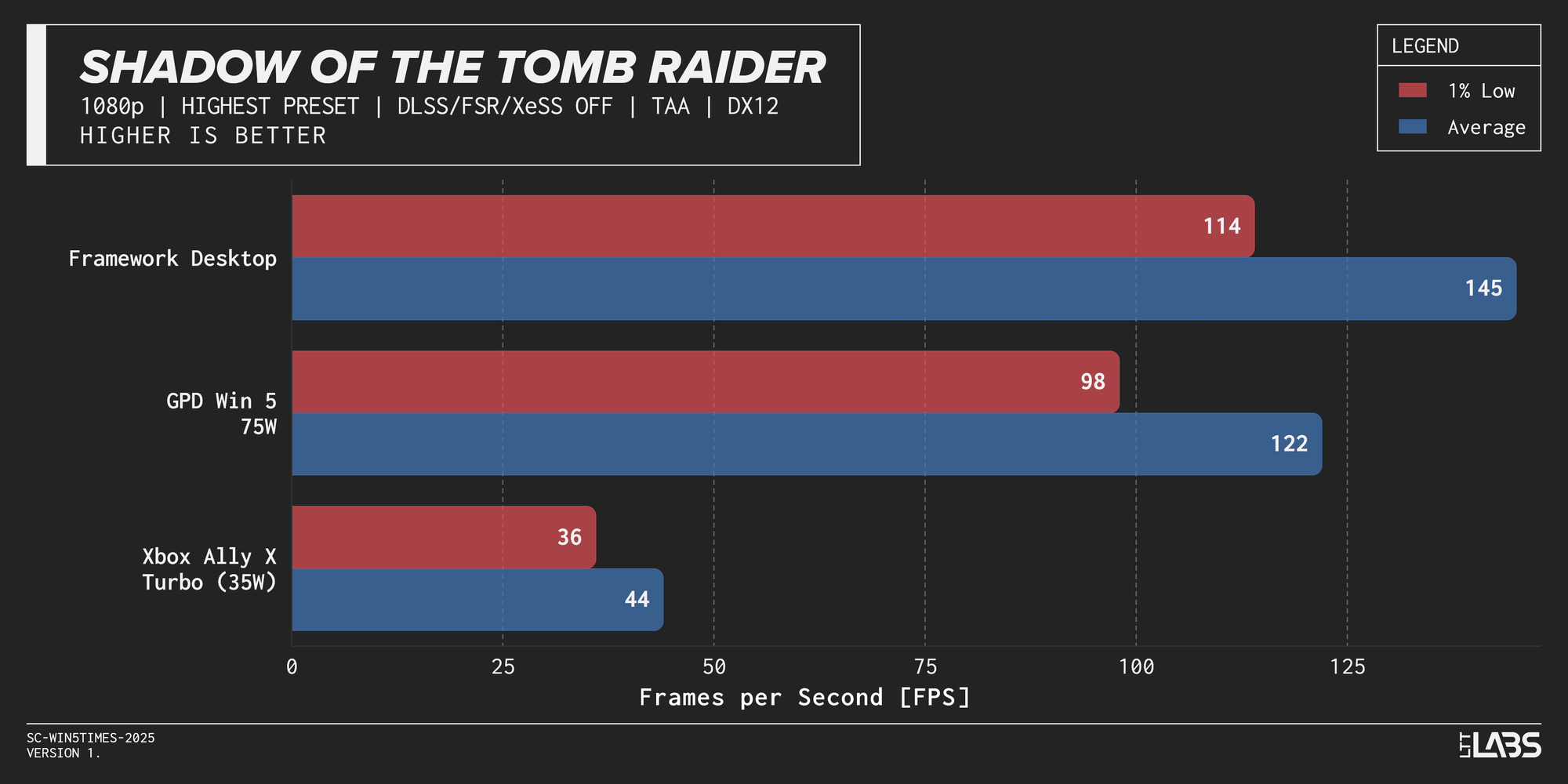
While unplugged the Win 5 is limited to 45 W, most likely due to battery life considerations. However, we can use 75 W through the DC in port when plugged in with the included 180 W adapter. When using a 100 W USB-C charger plugged in through the USB4 port, you will be limited to only 65 W maximum, a precautionary configuration set by GPD. Consequently, it pulls FPS numbers that look far too high for something with thumbsticks attached to it.
The averages land much closer to the Framework Desktop at 120 W than expected, and even the 1% lows stay tight for a handheld running this much power. The Win 5 not only leaves the Xbox Ally X behind, it leaves it in the parking lot since the Xbox’s maximum sustained mode tops out around 35 W. This TDP power, never seen before on a handheld, would be used when plugged in, connected to a monitor, and playing something demanding enough to justify it. It is the closest this device gets to replacing a compact PC, and the results make it clear that the hardware and cooling are both built with this level of performance in mind. This is why the Framework desktop, which has the same processors, was chosen as a comparison.
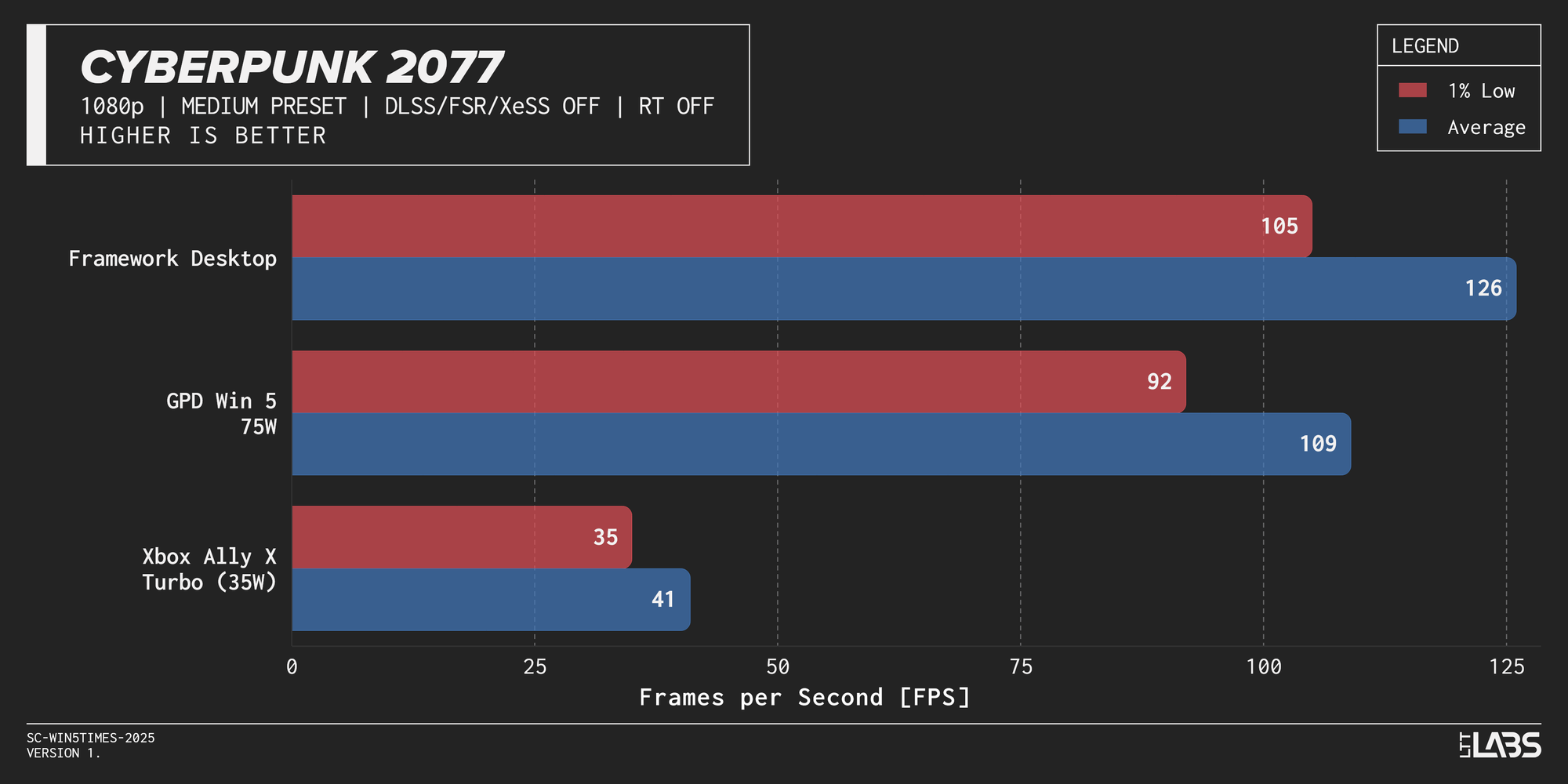
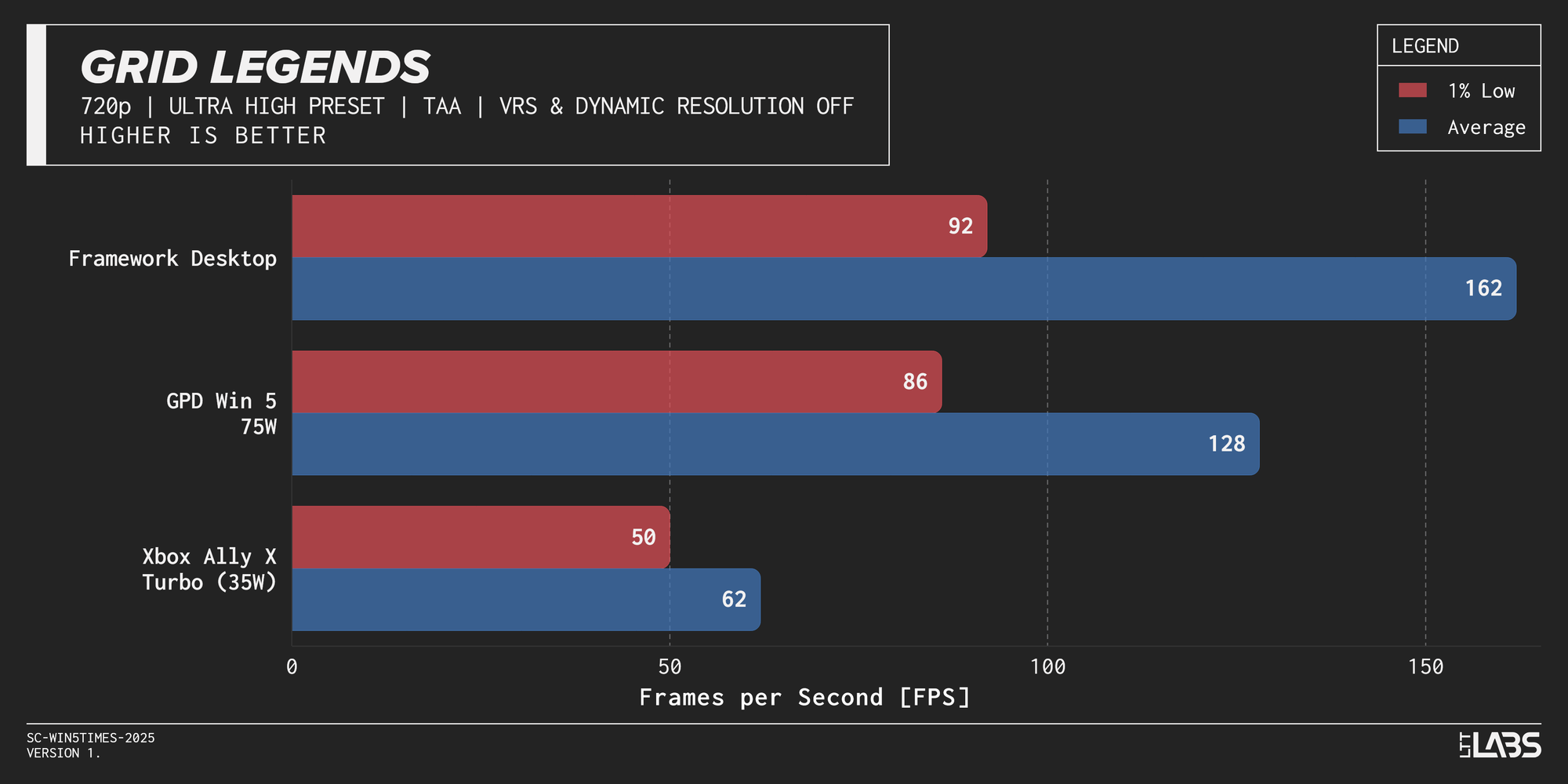
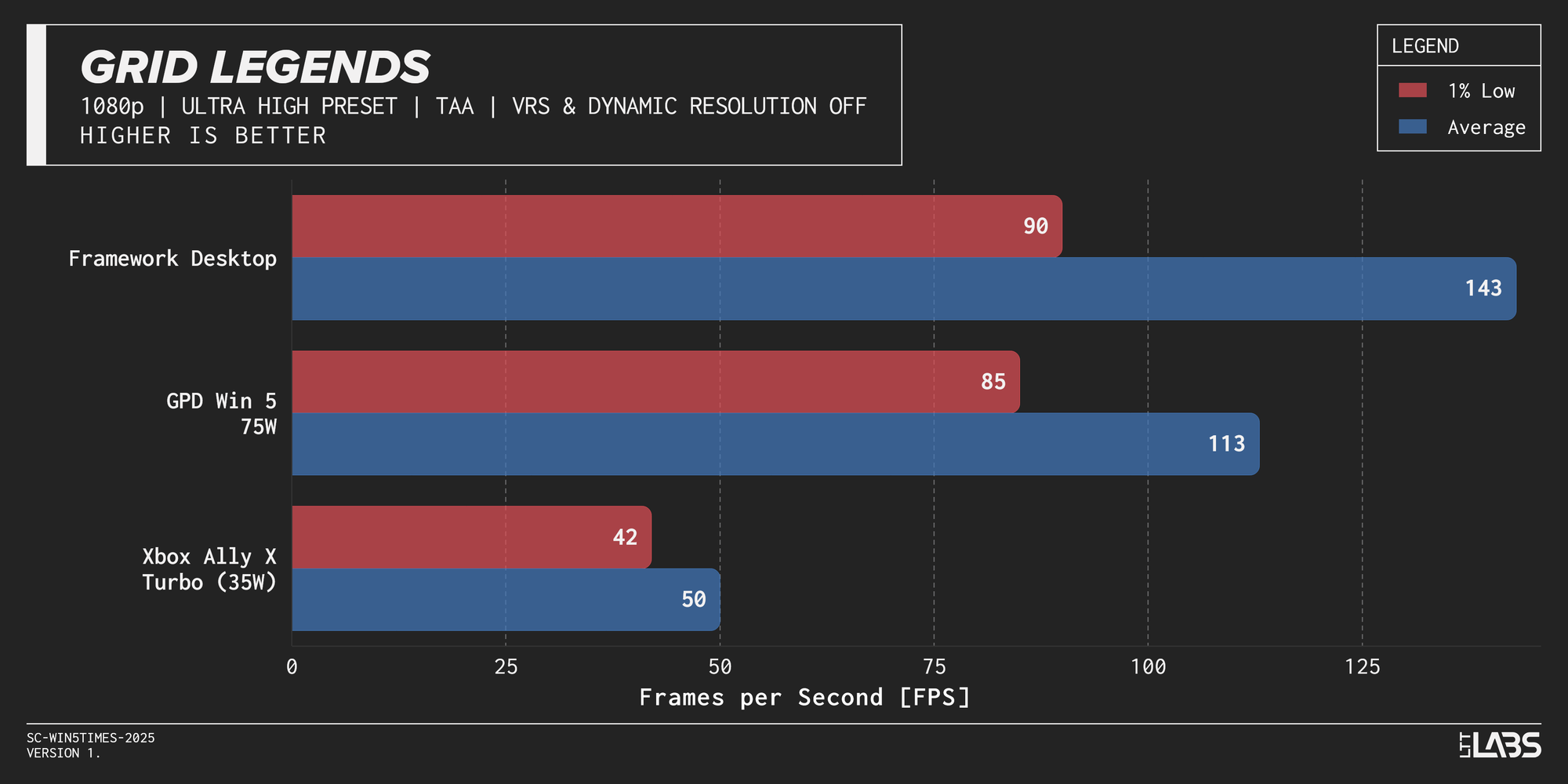
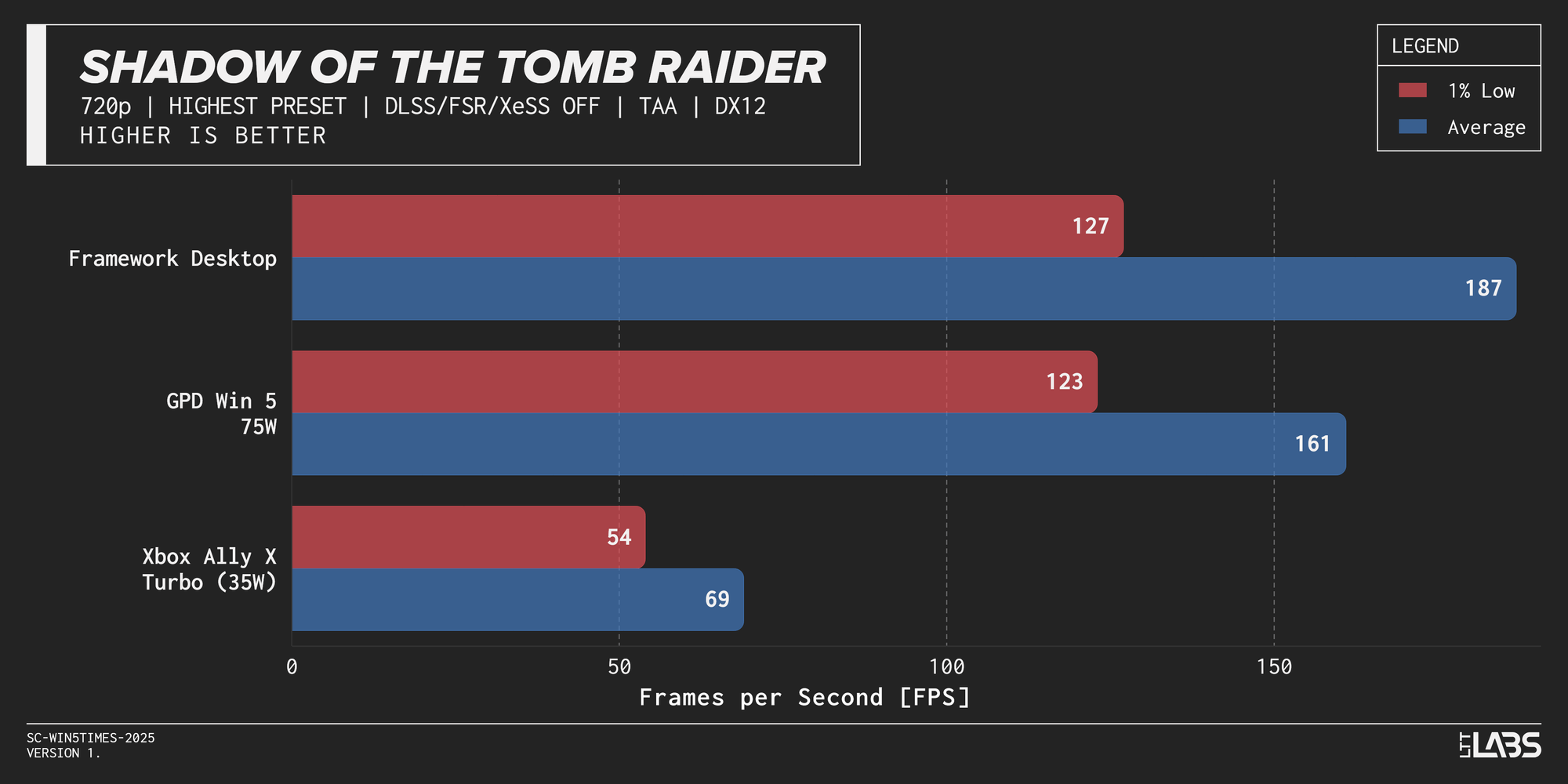
{{slide}}Cyberpunk 2077 720p - FPS Graph{{/slide}} {{slide}}Cyberpunk 2077 1080p FPS Graph{{/slide}} {{slide}}Grid Legends 720p FPS Graph{{/slide}} {{slide}}Grid Legens 1080p FPS Graph{{/slide}} {{slide}}Shadow of the Tomb Raider 720p FPS Graph{{/slide}} {{slide}}Shadow of the Tomb Raider 1080p FPS Graph{{/slide}}
35 W Mode
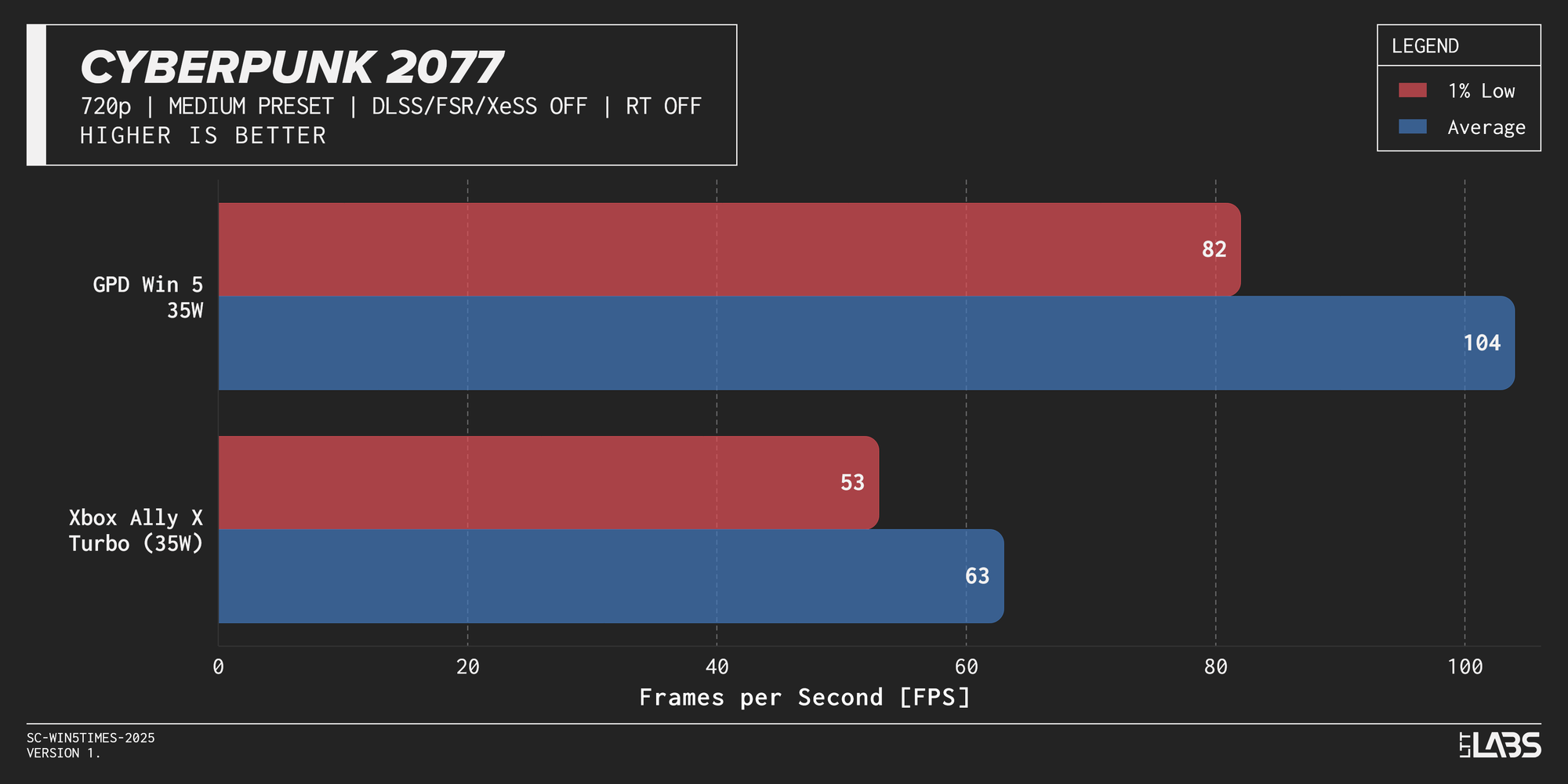
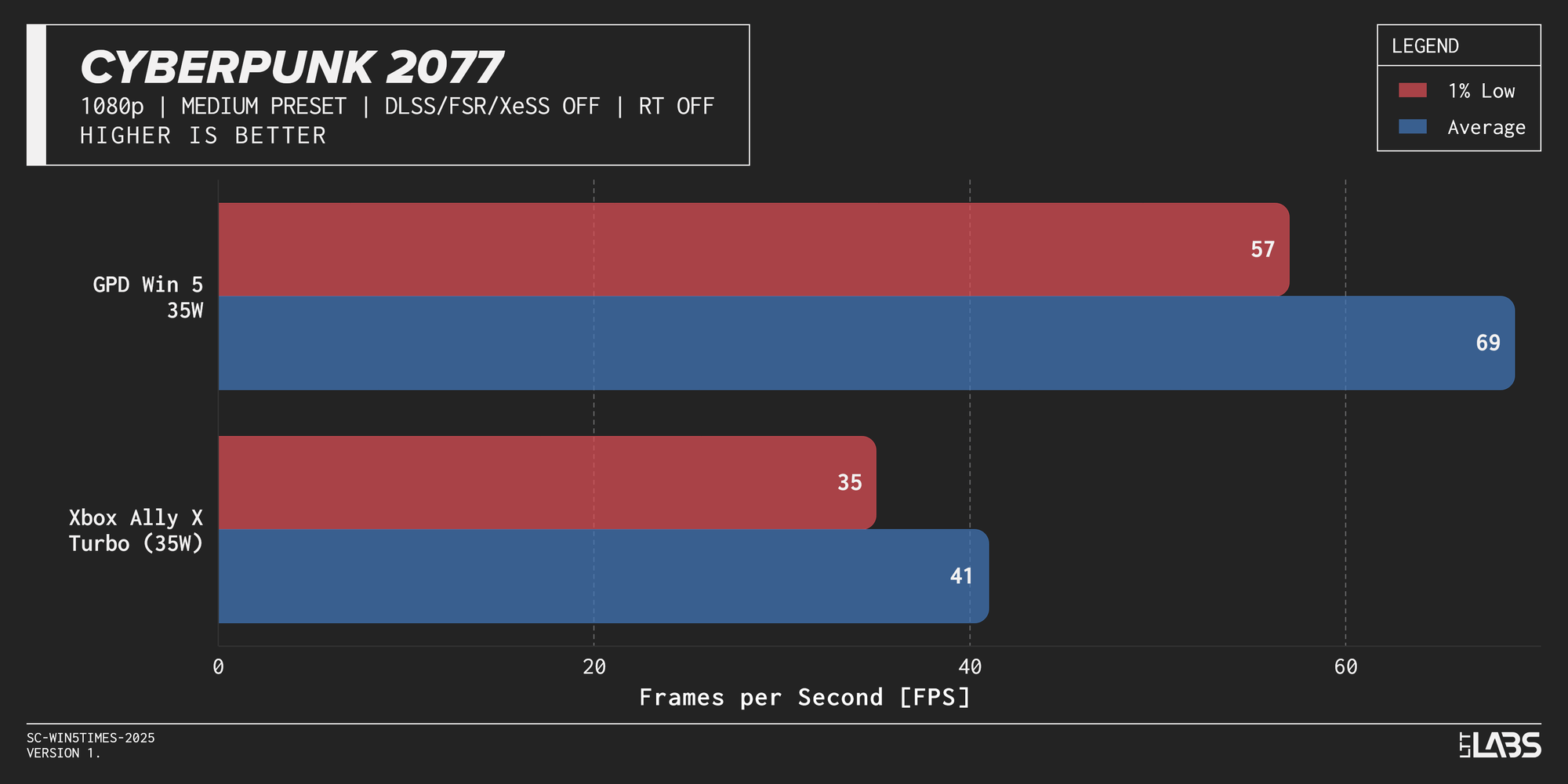
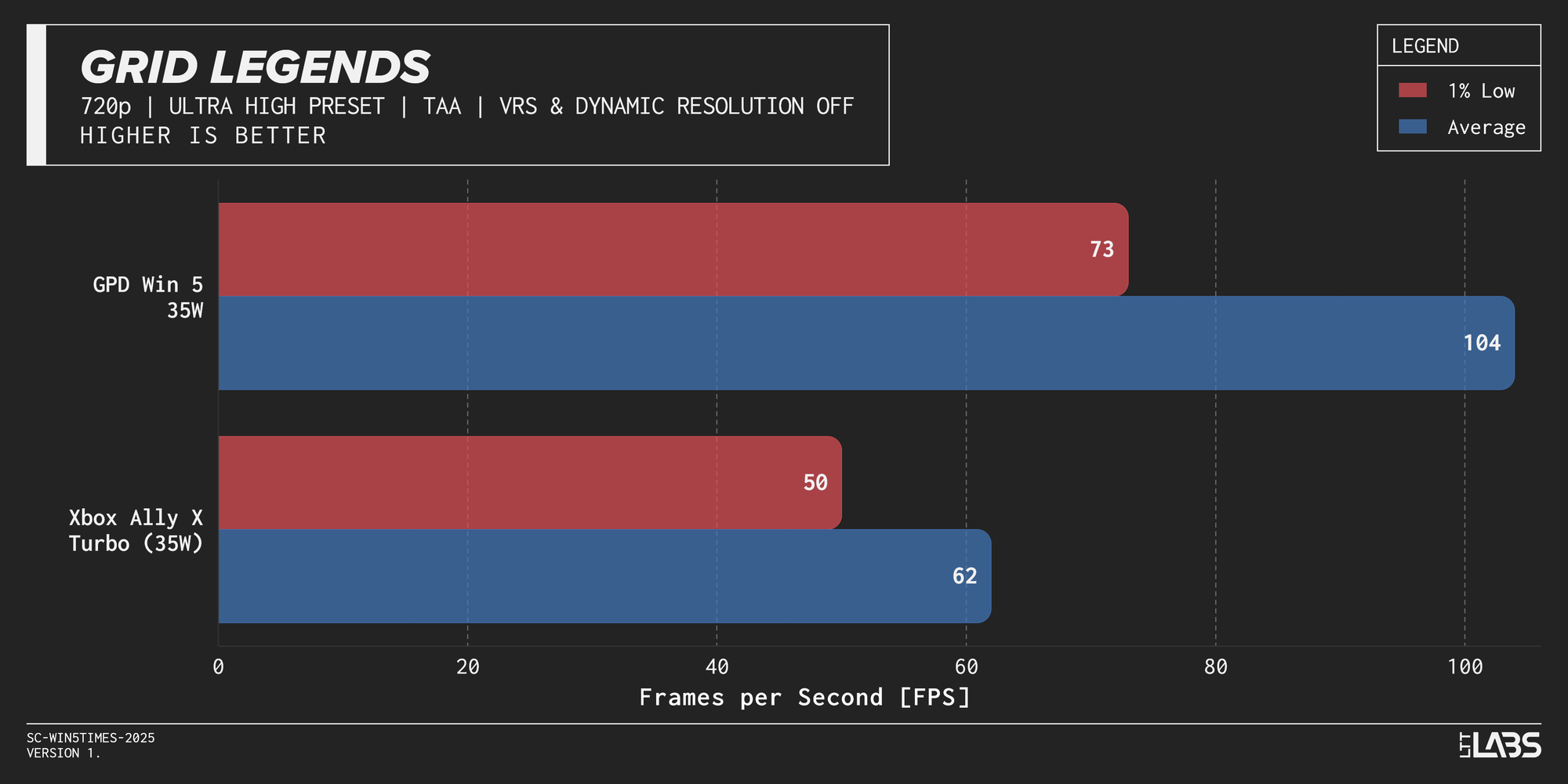
Since the Xbox Ally X draws 35 W in Turbo mode while plugged in, we configured the Win 5 to the same power level. With the power budget equal, the Win 5 STILL maintains a clear lead in both average FPS and 1% lows. The Win 5’s advantage at this TDP comes from its beefier APU with more CPU and GPU cores and the cooling headroom to use them. The Win 5 is designed to run up to 75 W, so 35 W is well within its comfort zone. It holds onto a large portion of its maximum performance, while the Xbox Ally X approaches its own thermal limits. It’s clear from the performance gap that there’s more to the Win 5 than just pushing the wattage.
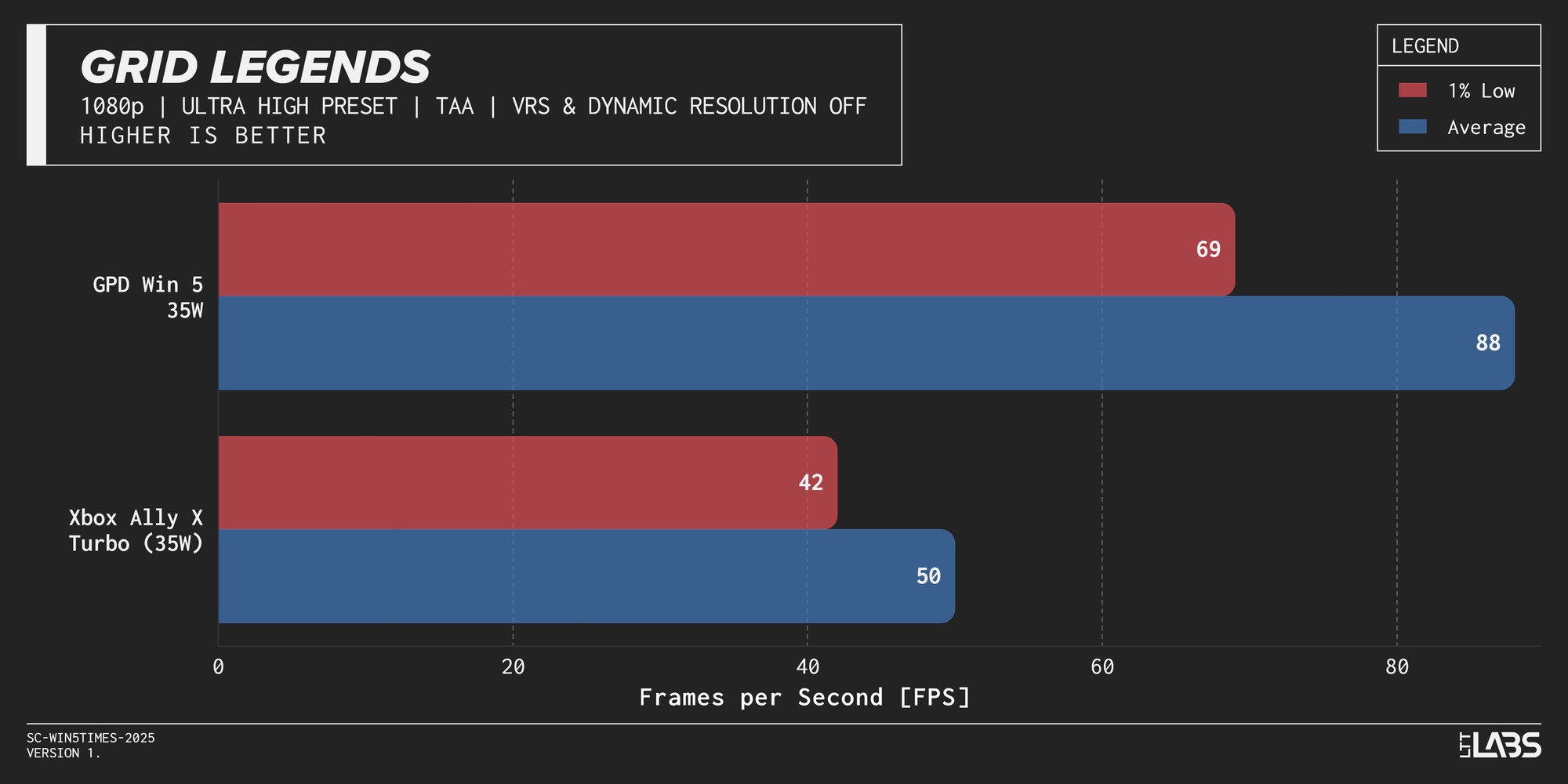
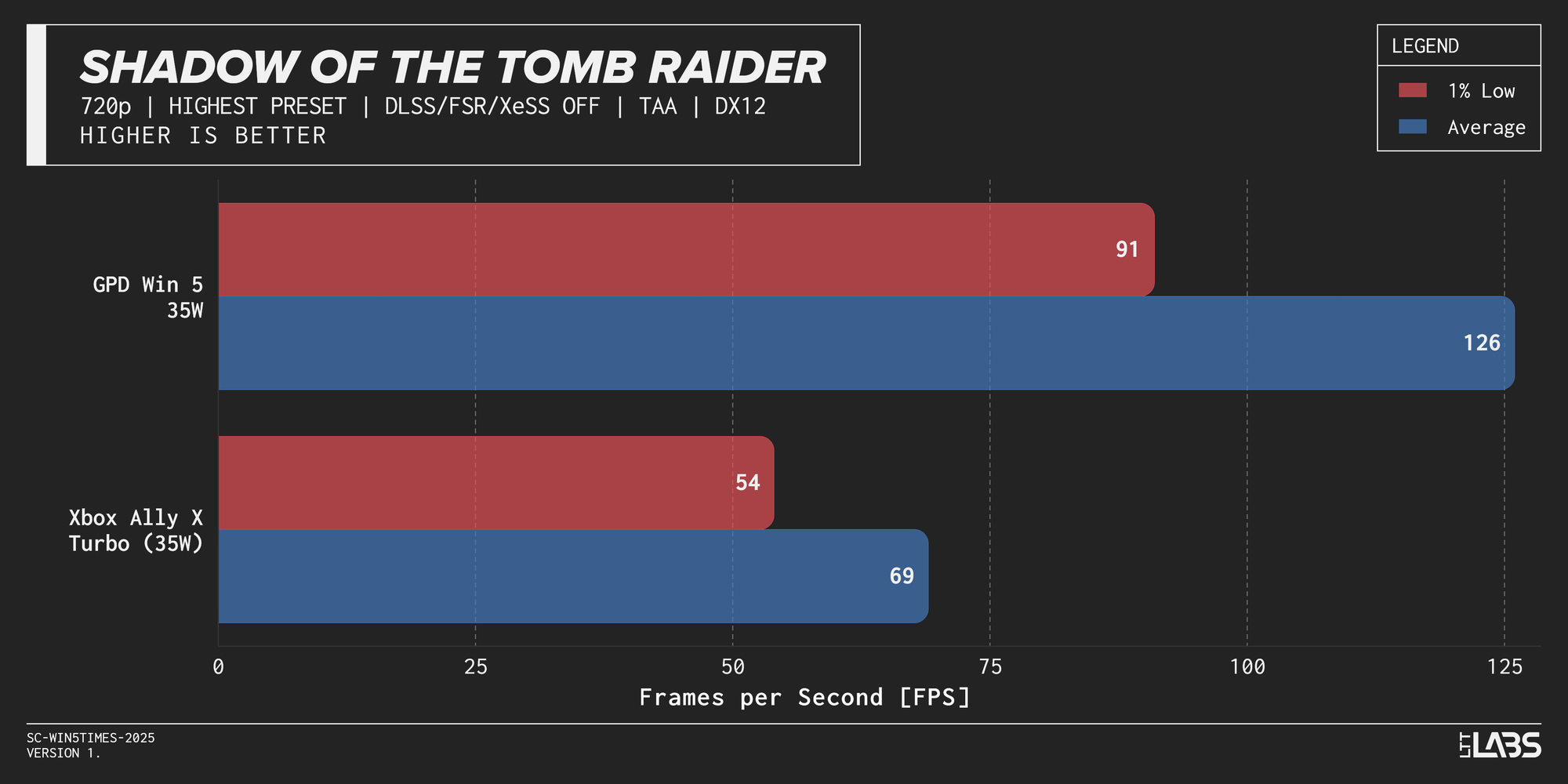
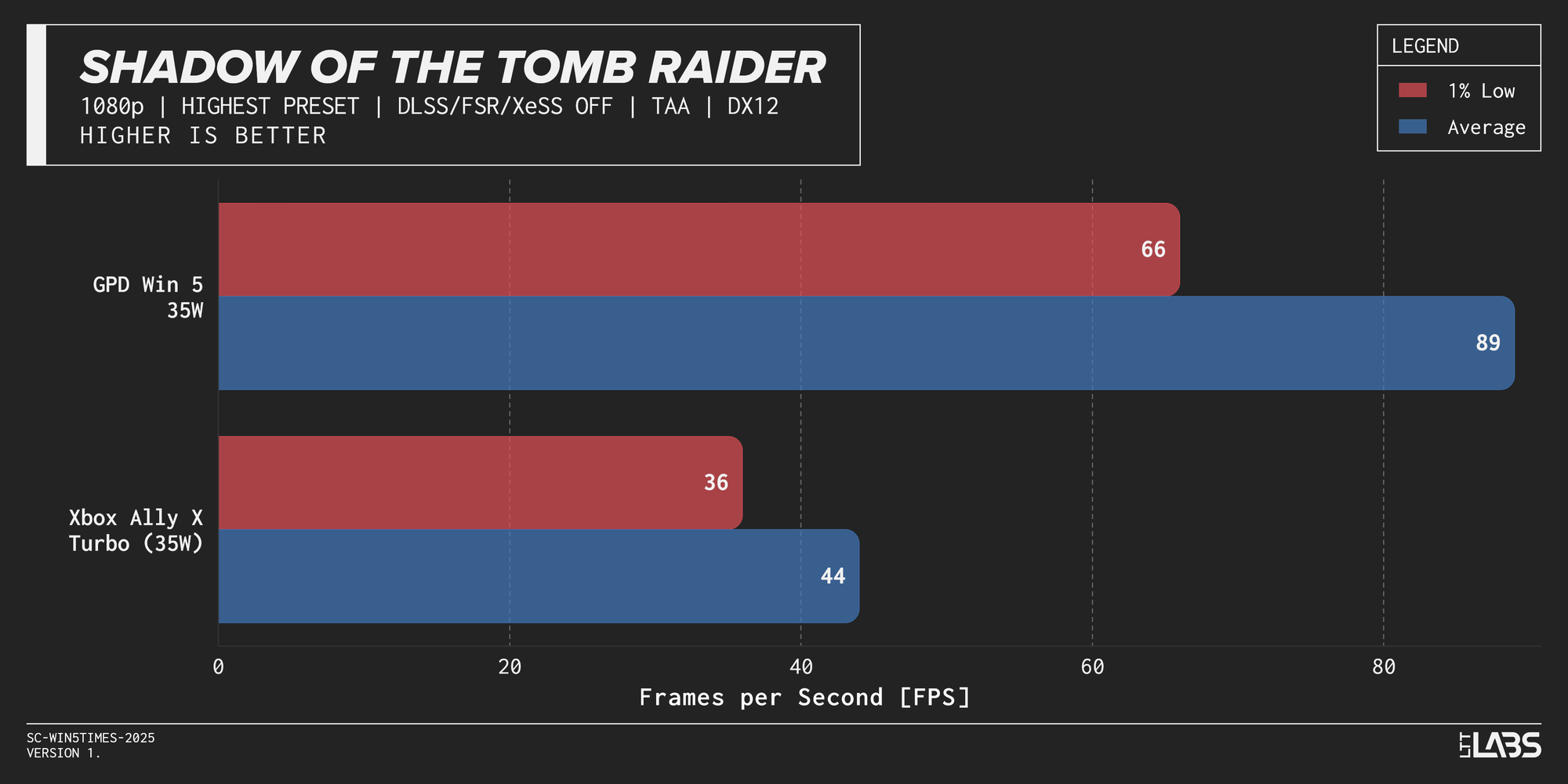
{{slide}}Cyberpunk 2077 720p FPS Graph{{/slide}} {{slide}}Cyberpunk 2077 1080p FPS Graph{{/slide}} {{slide}}Grid Legends 720p FPS Graph{{/slide}} {{slide}}Grid Legens 1080p FPS Graph{{/slide}} {{slide}}Shadow of the Tomb Raider 720p FPS Graph{{/slide}} {{slide}}Shadow of the Tomb Raider 1080p FPS Graph{{/slide}}
17 W Mode
At 17 W, the Win 5’s stronger hardware no longer gets room to stretch, so the two devices start performing quite similarly. The Strix Halo APU is clearly being limited by the low power budget, not by its own capability. As a result the Win 5 is in a neck to neck race with the Xbox Ally X in both averages and 1% lows at 1080p. At 1080p in Cyberpunk 2077, the Xbox Ally X even beats the Win 5. There IS a minor gap favouring the Win 5 at 720p. This isn’t unexpected since the wattage cap becomes a more significant bottleneck at this TDP.We tested with CPU boost enabled, which may have influenced how the power was split between CPU and GPU at this wattage, but we cannot confirm how much that affected the spread given the short testing window. Justifying a handheld of this calibre and cost is very difficult if you mostly play at low wattages. A cheaper, less powerful handheld might serve you better.
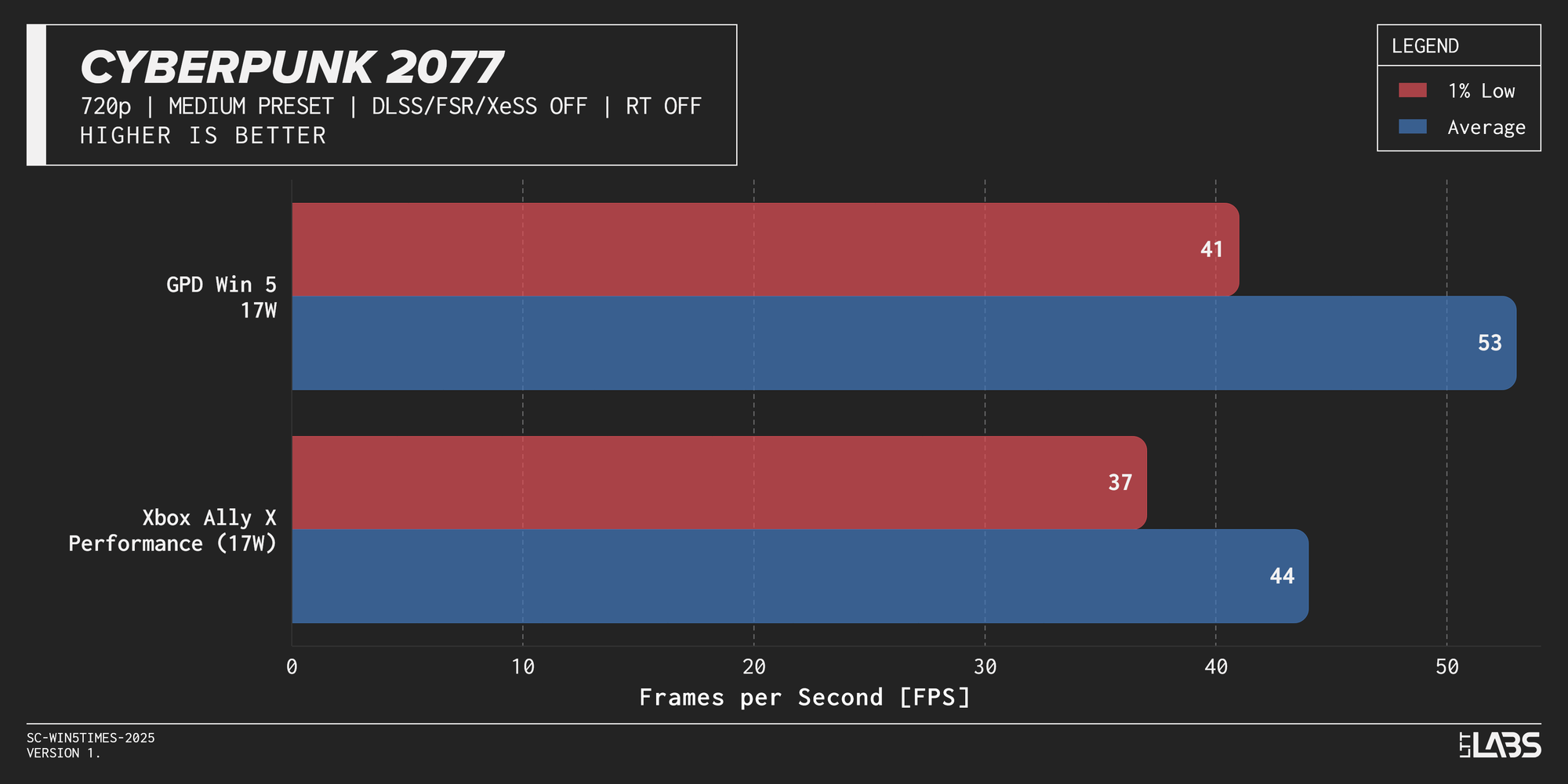
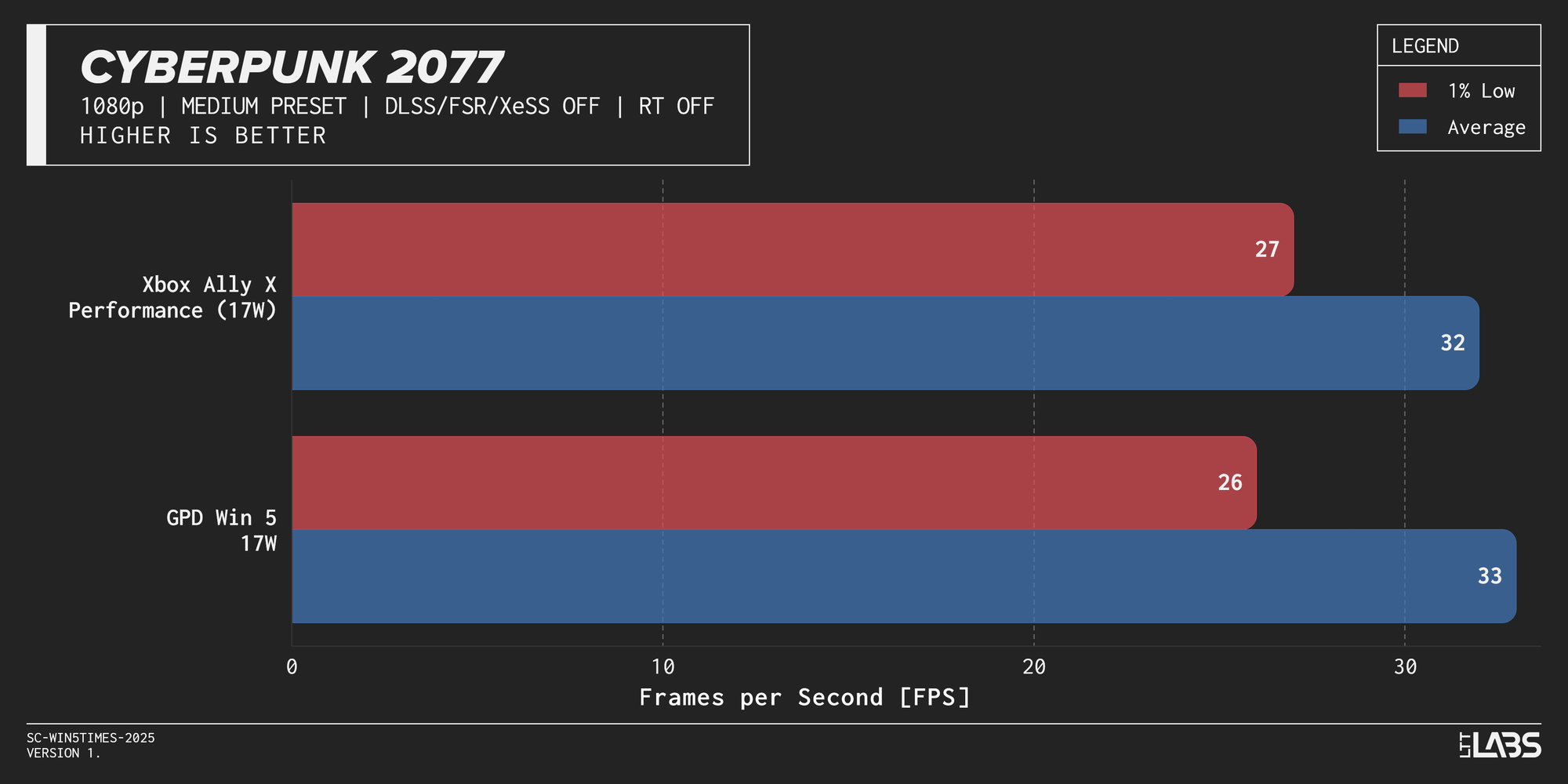
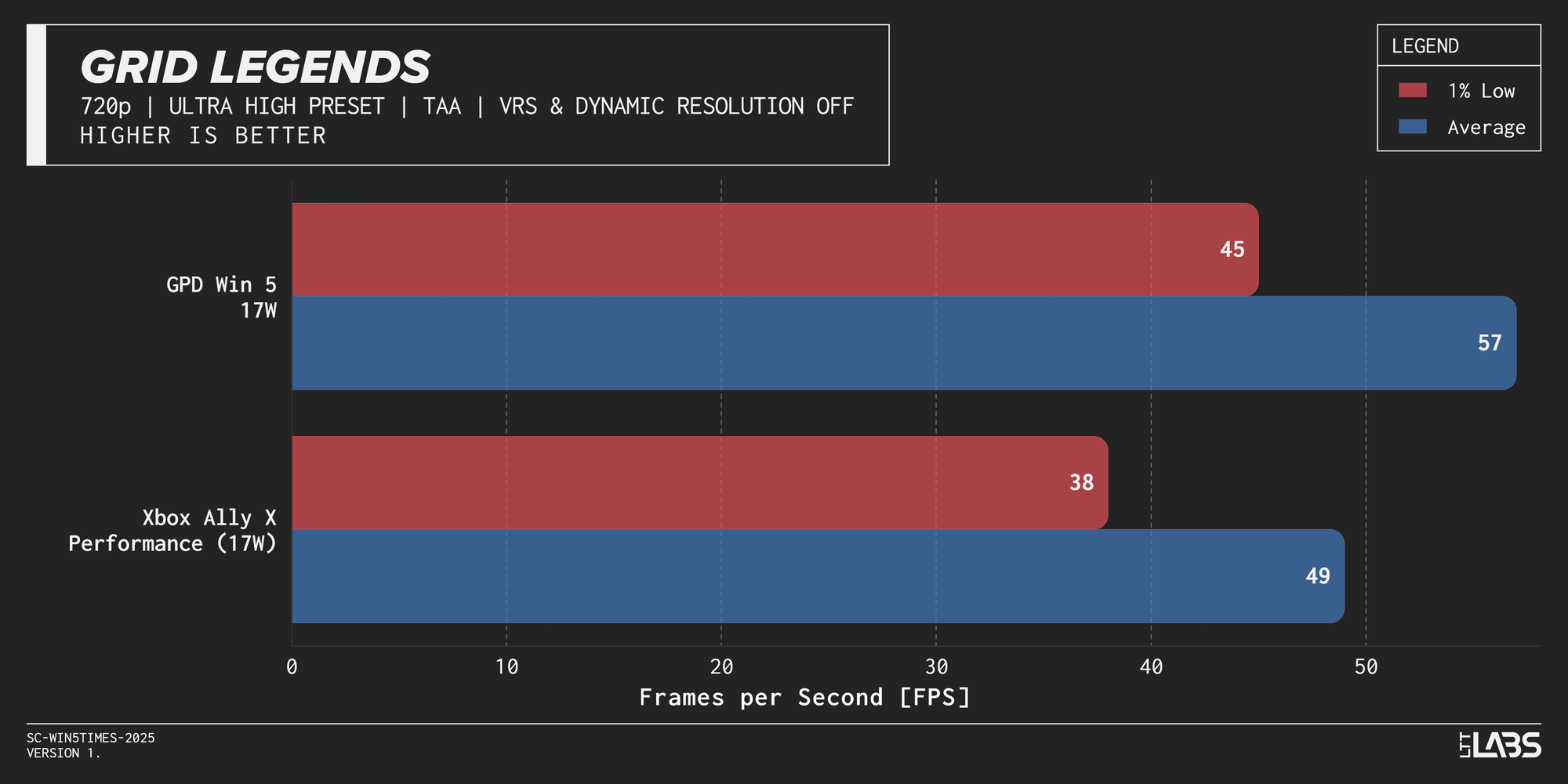
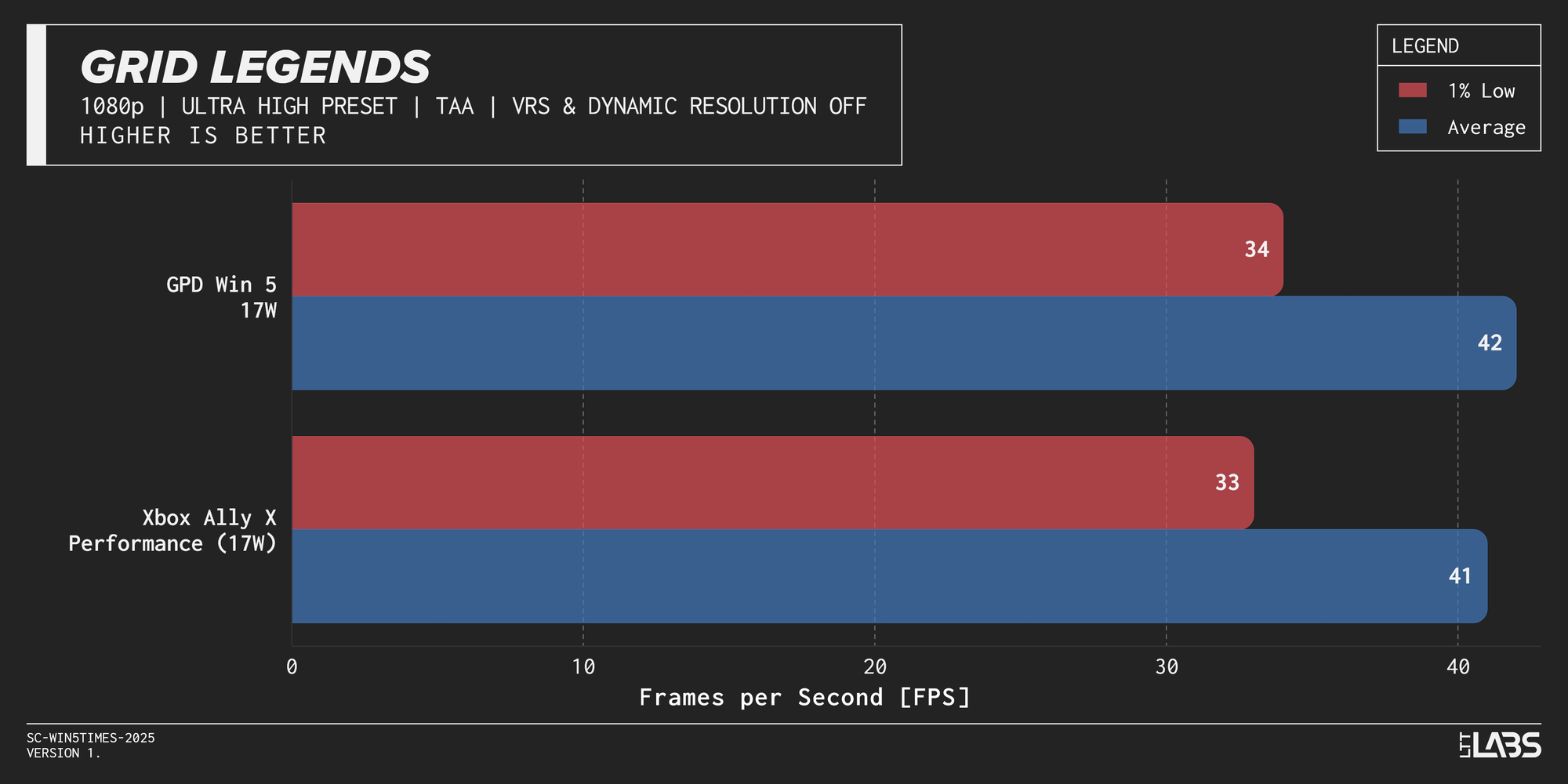
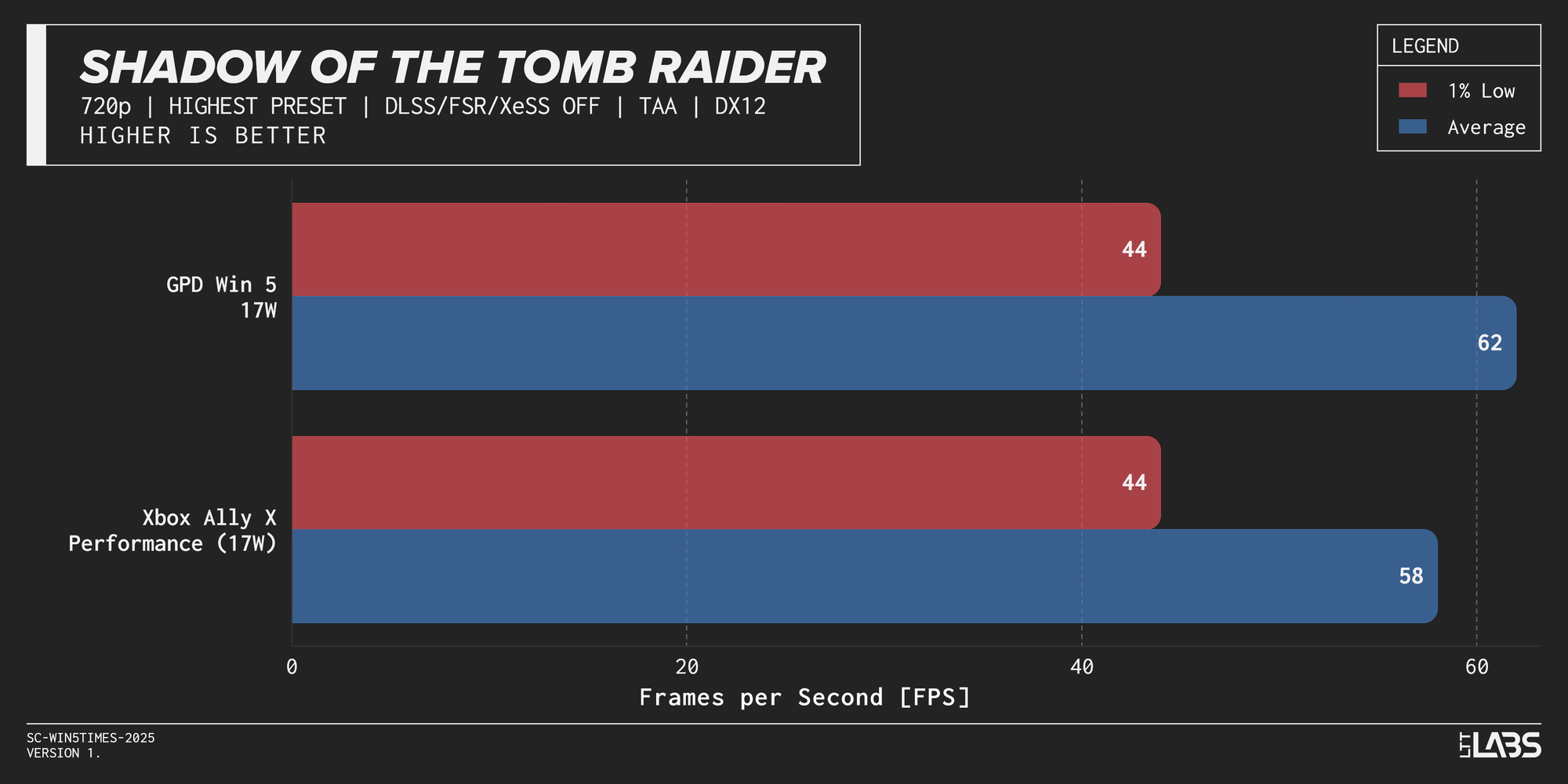
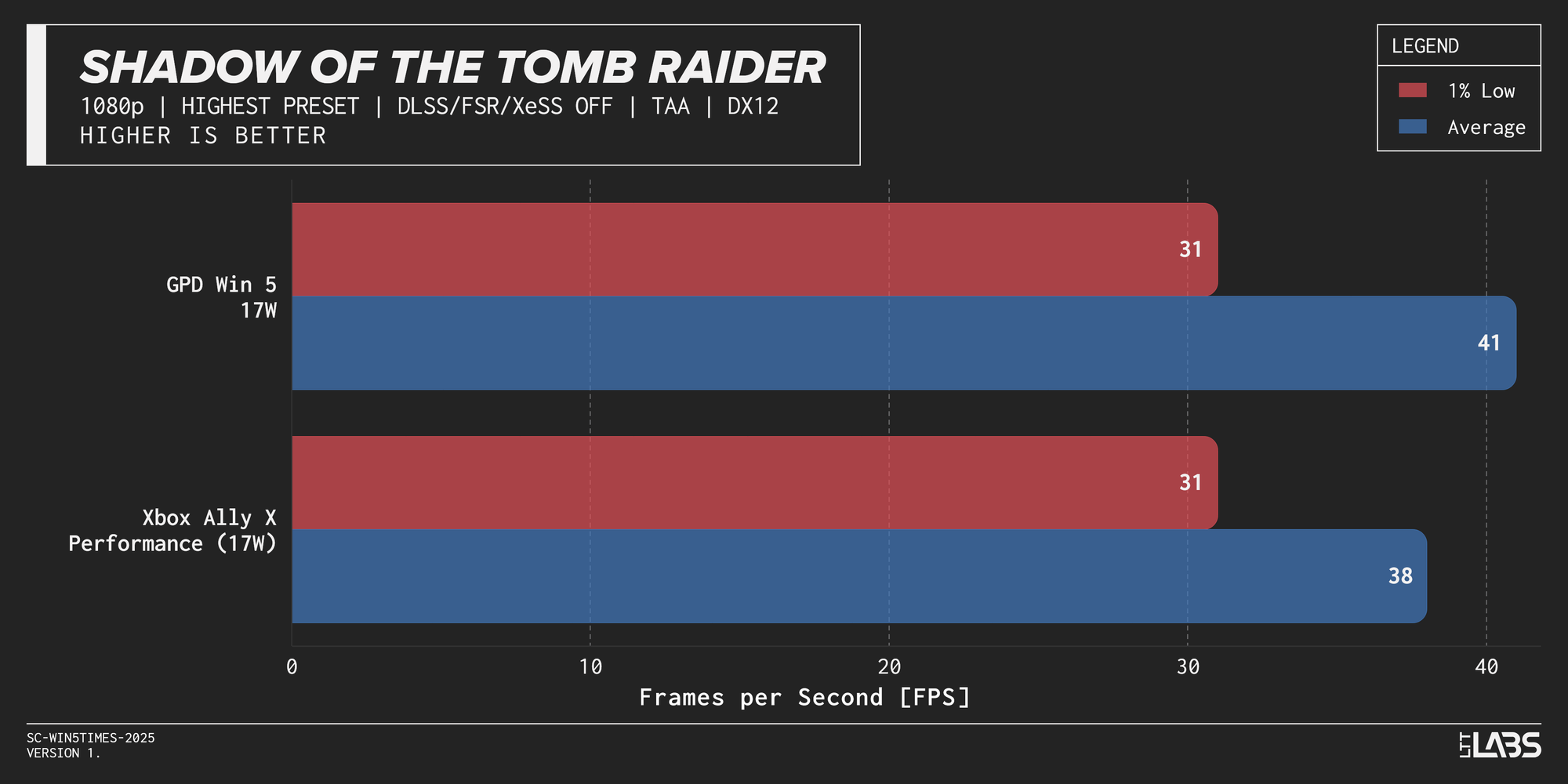
{{slide}}Cyberpunk 2077 720p FPS Graph{{/slide}} {{slide}}Cyberpunk 2077 1080p FPS Graph{{/slide}} {{slide}}Grid Legends 720p FPS Graph{{/slide}} {{slide}}Grid Legens 1080p FPS Graph{{/slide}} {{slide}}Shadow of the Tomb Raider 720p FPS Graph{{/slide}} {{slide}}Shadow of the Tomb Raider 1080p FPS Graph{{/slide}}
Thermals and Acoustics
The Win 5’s cooling system is advertised like something developed with NASA (ignoring the choice to use those eye-searing colors on their indiegogo page), and based on the results, it very well might be.
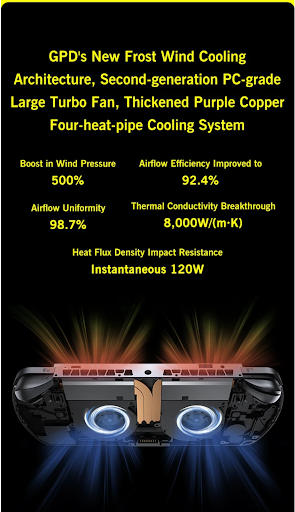
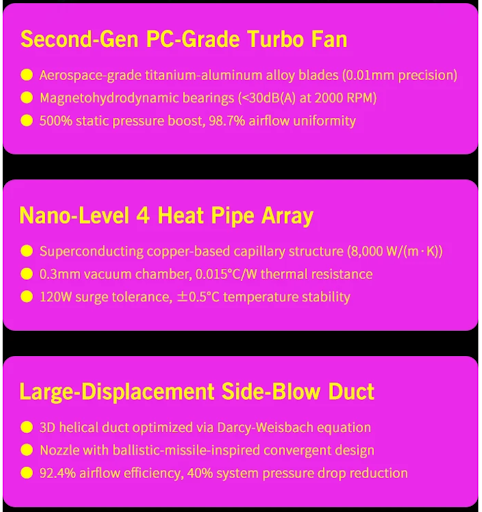
Win 5 Cooling Marketing Materials {{cite}}https://www.indiegogo.com/en/projects/gpdhk/gpd-win-5-the-ultimate-external-battery-handheld#/section/project-story{{/cite}}
At 75 W, the CPU temperature peaks at 81°C with an average of 79°C. Fan noise gets quite audible here. It sounds more like an MSI gaming laptop when it's under full load (quite loud) rather than a handheld. The Xbox Ally X cannot reach this wattage at all, and the temperatures for the Framework Desktop at 120 W were in the same ballpark as the Win 5 {{tooltip:Most likely due to the 120 mm fan, more room to breathe and a beefier cooler.}}while running significantly quieter{{/tooltip}}
At 35 W, both the Win 5 and Xbox Ally X CPUs output the same thermal energy, but the Win 5 runs significantly cooler. It sits just under 60°C for the entire run, and the fans only need a moderate speed to hold that temperature. The Ally X at 35 W peaks at a toasty 92°C with the fans cranked all the way up given that it is running at its full capacity – thermal and otherwise, which makes the Win 5’s thermal headroom at this point very clear. We did not perform any fan noise testing but qualitatively both the handhelds sound more or less comparable at this TDP. Although, the default fan curve on the GPD is quite sensitive and occasionally ramps up the fans during loading screens before going back to the calmer state – sounding more like the Xbox.
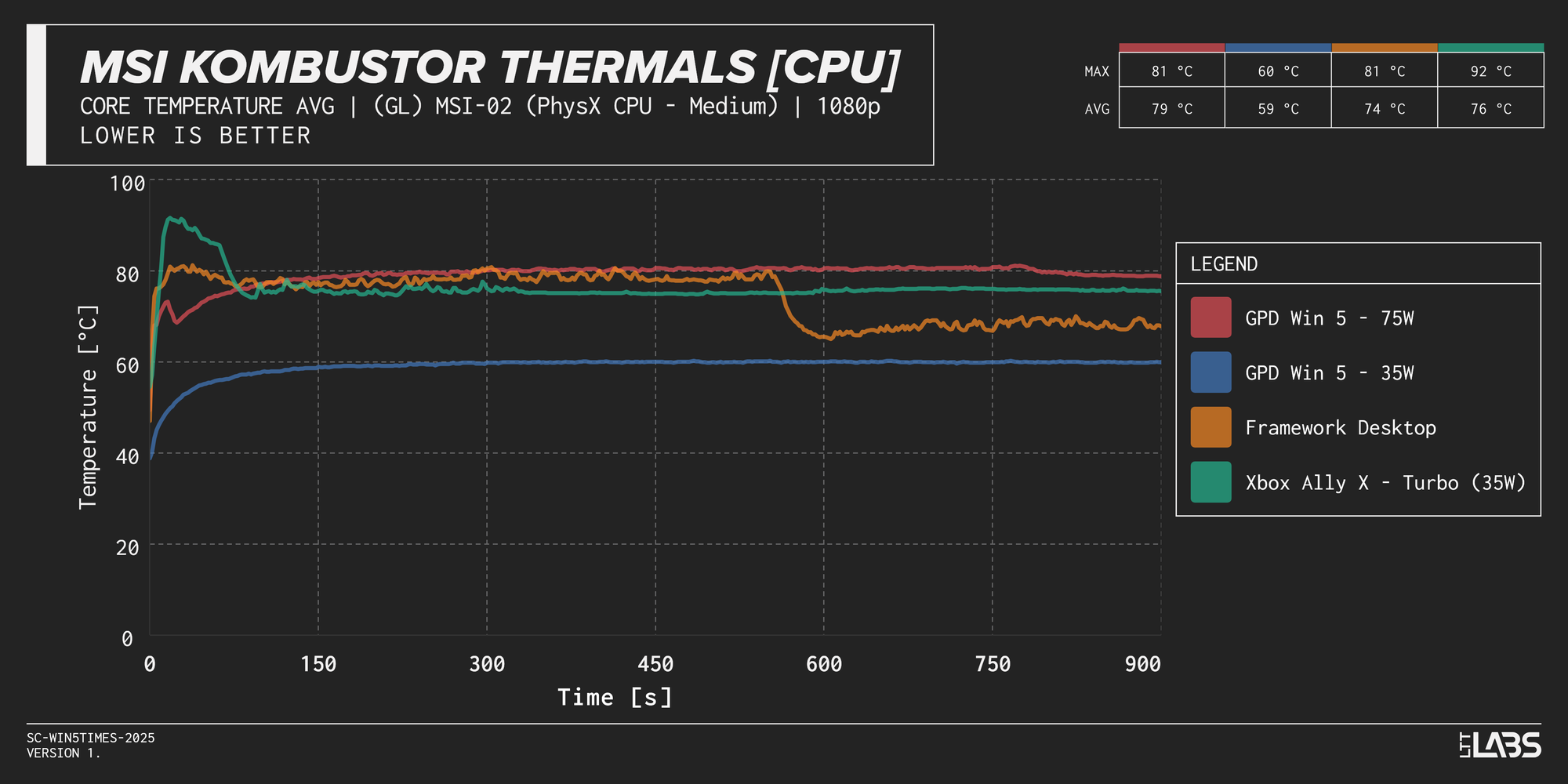
Overall, the cooling solution is well built for the top of the Win 5’s range, giving it plenty of headroom to stay cooler and quieter at lower power levels. With a small reduction in wattage and a little tuning for the fan curve, the Win 5 should stay noticeably quieter while still delivering more than enough performance for most games.
Battery and Charging
Battery Endurance Test
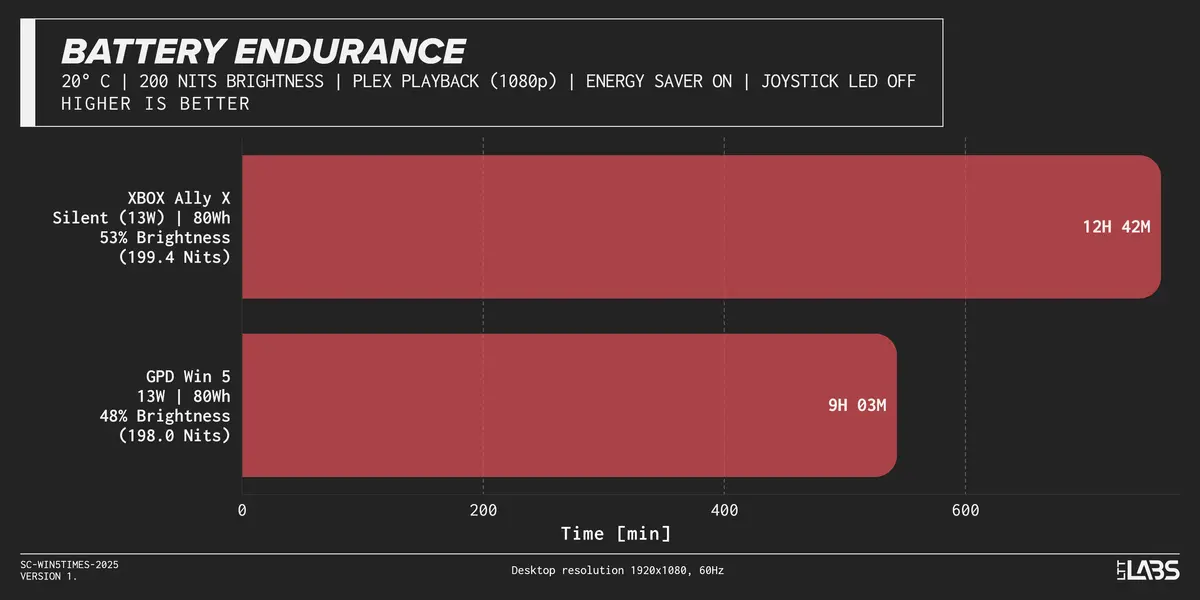
The Win 5’s battery life behaves exactly as you would expect from a device of this calibre. At 13 W in our longevity test, it achieves playback time of just over 9 hours, although the Xbox Ally X lasts significantly longer with almost 13 hours. This could be because the Xbox Ally X caters more to an on-the-go gamer and subsequently is more optimized for efficiency, while the Win 5 seems to have more of a ‘make the fps go up’ philosophy.
Battery Stress Test
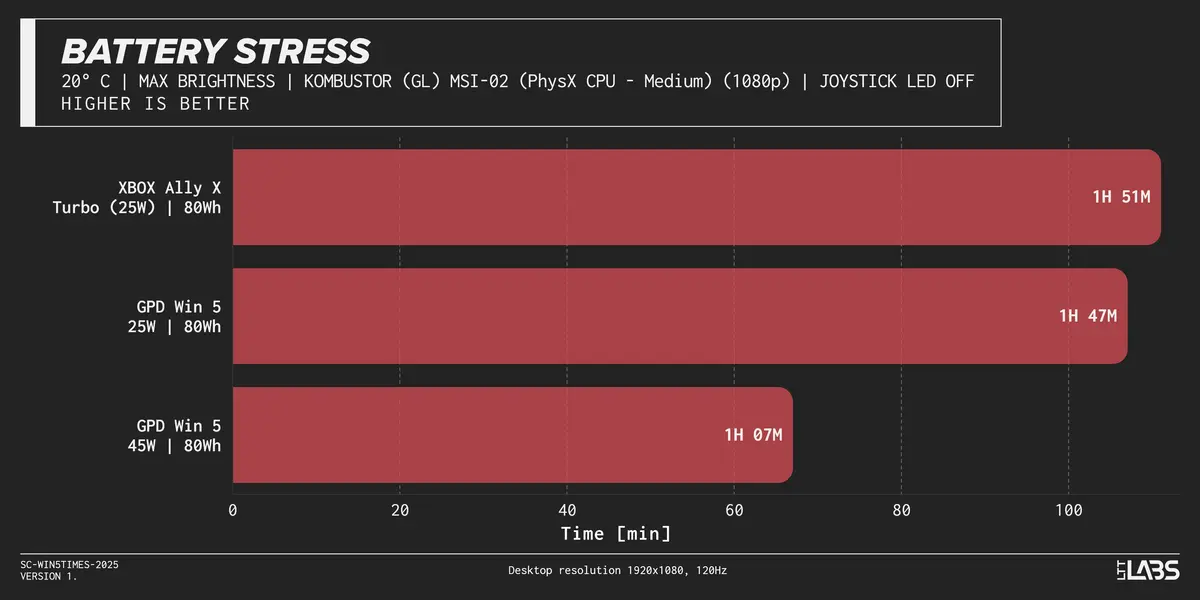
At 25 W in our stress test, which is what most handhelds reasonably operate at when unplugged, both devices reach nearly 2 hours, with the Xbox very narrowly taking the win by 4 minutes. However, these numbers aren’t something we could complain about given the average battery life of handhelds this powerful.
GPD has implemented a dynamic change in TDP when you unplug your device. It goes from the full 75 W to 45 W when unplugged. You could use Motion Assistant to set it back to 75 W after unplugging but realistically you wouldn’t want to because it would drain the battery very quickly. A thing to note here is that though the TDP is set to 45 W for the CPU, it doesn't necessarily mean that it's 45 W for the total system power draw as other hardware components in the system also draw some power. We tested the battery life at 45 W TDP for the CPU at just over an hour.
Charge Time
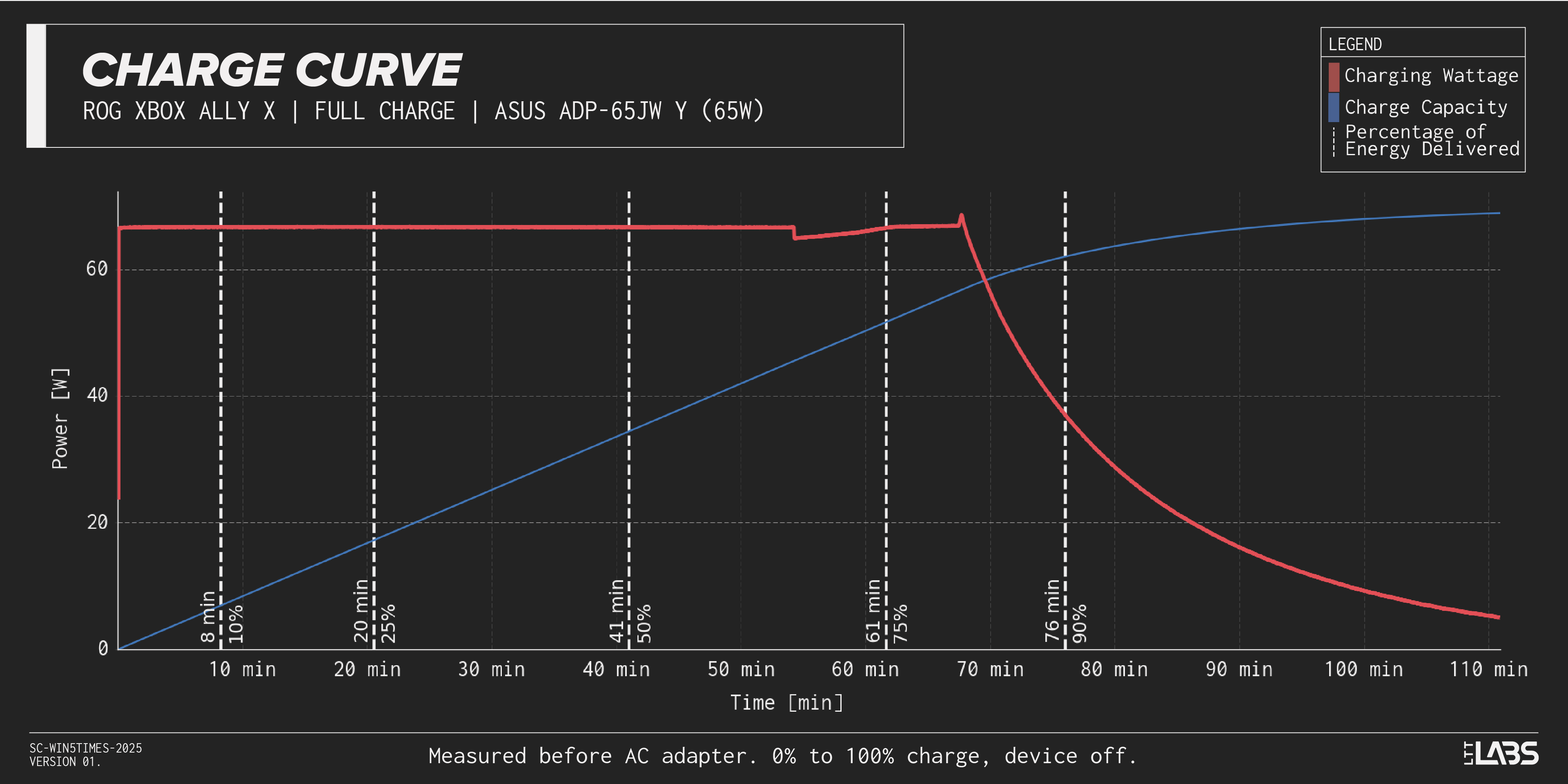
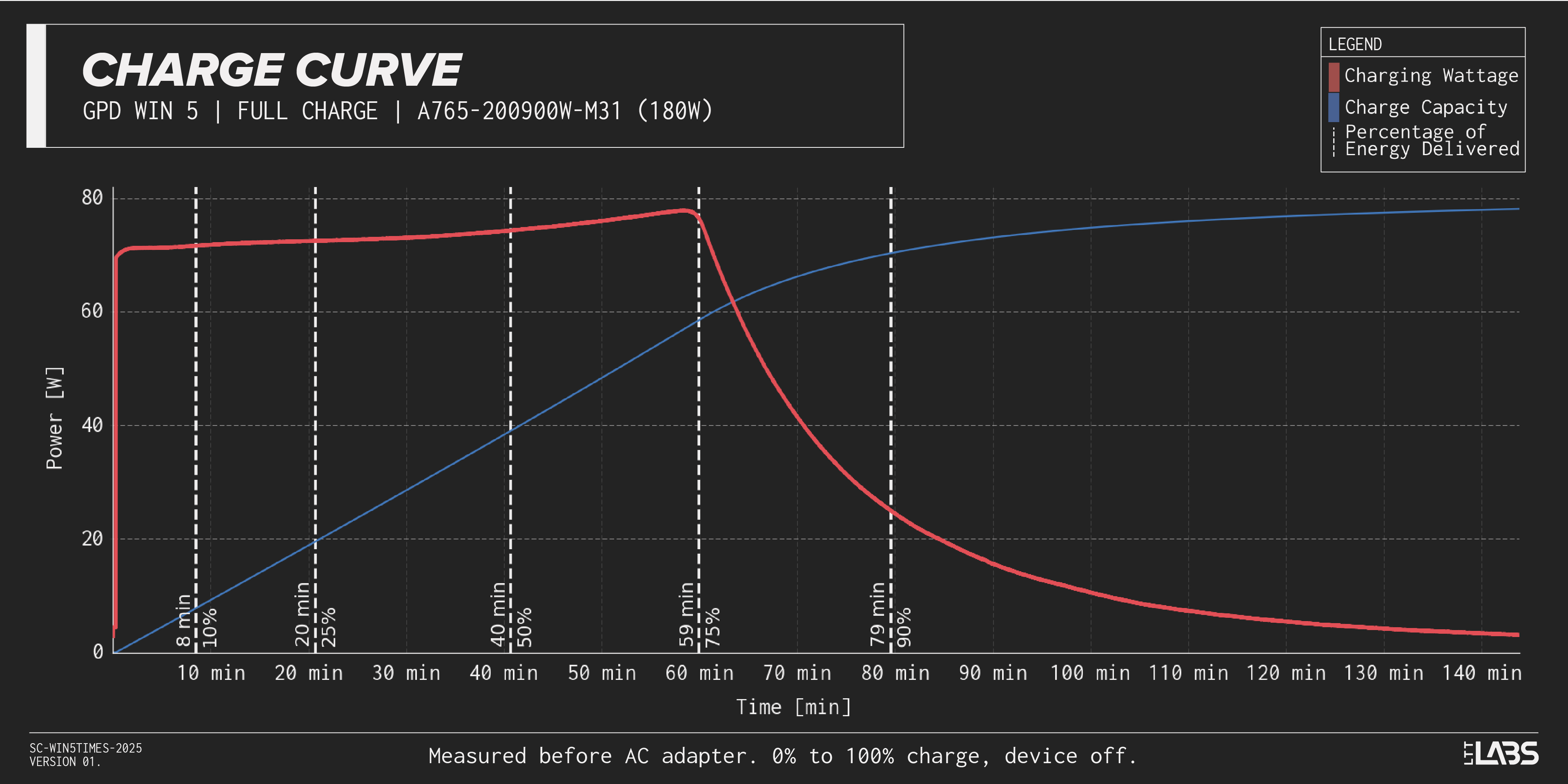
Charging the 80 Wh external battery with the included 180 W adapter of the Win 5 takes half an hour longer than the identically rated 80 Wh Xbox Ally X battery with its included 65 W adapter. However the time difference to reach 90% is much closer – only 3 minutes slower on the GPD. The difference despite the charger specs likely comes down to implementation rather than size.
The Win 5 pulls around 70 W right out of the gate, slowly increasing to just shy of 80 W for almost an hour before it reaches the 75% mark. After that point, the wattage drops sharply and stays low for the rest of the cycle. This long, gentle top-off phase is why the full charge takes significantly more than two hours. The system seems to prioritize cell longevity and heat control over outright speed. The Ally X also starts strong at about 65 W, but it maintains that same wattage for a longer period before tapering off. Its top-off phase is noticeably shorter and less conservative than the Win 5’s, allowing it to reach a full charge in just under two hours despite using the same rated 80 Wh capacity.
{{slide}}ROG Xbox Ally X{{/slide}} {{slide}}GPD Win 5{{/slide}}
Build and Usability
Besides performance, there are quite a few aspects of this device that impressed us. At the risk of sounding like salesmen, here are some of them that really stood out to us:
- The Mini SSD slot is genuinely cool. It is basically a tiny NVMe drive with real PCIe speeds, not a warmed-over microSD replacement.
- The quick swap battery can be a lifesaver during high-wattage sessions. Pop in a fresh pack and you can keep going without living next to a wall socket. Provided you buy the extra $105 USD (oof) external battery.
- The capacitive thumbsticks are based on new technology that makes it possible to have a significantly higher resolution than TMR and HE thumbsticks. They are not susceptible to magnetic interference either, meaning better compatibility with hall-effect triggers. This is a great video if you are curious about how they work.
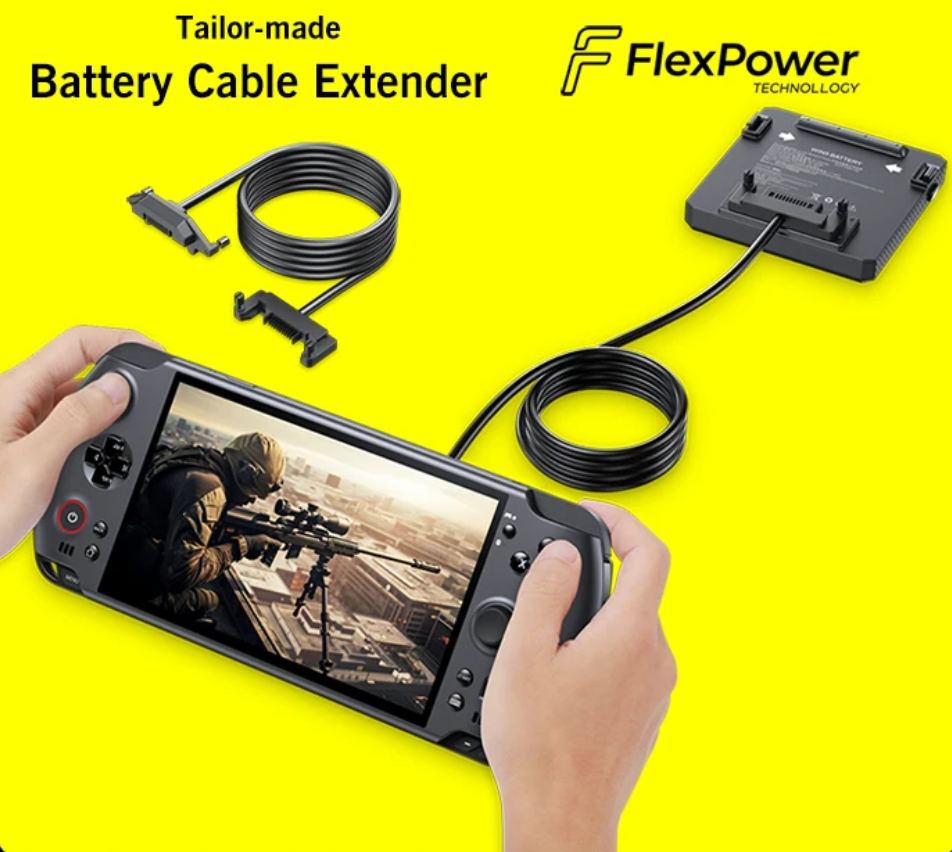
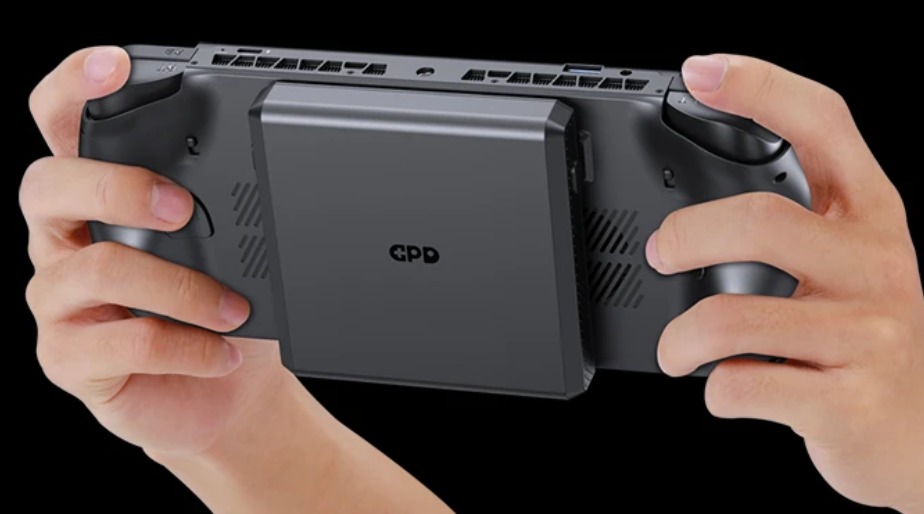
Marketing images of GPD Win 5 battery solution {{cite}}https://www.indiegogo.com/en/projects/gpdhk/gpd-win-5-the-ultimate-external-battery-handheld#/section/project-story{{/cite}}
Smaller quality of life touches like the excellent hall-effect triggers, 6-Axis Gyroscope, configurable VRAM allocation to be ready for future releases, and the included battery extension cable that shifts the weight off your hands all add to the experience. However, the Win 5 is not without compromises:
- The battery system has quirks. Attaching the pack can be finicky and since there is no internal cell, you cannot hot swap it without powering the device off. Again, at $105 USD per pack, the idea of losing one feels like misplacing a piece of your paycheck. If you plan on grabbing extras for long trips, the cost piles up fast.
- The power behaviour is inconsistent. Unplugged, the device dynamically adjusts the TDP to a maximum of 45 W, requiring the user to re-launch MotionAssistant and set it to something higher if they need it. Additionally, loading different profiles does not reliably apply their TDP settings unless the profile has the auto-limit TDP box checked.
- The size and weight make it a handful. At 943 g with the battery attached and no kickstand to support it, the device gets tiring fast if you’re not using the extension cable. For comparison, the Xbox Ally X is 715 g. This contributes to the aforementioned sore arm. With the battery attached using the extension cable, it weighs in at a much more manageable 620 g.
- The 100W PD charging is only available through the top USB4 port. Unfortunately, the bottom USB-C is restricted to data USB functionality such as DisplayPort Alt mode, connecting peripherals and interacting with the GPD dock.
- GPD currently does not have an on screen display GUI for configuring the handheld which makes quick TDP adjustments on the fly impossible.
Now we finally arrive at the elephant in the room: the price.
Power, Price, and the Future
The Win 5 is one of those pieces of technology that makes you laugh, then stare, then wonder how something this expensive ended up in the handheld category. Price ranges from an already high $1674 USD (oof) to a whopping $3100 USD (big OOF) depending on configuration! This puts it in the same cost bracket as full PC setups and plenty of high-end gaming laptops. The weight almost feels symbolic, as if the device is physically reminding you of the financial burden you just took on.
The Win 5 exists because GPD clearly wanted to throw as much raw performance and cutting-edge technology into one handheld. The impressive performance of the Strix Halo APU, a huge external battery, capacitive thumbsticks, a mini SSD slot with real PCIe speeds, and a cooling system rated for numbers that usually belong in desktops is absolutely bonkers. It is not trying to be practical or elegant. It is trying to prove a point about what is technically possible.
Other companies like Ayaneo and OneXPlayer already have similar devices in the pipeline, which means this will not remain a one-product phenomenon for long. A new segment of “desktop performance handhelds” might be emerging, and the Win 5 feels like the opening act.
Hope is not lost for anyone who looked at the price and felt their soul exit their body. Strix Halo-level performance will not stay locked behind a premium forever, but looking at how many mini PCs are already shipping with these chips at equally steep prices, it might take longer than we would like.
The Win 5 does not need to be anything more than an all-out showcase of what can be done when limitations are ignored. It is heavy, expensive, and occasionally inconvenient, yet it is also one of the most exciting handhelds that we’ve tested. The next challenge for the industry is to make that power attainable without demanding a second mortgage.