LTT TrueSpec Cable Voltage Drop Testing
With the release of the LTT TrueSpec cables, the 40 Gbps data transfer is neat, but I figure it is interesting to look at the power delivery characteristics of the cables. This is a test of the cables we had around with some equipment that most people don't have access to.
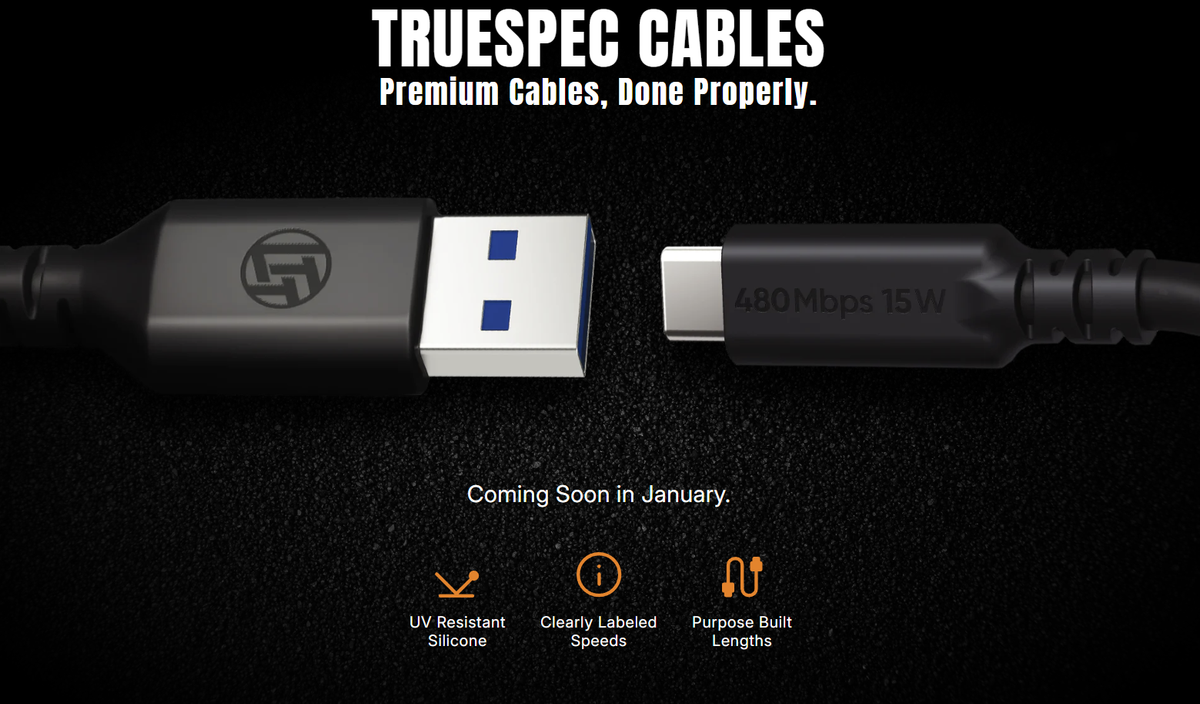
With the release of the LTT TrueSpec cables, the 40 Gbps data transfer is neat, but I think it is interesting to look at the power delivery characteristics of the cables. This isn't a full study of the LTT cables or the alternatives, but a test of the cables we had around with some equipment that most people don't have access to.
Voltage drop is inherent with any cable(conductor), but ideally it can be minimized to limit waste heat and keep devices running smoothly. We'll look into this below, but also let us know if you'd like us to look into anything else!
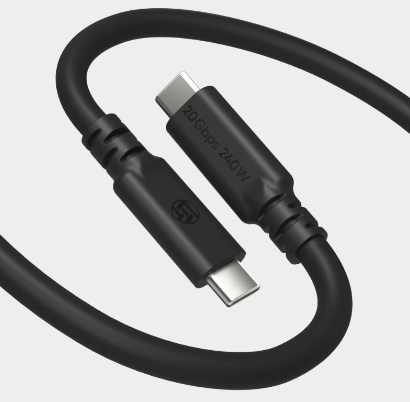
Below is an interactive CT scan of the 10 cm LTT TrueSpec cable.
Test Setup
The test setup is quite simple, I would create a block diagram but everything is in a straight line so a list should do. Each fixed output voltage is selected on the USB-C trigger board with a momentary switch while every other device is controlled using the Chroma PowerPro 5 software. The Chroma equipment has recently been calibrated by an ISO/IEC 17025 and NIST traceable laboratory and found within tolerance.
- AC Source - Chroma 61507 - Used to generate a 115 V 60 Hz signal and simulate 'wall power'.
- USB-C PD Power Adapter - UGREEN 500W Charger - One of the few USB-C Power Delivery(PD) 240 W capable devices that we have available. Note that only the C1 port is capable of 240 W.
- USB-C Cable - The cable under test.
- USB-C Trigger Board - ChargerLAB POWER-Z SINK240 - This 'negotiates' the various fixed voltage modes of the USB-C power adapter. This provides output terminals with which to connect the programmable load.
- Programmable DC Load - Chroma 63640-80-80 - Capable of up to 80 V and 80 A, up to 400 W.
Testing
For each cable, the trigger board was used to select one of the advertised fixed output voltage USB-C PD Power Data Objects(PDOs). The PDOs are communicated by the power source(USB-C power adapter) to define the available voltage, current, and power modes of the power adapter and cable. With the appropriate PDO selected, the programmable DC load in constant current(CC) mode increments through the available current range in steps of 200 mA. For the 5 V mode this is a maximum of 3 A, while the 20 V and 48 V modes are capable of 5 A output.
The UGREEN Nexode 500 W and the USB-C trigger board are capable of selecting other fixed voltages like 9 V, 12 V, 15 V, 28 V, and 36 V, but the three tested voltages of 5 V, 20 V, and 48 V are representative. As can be seen in the graphs, the voltage drop of a cable is {{tooltip: within reason}}independent{{/tooltip}} of the voltage and solely dependent on the current. The voltage drop in the cables is predominantly governed by Ohm's law as shown below. Voltage is only a function of the resistance of the conductors, and the amplitude of the current being transmitted.
{{blockLatex}}V = I * R{{/blockLatex}}
Cables
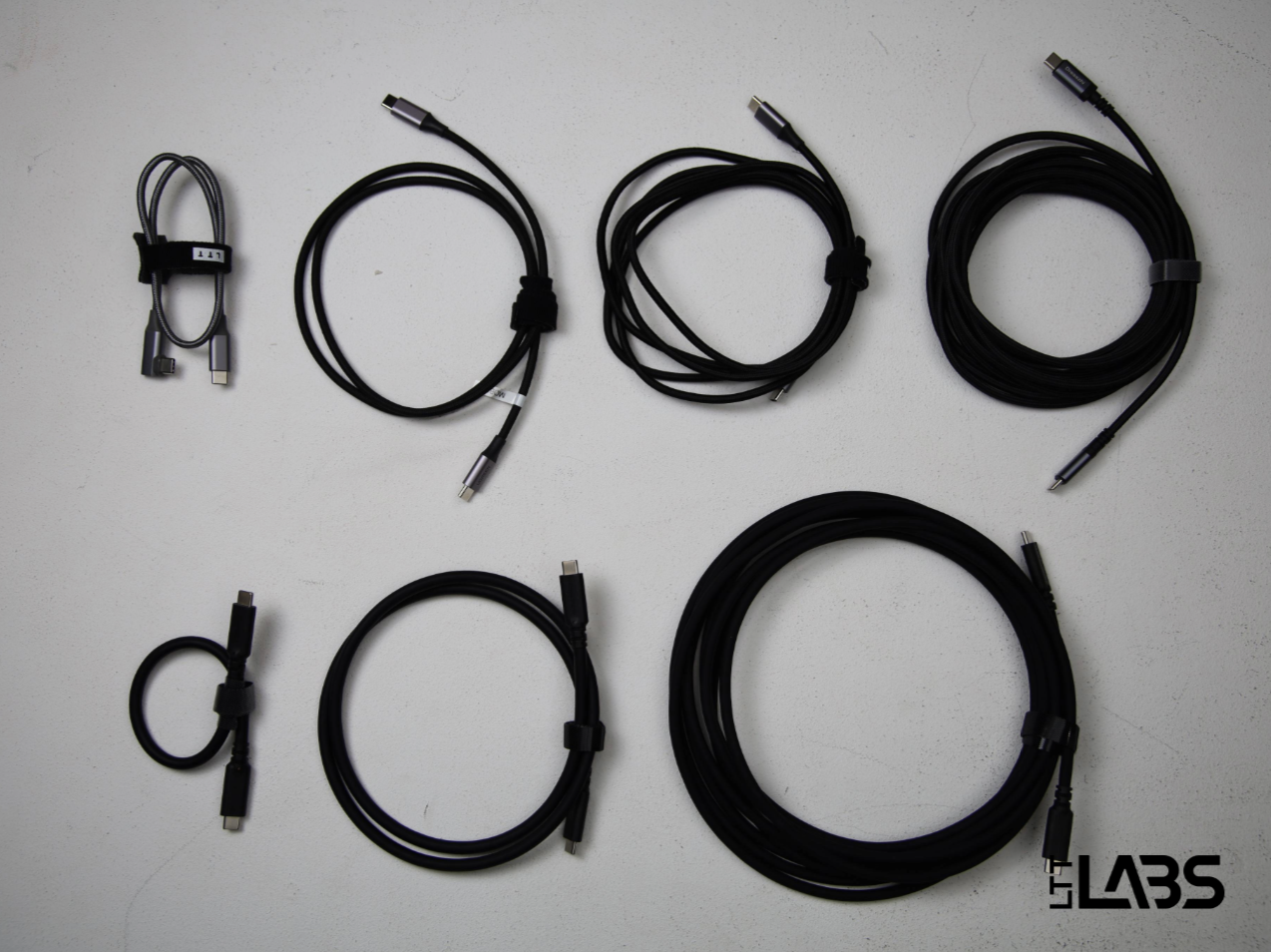
We've selected a few cables that we have around along with the new LTT TrueSpec collection at a few lengths. Note that this is not a comprehensive test against the best of the competition. I've included the information that I could find on them below.
- 20 cm LTT TrueSpec Cable
- 100 cm LTT TrueSpec Cable
- 500 cm LTT TrueSpec Cable
- {{tooltip: We could not find a page for this item, see image below.}}40 cm Anker Cable (Right Angle){{/tooltip}}
- 100 cm UGREEN 100 W Cable
- 200 cm UGREEN 100 W Cable
- 500 cm Dreaazhi Cable
Test Results
All graphs show the current along the x-axis(horizontal) while the y-axis(vertical) of these graphs represents the absolute voltage measured. Note that even when outputting 0 A, the voltage measured is not equal to the nominal 5 V, 20 V, and 48 V. There is some inherent imprecision to power supplies, and voltage drop of the test equipment, this is discussed more in the appendix.
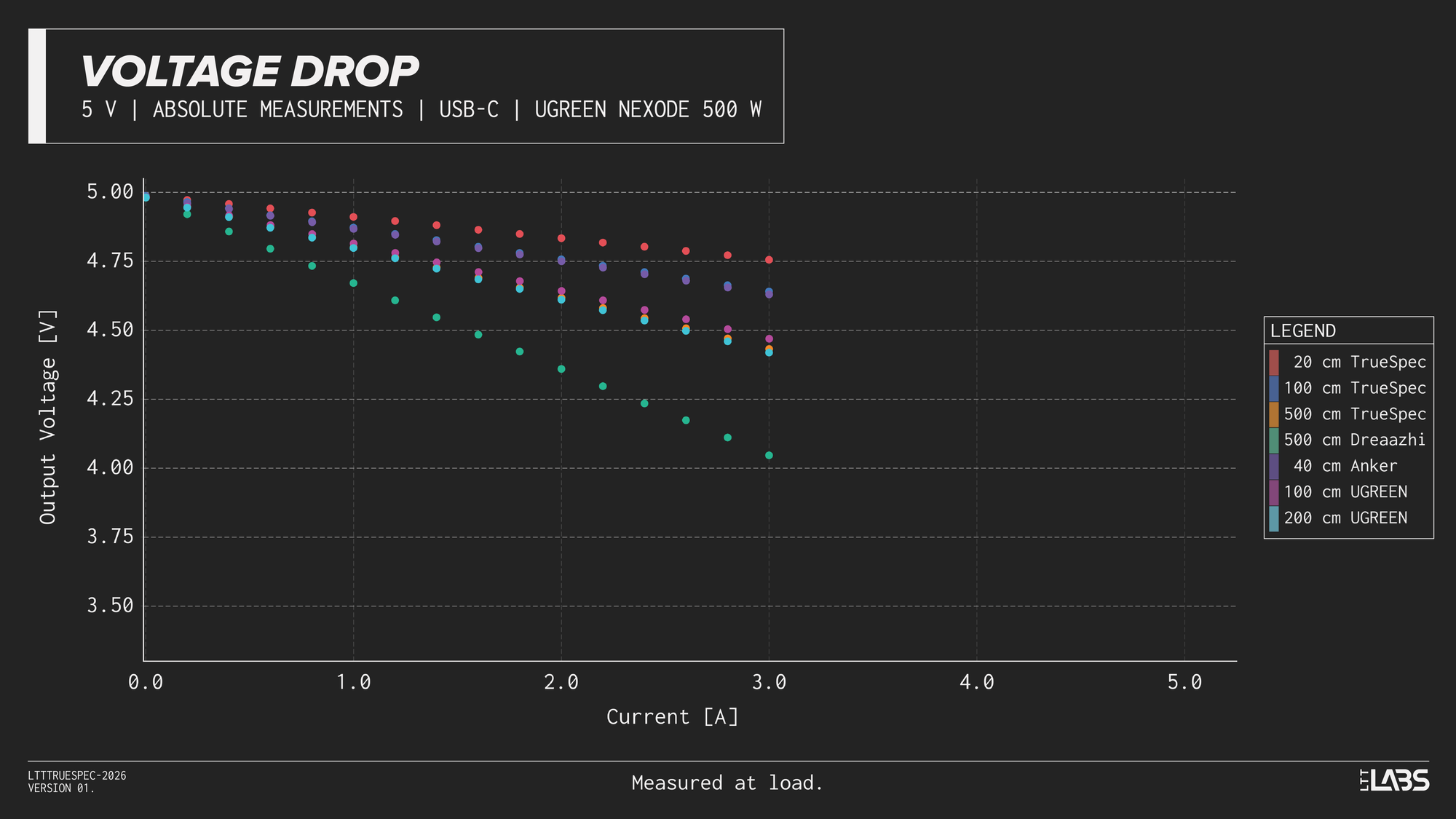
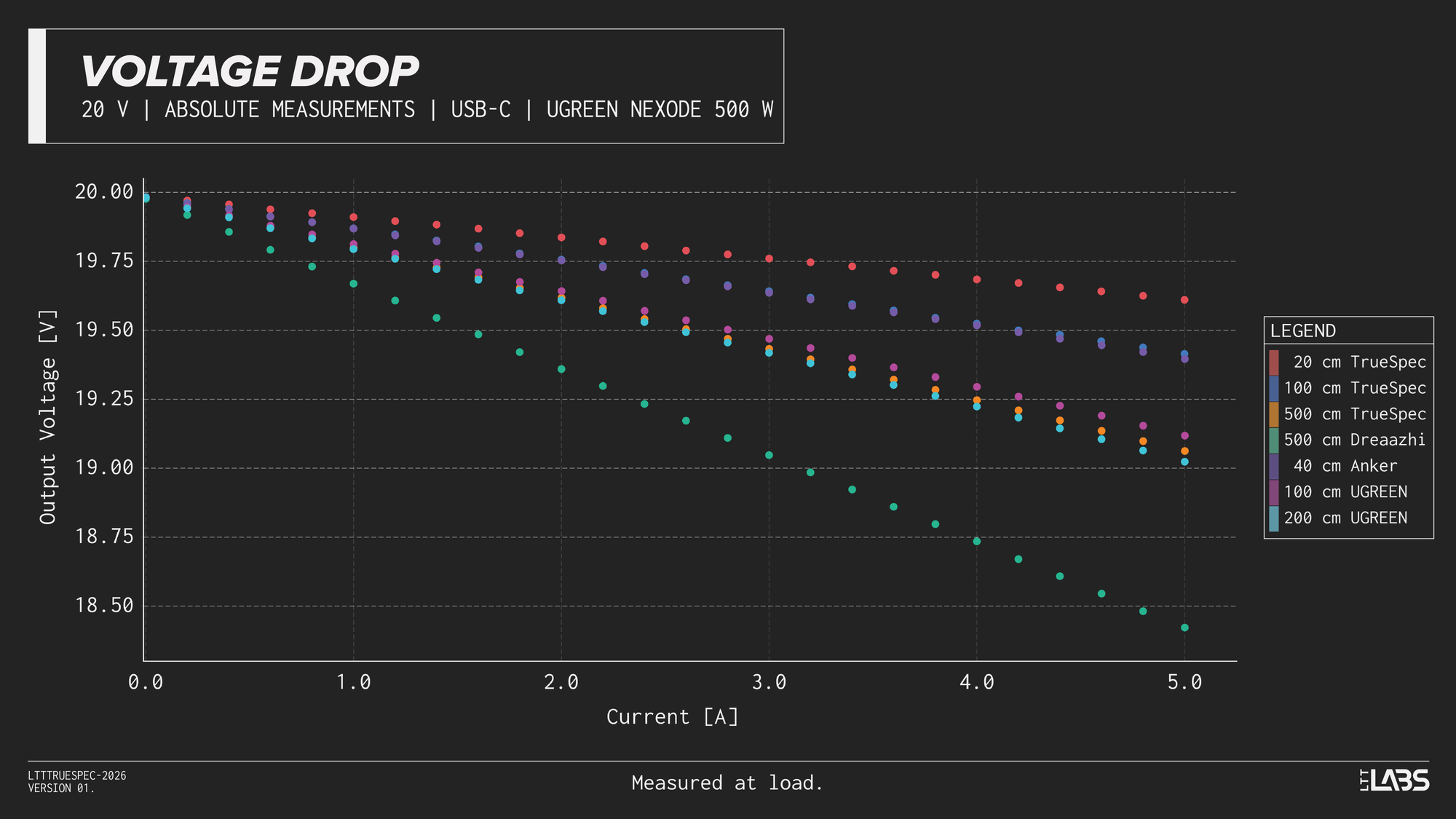
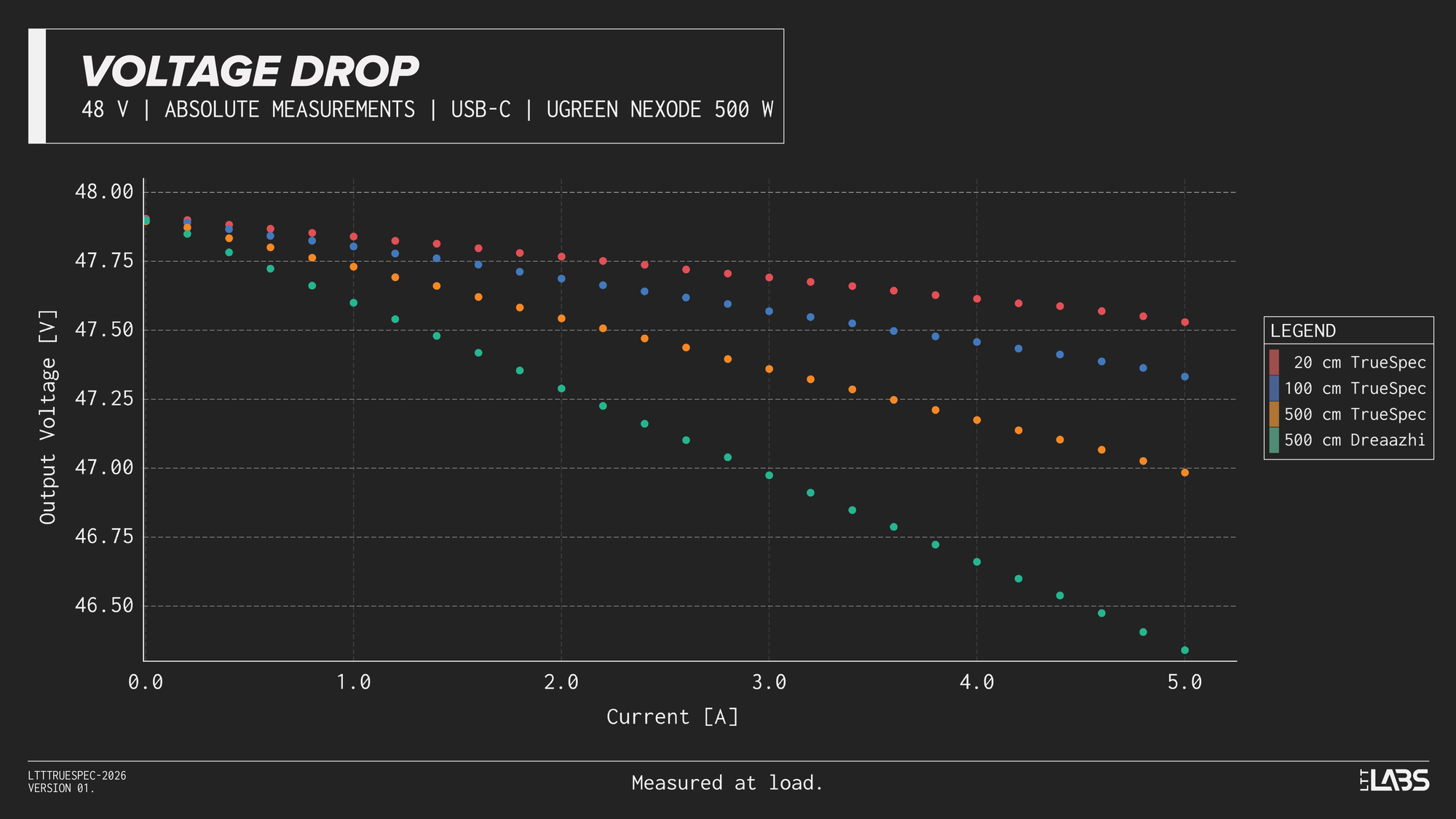
{{slide}}5 V Voltage Drop Results{{/slide}}{{slide}}20 V Voltage Drop Results{{/slide}}{{slide}}48 V Voltage Drop Results{{/slide}}
The graphs below show the voltage drop of each series of measurements relative to the measured voltage when delivering 0 A. In 'plain English', I shifted the data so that they all 'begin' in the top left corner. This is to account for the minor differences in output voltage and doesn't affect the comparative observations.
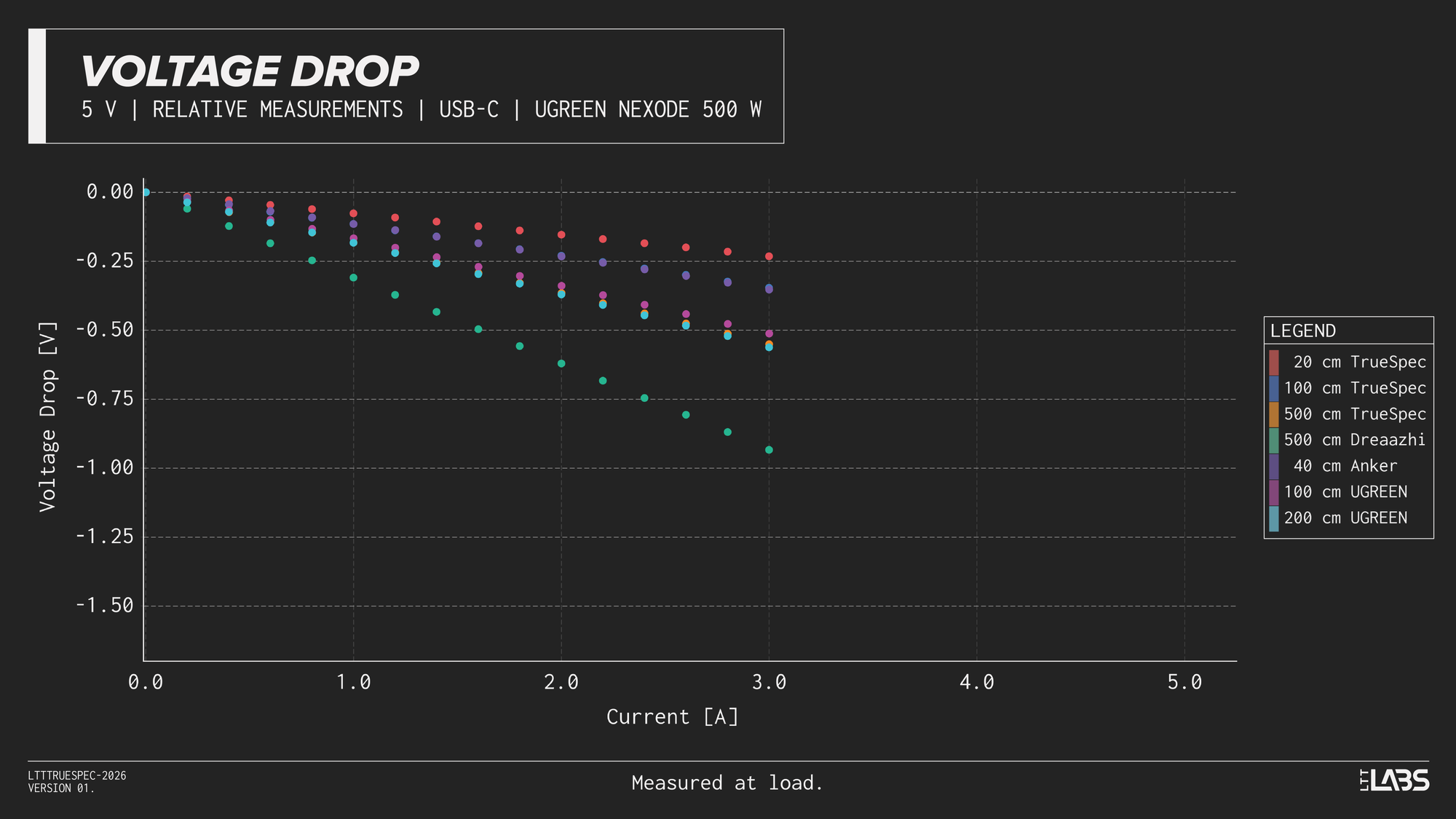
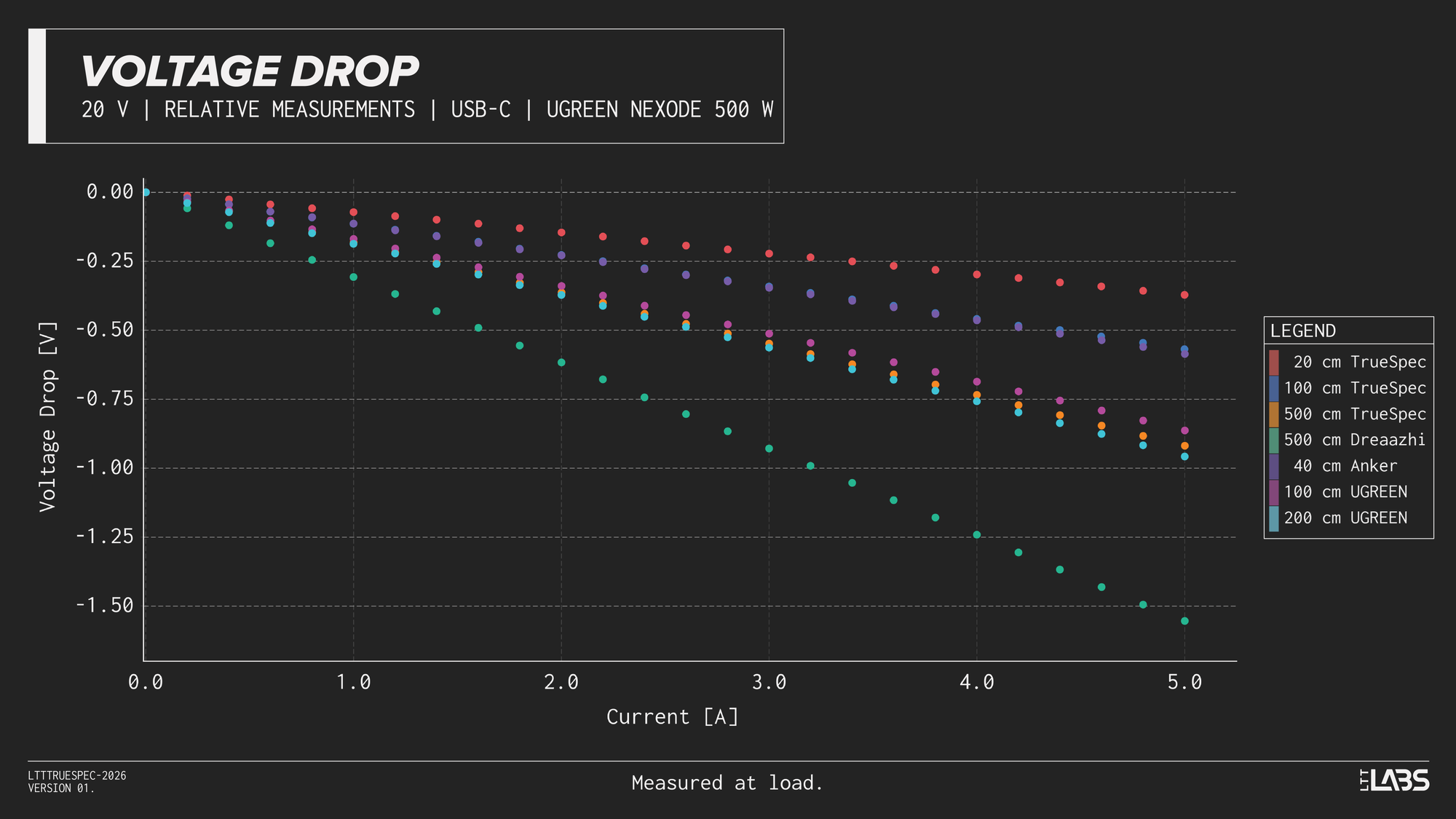
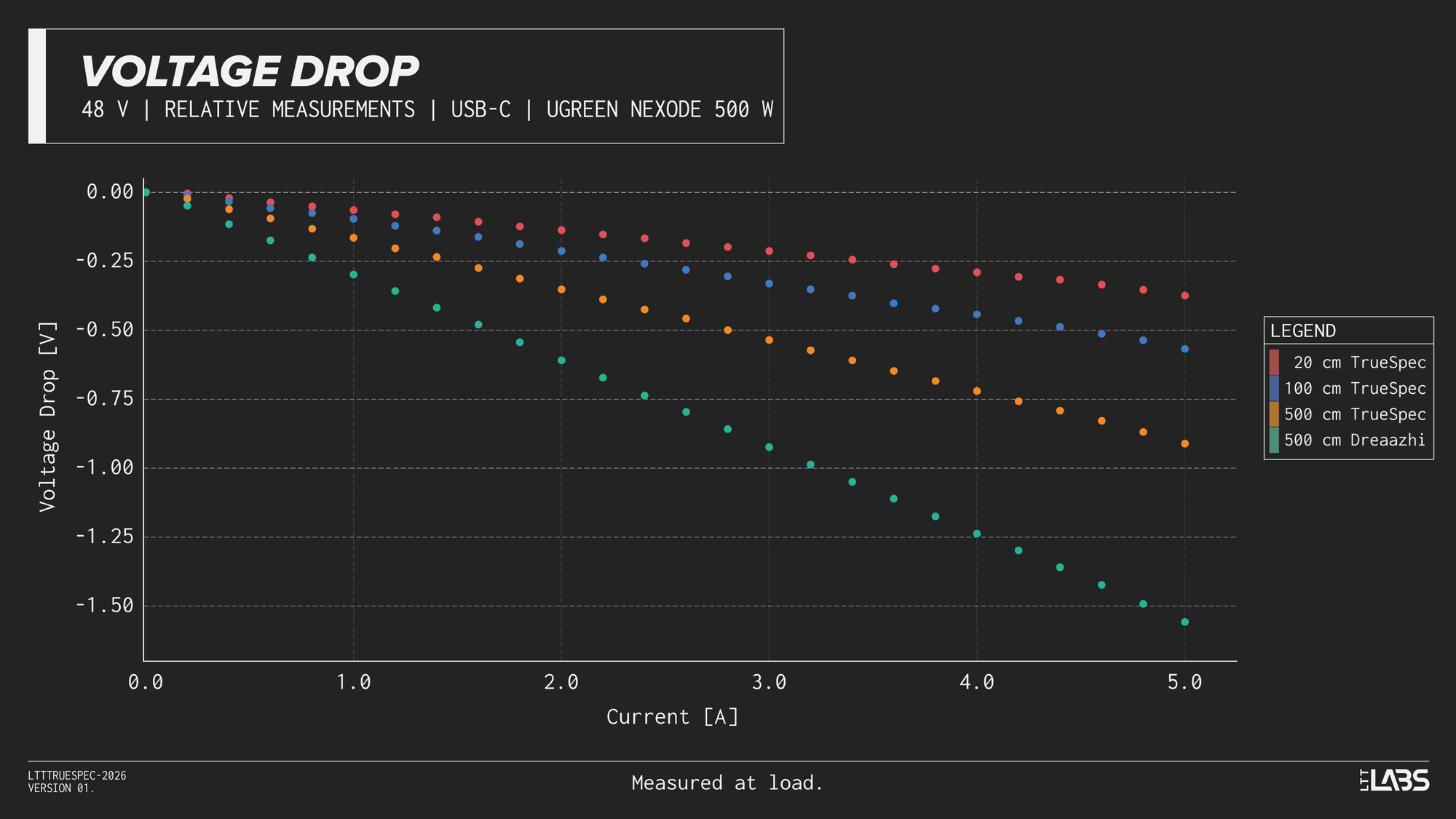
{{slide}}5 V Voltage Drop Results{{/slide}}{{slide}}20 V Voltage Drop Results{{/slide}}{{slide}}48 V Voltage Drop Results{{/slide}}
Voltage Drop
As can be observed, the LTT TrueSpec cables are capable of maintaining a high output voltage through the whole range of lengths, from {{tooltip: They actualy come in lengths of 0.1 m to 5.0 m but we only tested the 0.2 m.}}0.2 m to 5.0 m{{/tooltip}}. The 100 cm TrueSpec cable produces similar results to the shorter 40 cm Anker cable. The linear relationship of V = I x R can be observed in all cables, as current increases, the measured voltage drop also increases. Note that these results are affected by the voltage drop of the power adapter and test equipment, but it will be equivalent for all cables tested.
Compatibility
The keen eyed will notice that there are fewer cables included in the 48 V graphs. This is because within the USB PD specification there is the Standard Power Range(SPR) for 0 - 20 V and Extended Power Range(EPR) for 0 - 48 V. This is often not marked anywhere on the cables themselves but you may find that your USB-C cable is only capable of SPR and will not supply anything over 100 W(5 A at 20 V). Output voltages of 28 V, 36 V, and 48 V enabling power delivery up to 140 W, 180 W, and 240 W require the USB-C power supply and USB-C cable to be capable of EPR.
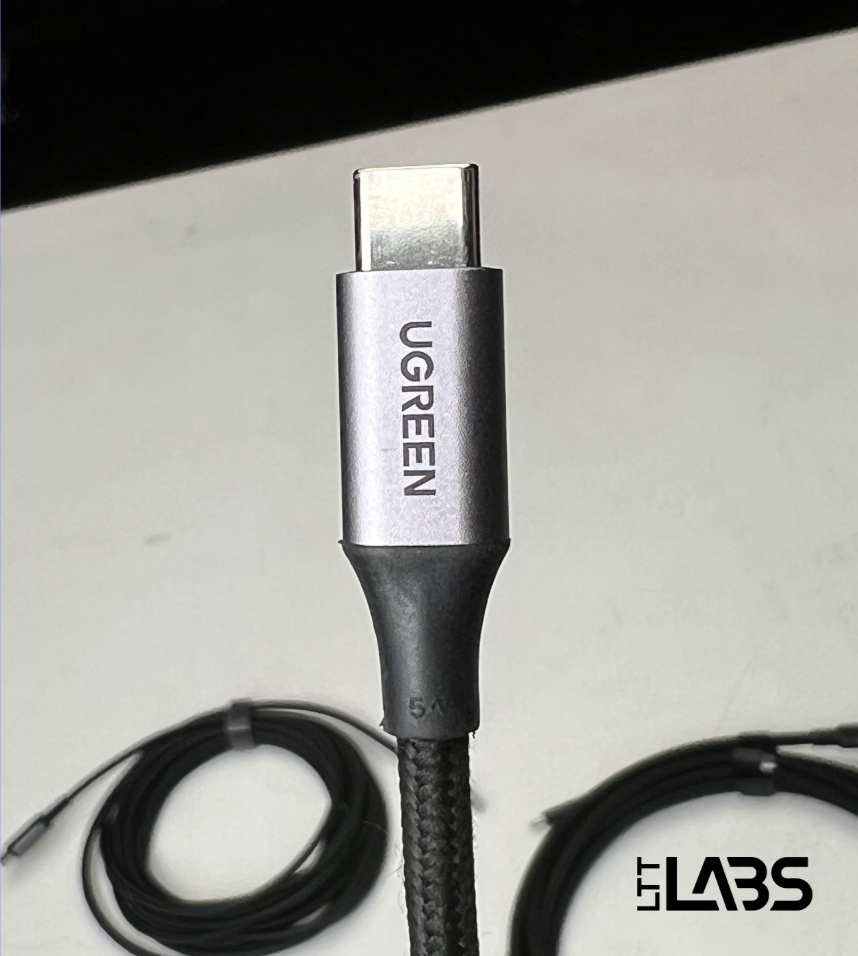
We were actually surprised to discover that our 100 cm UGREEN cable which looks very new, very capable, and can deliver 5 A(as marked, see image below), is not capable of EPR. It turns out that you actually require a newer UGREEN cable to enable EPR. Thankfully these ones now have "240 W" labeled on them.
Does this Matter?
It is unlikely that this level of voltage drop within a USB-C cable will have a major impact when charging your phone or laptop. Cables with higher voltage drop will leech off some power as you charge, but it will likely be below 5% of the total when operating at 5 A.
Furthermore, many devices can now negotiate in the Programmable Power Supply(PPS) and Adjustable Voltage Supply(AVS) modes which allow the device being charged to request specific voltages. This allows them to optimize the voltage(in 20 mV or 100 mV steps) that they're receiving so that they can convert the power or charge batteries more efficiently. Another benefit of this is that the device being charged can compensate for any cable voltage drop by simply requesting a slightly higher voltage.
Cables with low voltage drop can provide more of a benefit in voltage sensitive applications. Some test & measurement equipment, audio equipment, and single-board computers are far more sensitive to voltage fluctuations and the voltage drop they experience when drawing a high load could affect performance. This may also be the case with budget equipment that doesn't incorporate a lot of protections or power conditioning components.
As we will clearly have a {{tooltip: the tester and author of this article doesn't "directly" benefit from the sales of these cables, but it should be considered}}conflict of interest{{/tooltip}} in determining the performance or utility of these cables, I will leave all conclusions to the audience, but I hope that these measurements are helpful and certainly let us know if there is anything else {{tooltip: we're not going to CT scan 1000 batteries}}you'd like us to test!{{/tooltip}}
Check out the LTT TrueSpec cables on LTTStore.com!
Appendix - Voltage Source Drop
It should be noted that not all of the voltage deviation measured or displayed in these measurements is caused by the cable under test. The power adapter(charger) will have some level of voltage drop with increasing load, as well as many other components of the system. However, we are able to account for much of the voltage drop induced by the test setup by using the same equipment and procedures for all measurements. Further setup refinements will be required for direct comparison to results from other sources.
The main contributors to this voltage drop will be the contact resistance of the two USB-C connectors, inherent voltage drop due to the internal resistance of the power source(USB-C power adapter), and the voltage drop of the SINK240W trigger board.
Considering the shortest cable we tested(LTT TrueSpec 20 cm) as a 'reference', we can see that even with a short cable, there is nearly a 0.25 V drop inherent to the test setup when delivering 5 A. This voltage drop should be considered for the all measurements above.