Pixel 10 Pro Fold Test Results
Further in-depth results of the Pixel 10 Pro Fold and Pixel 9 Pro Fold to accompany the Pixel 10 Pro Fold ShortCircuit video.
This is a second-of-its-kind post on the LTT Labs website where we're talking about the test results we got from the new Google Pixel 10 Pro Fold.
As with our iPhone 17 series test results post, some of the formatting and presentation of this post isn't in its final form, but this should give you a chance to review the results all in one place and without having to pause the video.
Battery Discharge Test
Battery Discharge Test Procedure
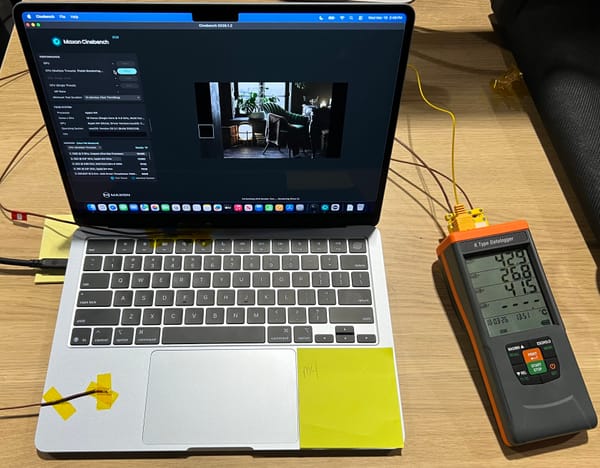
We were unable to use our standard procedure of testing with the Plex app as the app would crash upon opening. Therefore, we reverted to our previous procedure for both devices. It instead uses the VLC Player app to stream from the Plex server.
While we were not able to match the battery test results achieved by Google, they use a different procedure, which is detailed on their website.
To summarize the differences, Google's battery drain test involves a mix of activity such as talk, data, standby, and use of other features (including YouTube video streaming). Additionally, all settings are left at default, which includes automatically enabling Battery Saver when the battery gets low.
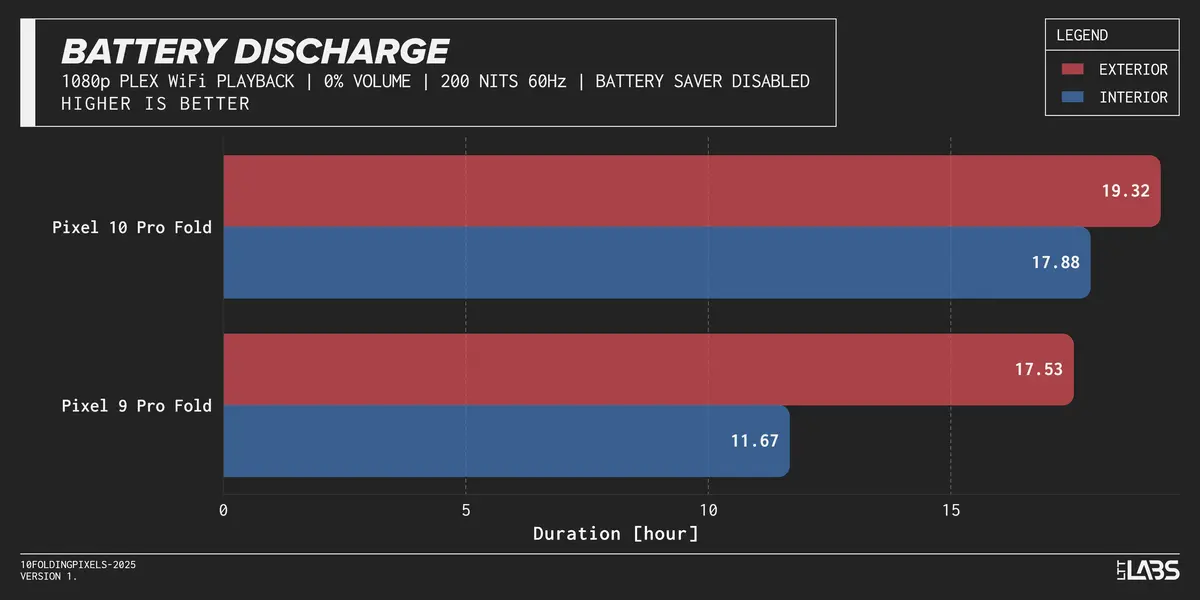
Battery Discharge Test Results
Pixel 10 Pro Fold - Folded | Pixel 10 Pro Fold - Unfolded | Pixel 9 Pro Fold - Folded | Pixel 9 Pro Fold - Unfolded | |
|---|---|---|---|---|
Duration [min] | 1159 | 1073 | 1052 | 700 |
Duration | 19h 19m | 17h 53m | 17h 32m | 11h 40m |
- While still not a market leader in terms of battery life, the Pixel 10 Pro Fold does offer improvements over its predecessor, the Pixel 9 Pro Fold.
- Unsurprisingly, streaming video while the phones on the internal display took a large toll on the battery life compared to streaming video on the external display.
- The difference in test duration between using the internal display and external display are suspect. Both phones were tested twice and their second set of results only heightened the confusion. The Pixel 9 Pro Fold lost 5h 32m of battery life when testing on the internal display while the Pixel 10 Pro Fold lost 1h 15m - a substantial difference.
Battery Charge Test
Tests in the charts below were conducted with adaptive charging modes disabled and the devices powered off. These charts may require a little bit of time to read and analyze, see this previous article for context.
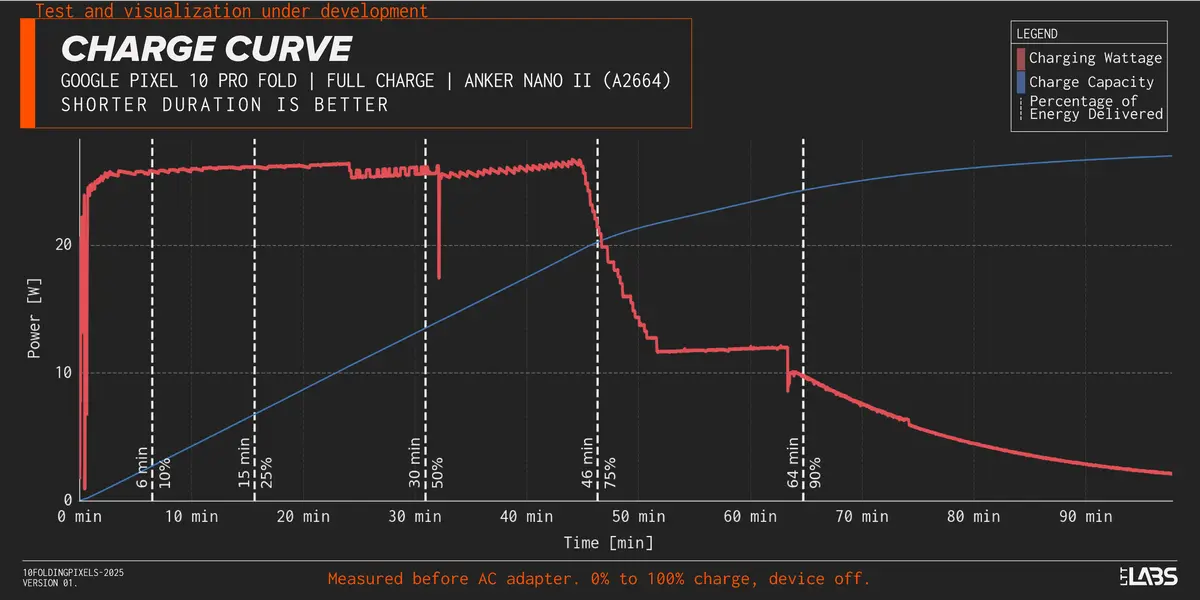
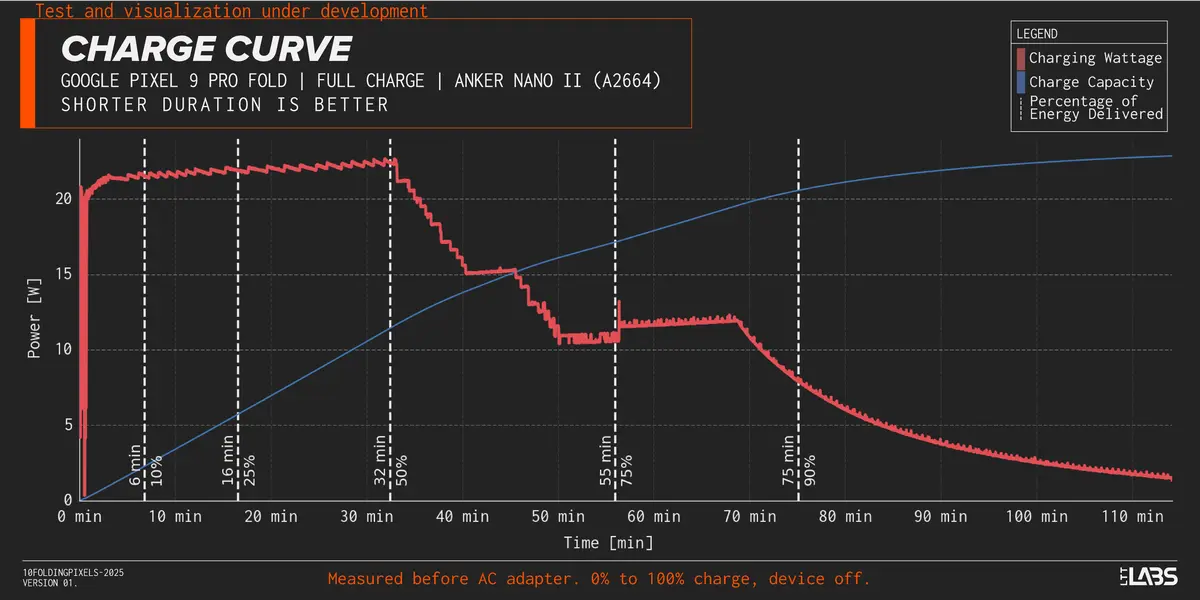
{{slide}}Google Pixel 10 Pro Fold Charge Curve{{/slide}} {{slide}}Google Pixel 9 Pro Fold Charge Curve{{/slide}}
All tests in the table below were conducted with the Anker NANO II 45W (A2664) charger. All adaptive charging modes and features were disabled and the devices were powered off.
Pixel 10 Pro Fold | Pixel 9 Pro Fold | |
|---|---|---|
Charge Duration | 1h 38m | 1h 55m |
- Note that these charge curve graphs were created with measurements using the Quarch QTL2843 on the input side of the AC adapter, not measuring the USB-C power.
- The test results in the table are slightly informative, but with the aggressive battery protection employed by most devices the total duration is less meaningful than looking at the entire charging curve.
- In the charts above, we can see that the Pixel 10 Pro Fold was able to pull a few extra watts and remain near its peak charging wattage for longer than the Pixel 9 Pro Fold, This allowed a faster charge time, despite it having a slightly larger battery (5015 mAh typical vs 4550 mAh typical).
- We were also able to confirm Google's claim of 50% charge in 30 minutes for the Pixel 10 Pro Fold.
Benchmarks
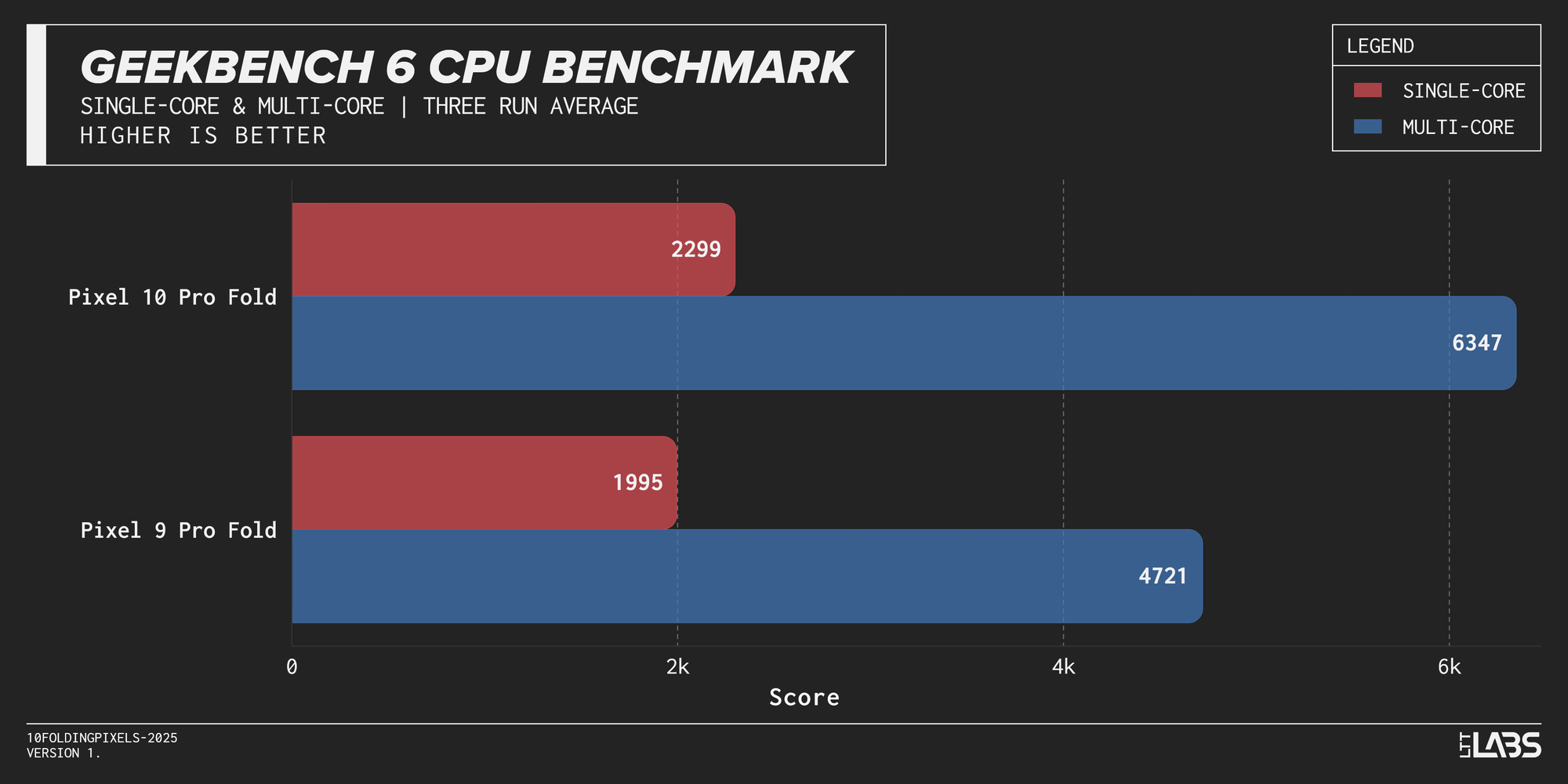
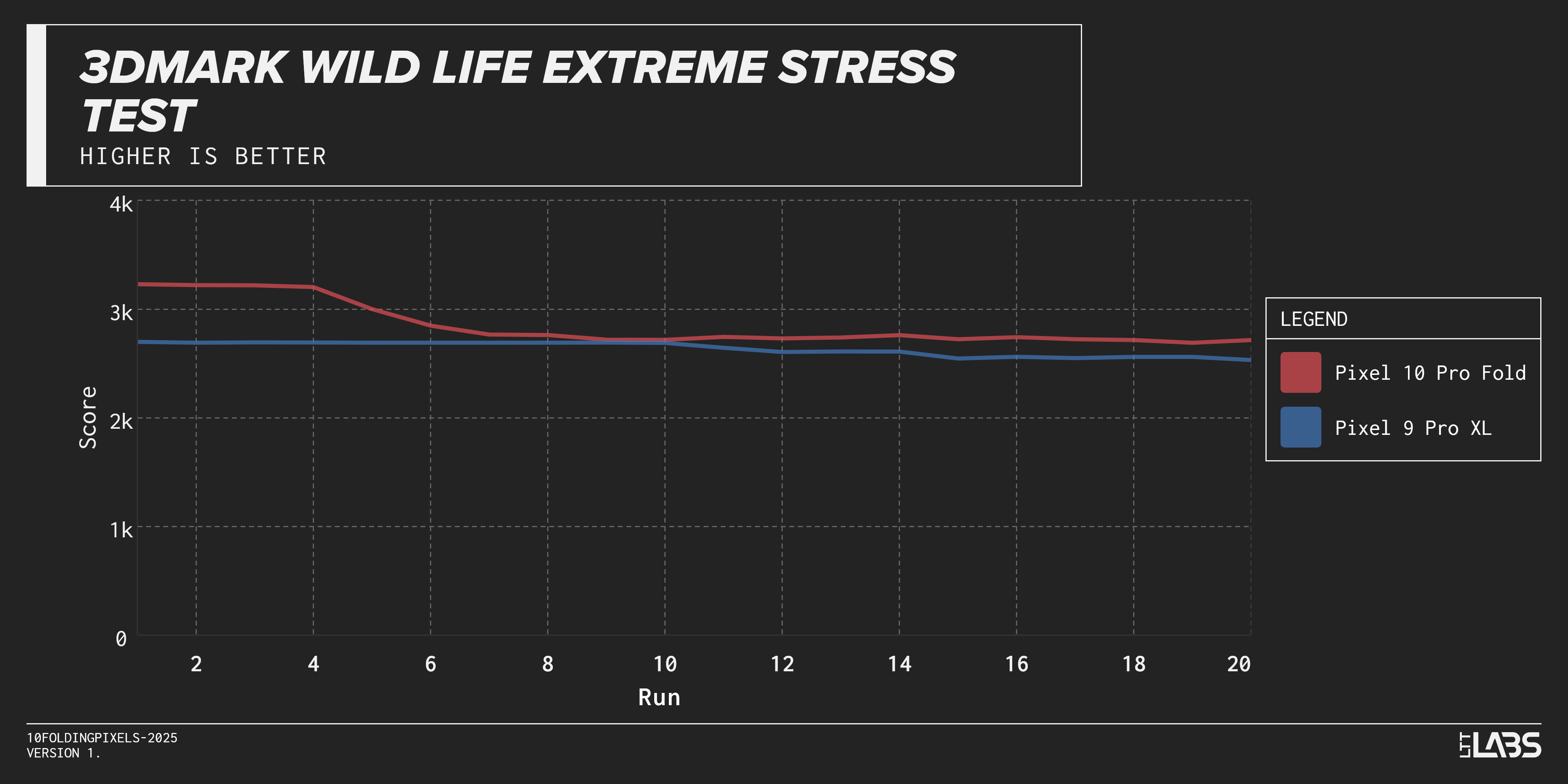
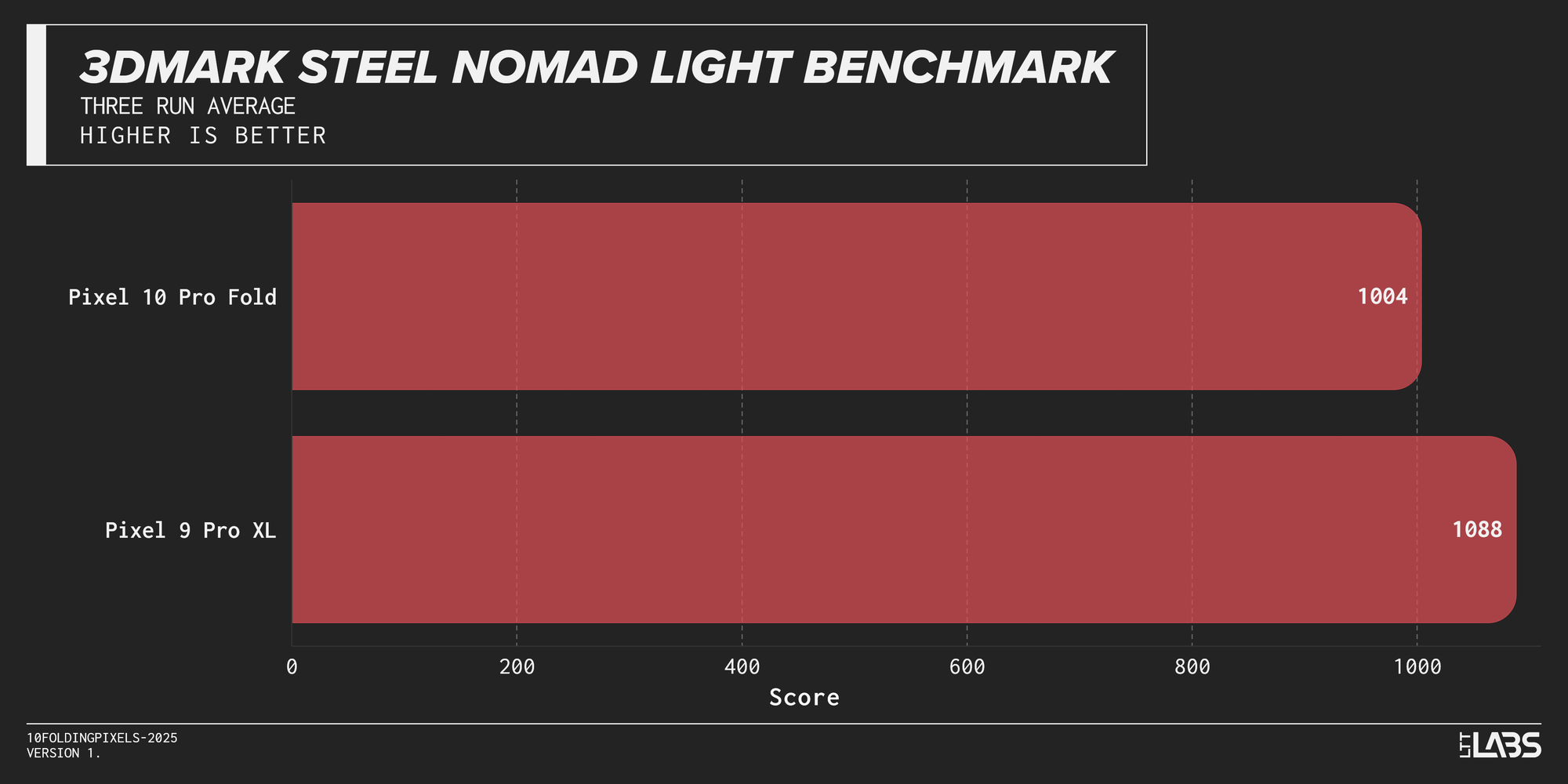
{{slide}}Geekbench 6 CPU Benchmark Graph{{/slide}} {{slide}}3DMARK Wild Life Extreme Stress Test Graph{{/slide}} {{slide}}3DMARK Steel Nomad Light Benchmark Graph{{/slide}}
CPU Benchmarks
Pixel 10 Pro Fold | Pixel 9 Pro Fold | |
|---|---|---|
Geekbench CPU Single-Core | 2299 | 1995 |
Geekbench CPU Multi-Core | 6347 | 4721 |
- As expected due to the inclusion of Google's new Tensor G5, the Pixel 10 Pro Fold performed much better than the Pixel 9 Pro Fold in both single-core and multi-core Geekbench 6 tests.
GPU Benchmarks
Unfortunately, we were not able to test the Pixel 9 Pro Fold with 3DMark as the app would not load past the splash screen. For a different, but similar, comparison device, we used the Pixel 9 Pro XL in its place. It sports the same Google Tensor G4 and Titan M2 security coprocessor as the Pixel 9 Pro Fold.
Pixel 10 Pro Fold | Pixel 9 Pro XL | |
|---|---|---|
3DMark Steel Nomad Light | 1004 | 1088 |
3DMark Wild Life Extreme Stress Test
Pixel 10 Pro Fold | Pixel 9 Pro XL | |
|---|---|---|
Average | 2848 | 2635 |
Minimum | 2690 | 2531 |
Maximum | 3229 | 2698 |
- Similar to the other Pixel 10 series phones, we did not see great results when it came GPU performance in Steel Nomad Light, with the Pixel 10 Pro Fold performing slightly worse than the Pixel 9 Pro Fold.
- The Pixel 10 Pro Fold did offer slightly better performance over a sustained load and maintained fairly steady results, as can be seen from our still-experimental line graph.
Display Luminance
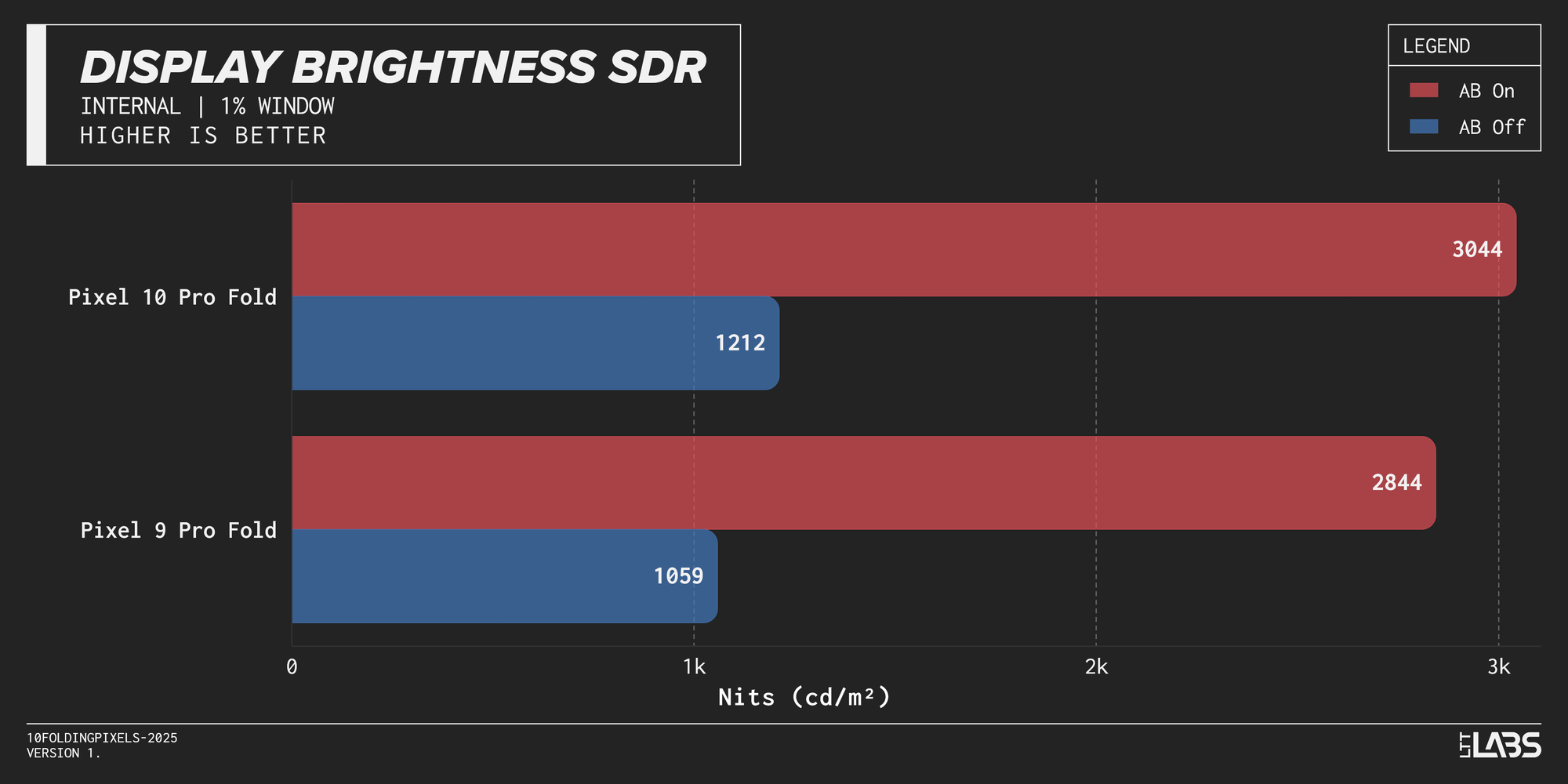
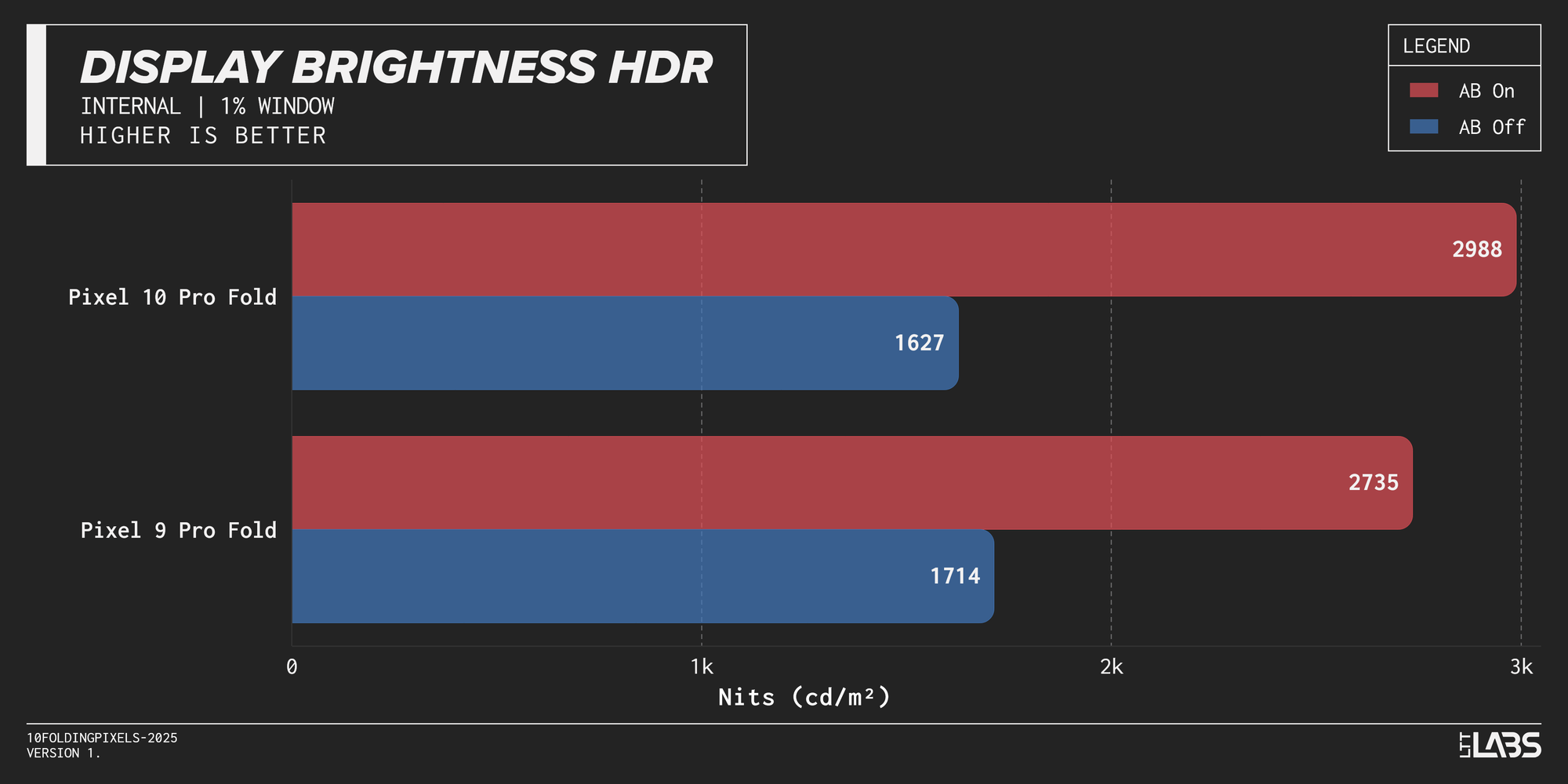
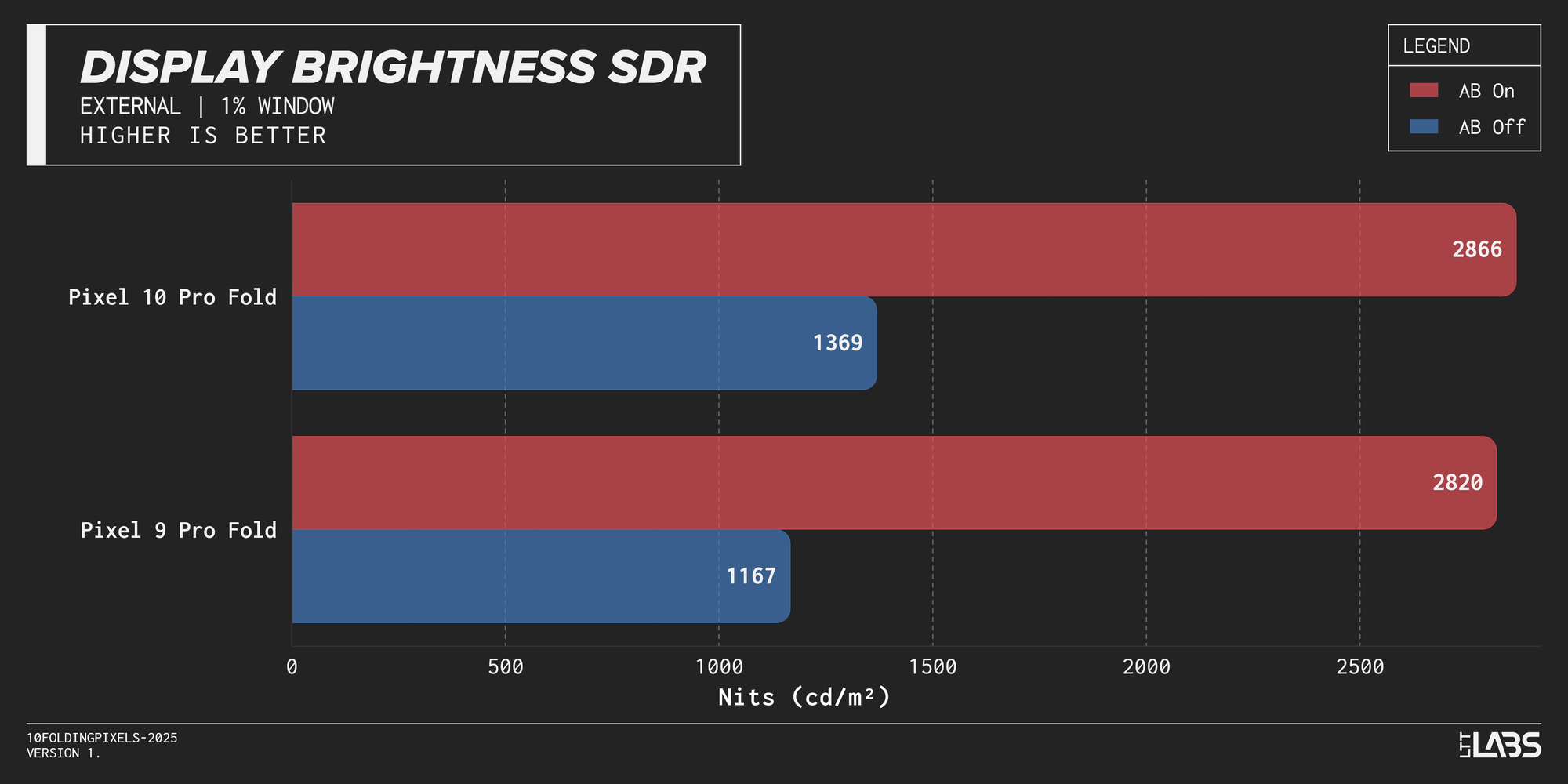
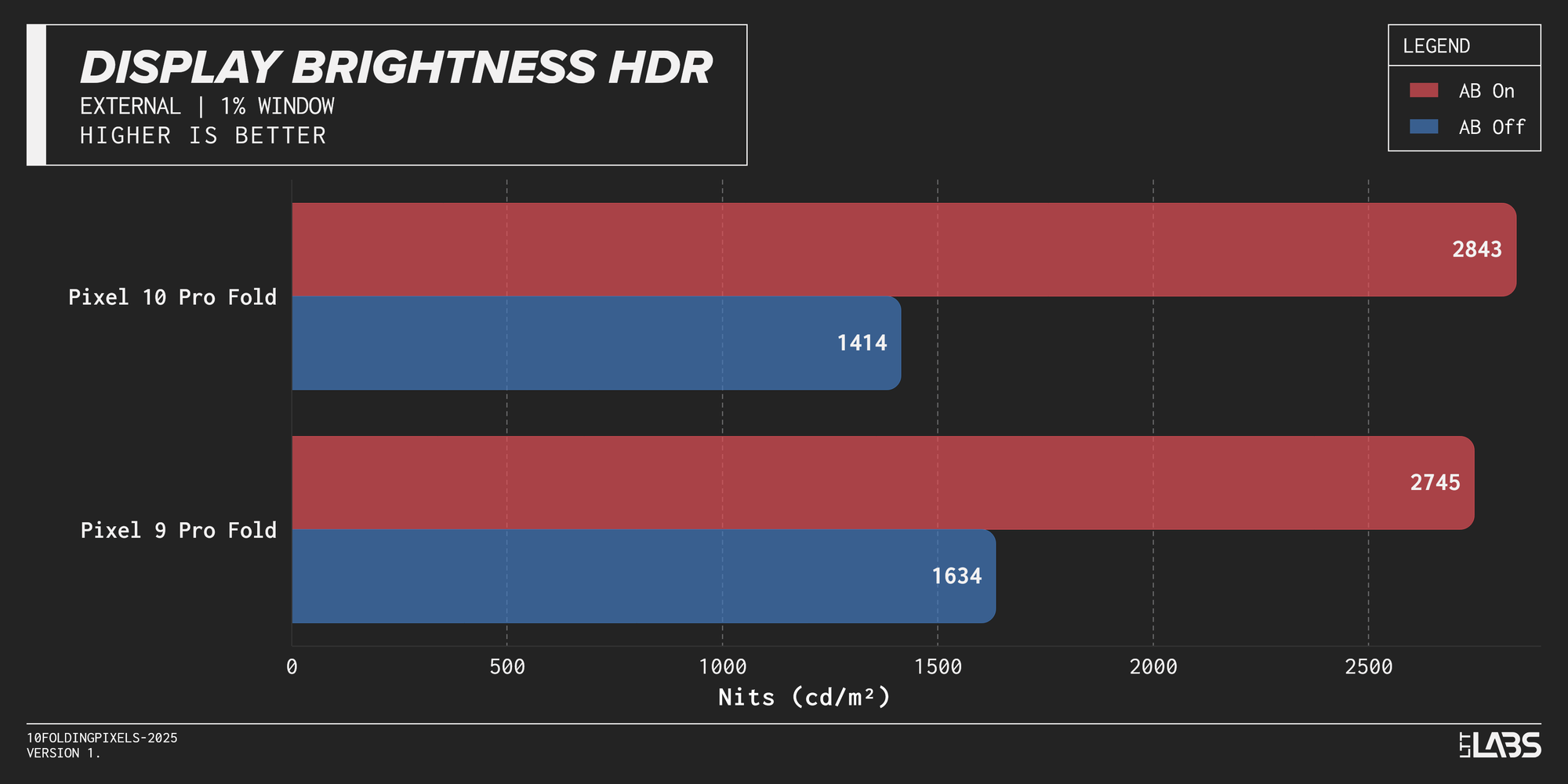
{{slide}}Display Brightness SDR Internal{{/slide}} {{slide}}Display Brightness HDR Internal{{/slide}} {{slide}}Display Brightness SDR External{{/slide}} {{slide}}Display Brighness HDR External{{/slide}}
All measurements in the tables below are in nits.(candela per square meter)
- Similar to other new phones on the market, auto-brightness (AB) seems to be more of a suggestion than a rule. We found that even if AB was turned off, if we shone a light at or near the main light sensor, the screen would brighten considerably beyond the maximum adjustable brightness value with AB off.
With that information in mind, the below AB off numbers were taken without intentionally stimulating the light sensor.
External Display
Standard Dynamic Range - SDR
Auto-brightness | Window Size | Pixel 10 Pro Fold | Pixel 9 Pro Fold |
|---|---|---|---|
Off | 1% | 1369 | 1167 |
100% | 1348 | 1121 | |
On | 1% | 1414 | 2820 |
100% | 1761 | 2032 |
High Dynamic Range - HDR
Auto-brightness | Window Size | Pixel 10 Pro Fold | Pixel 9 Pro Fold |
|---|---|---|---|
Off | 1% | 1414 | 1634 |
100% | 1761 | 1762 | |
On | 1% | 2843 | 2745 |
100% | 2056 | 2038 |
- With AB off and a 100% window with HDR content, we measured 1761 nits without stimulating the light sensor on the Pixel 10 Pro Fold's external display, however, we measured 1999 nits while shining a pen flashlight at the light sensor - a drastic difference.
Internal Display
Standard Dynamic Range - SDR
Auto-brightness | Window Size | Pixel 10 Pro Fold | Pixel 9 Pro Fold |
|---|---|---|---|
Off | 1% | 1212 | 1059 |
100% | 1211 | 1001 | |
On | 1% | 3044 | 2844 |
100% | 2014 | 1786 |
High Dynamic Range - HDR
Auto-brightness | Window Size | Pixel 10 Pro Fold | Pixel 9 Pro Fold |
|---|---|---|---|
Off | 1% | 1627 | 1714 |
100% | 1458 | 1601 | |
On | 1% | 2988 | 2735 |
100% | 2268 | 2027 |
- A result we found odd was the measurement of 1776 nits on the Pixel 10 Pro Fold using AB with a 1% window with SDR content. While we expected it to be lower than the 1% window, nearly 1000 nits lower is strange. This could be that we simply were not able to stimulate the light sensor in the way the phone required, or perhaps the phone needed to be re-started or cooled down prior to measurement.